There are about 7,000 languages spoken around the world -- and they all have different sounds, vocabularies and structures. But do they shape the way we think? Cognitive scientist Lera Boroditsky shares examples of language -- from an Aboriginal community in Australia that uses cardinal directions instead of left and right to the multiple words for blue in Russian -- that suggest the answer is a resounding yes. "The beauty of linguistic diversity is that it reveals to us just how ingenious and how flexible the human mind is," Boroditsky says. "Human minds have invented not one cognitive universe, but 7,000."

Showing posts with label Semantics and Meaning. Show all posts
Showing posts with label Semantics and Meaning. Show all posts
Thursday, 27 December 2018
How language shapes the way we think by Lera Boroditsky
Lera Boroditsky is a cognitive scientist. This is a talk delivered by her at
TEDWomen 2017 (November 2017).
There are about 7,000 languages spoken around the world -- and they all have different sounds, vocabularies and structures. But do they shape the way we think? Cognitive scientist Lera Boroditsky shares examples of language -- from an Aboriginal community in Australia that uses cardinal directions instead of left and right to the multiple words for blue in Russian -- that suggest the answer is a resounding yes. "The beauty of linguistic diversity is that it reveals to us just how ingenious and how flexible the human mind is," Boroditsky says. "Human minds have invented not one cognitive universe, but 7,000."
There are about 7,000 languages spoken around the world -- and they all have different sounds, vocabularies and structures. But do they shape the way we think? Cognitive scientist Lera Boroditsky shares examples of language -- from an Aboriginal community in Australia that uses cardinal directions instead of left and right to the multiple words for blue in Russian -- that suggest the answer is a resounding yes. "The beauty of linguistic diversity is that it reveals to us just how ingenious and how flexible the human mind is," Boroditsky says. "Human minds have invented not one cognitive universe, but 7,000."

Saturday, 24 February 2018
The suffix "-ster" in "Get Fuzzy"
The follow comic strip displays an excellent use of the suffix "-ster".
Longman Dictionary defines the suffix "-ster" is as:
1. a person who is.
Eg.: a youngster (a young person),
2. a person who is connected with, deals with, or uses.
Eg.: a trickster (a person who plays deceiving tricks),
a gangster (a member of a gang),
a pollster (someone who carries out polls).
Often, the suffix "-ster"is used in a humorous and/or derogatory manner. It is true in the case of this cartoon strip.
The table below explains the meaning of the root words and the root words + suffix, as used in this comic strip.
It is good to note that while "limpster" is not yet recognised as an English word, "dipster" is already a widely used slang which means "a person who actually thinks being a hipster is cool. Will never refer to themselves as one, but is obviously trying to be one." It's a blending of "dipshit" and "hipster"(source).
However, in the context of the comic strip, the character Bucky Katt precedes his use of the word "dipster" with his definition: "...he's not smart enough to realize he looks silly," obviously referring to the word "dip", a slang in North America which means stupid or foolish.
 |
| Published 10th July 2017 |
Longman Dictionary defines the suffix "-ster" is as:
1. a person who is.
Eg.: a youngster (a young person),
2. a person who is connected with, deals with, or uses.
Eg.: a trickster (a person who plays deceiving tricks),
a gangster (a member of a gang),
a pollster (someone who carries out polls).
Often, the suffix "-ster"is used in a humorous and/or derogatory manner. It is true in the case of this cartoon strip.
The table below explains the meaning of the root words and the root words + suffix, as used in this comic strip.
| Root word | Meaning | Root word + Suffix | Meaning |
| Hip | Aware, informed, up-to-date, trendy. Also: cool, groovy. (Source) | Hipster | 1. A person who is keenly interested in the latest trends or fashions. 2. A member of Bohemian counterculture. 3. An aficionado of jazz who considers himself or herself to be hip. (Source) |
| Limp | Lacking internal strength, energy or vigour. | Limpster | A person who lacks internal strength, energy or vigour. Also: lazy. |
| Dip | Stupid or foolish. | Dipster | A stupid or foolish person. |
It is good to note that while "limpster" is not yet recognised as an English word, "dipster" is already a widely used slang which means "a person who actually thinks being a hipster is cool. Will never refer to themselves as one, but is obviously trying to be one." It's a blending of "dipshit" and "hipster"(source).
However, in the context of the comic strip, the character Bucky Katt precedes his use of the word "dipster" with his definition: "...he's not smart enough to realize he looks silly," obviously referring to the word "dip", a slang in North America which means stupid or foolish.
Monday, 6 November 2017
The story of colour names around the world
The naming of things and animals around us is heavily influenced by our environment and culture.
"In 1969, two Berkeley researchers, Paul Kay and Brent Berlin, published a book on a pretty groundbreaking idea: that every culture in history, when they developed their languages, invented words for colors in the exact same order."
The video is published by Vox.
"In 1969, two Berkeley researchers, Paul Kay and Brent Berlin, published a book on a pretty groundbreaking idea: that every culture in history, when they developed their languages, invented words for colors in the exact same order."
The video is published by Vox.
Saturday, 29 August 2015

Thursday, 15 May 2014
“Biawak” in Malay figurative language
On 8th March 2014, MH370 went missing. In the
subsequent days, suddenly, almost everyone is a theorist, plane expert, SAR
expert and a comedian. The internet has provided an open platform for the general
public, including those without any thinking/rational capacity to express their
thoughts and opinions, uninhibitedly.
At the height of senseless and irrational speculations about the flight disappearance, this was shared with me:

Biawak: the animal
In Malay (Malaysia), “biawak” is a type of varanus, living mostly in the forest. There are many types of its species, but a common one when spoken about in Malaysia is the monitor lizard.
The lexeme “biawak” can also be used as a verb, as in “membiawak”, which means to crawl, slither or slide (like a monitor lizard).
Connotation of “biawak” in Malay
Generally, the noun “biawak” carries negative connotation in Malay. This is due to the fact that a monitor lizard eats small animals, vermin, dead animals and decaying flesh (although some species do eat vegetation), and it scavenges human waste too. It is perceived as ugly and highly temperamental. All these characteristics contribute to an unpleasant reputation.
“Biawak” in Malay figurative language
Figurative language such as similes, metaphors, idioms, idiomatic expressions and proverbs is very culturally specific. How it is structured, rhymed and intended to mean depends very much on real-world experience and perception of its native speakers. In the case of “biawak”, its status and how it is perceived are clearly depicted in how it is used in our figurative language.
i. Simile and metaphor
ii. Idiom and idiomatic expression
iii. Proverb
As we can see above, figurative expressions associated with
“biawak” in Malay all carry negative connotation and meaning; even its body parts, such as the tail and tongue. All the negative connotation is mostly due to the bad press these types of lizards is getting - perhaps the killing of livestock and/or destruction of farms. In an agricultural society, that simply means loss of means of income, and any animal which causes harm to livelihood is declared war upon.
In short, to be called a "biawak" is never a good thing in Malay.While it is an important animal in the eco-system, it is obviously under-appreciated and resented by the society. Reaction is generally hostile towards "biawak" (unless of course, you eat it, but that's a different story altogether).
References
Ding Choo Ming. (2009). Beberapa Sifat, Asal Usul dan Kepengarangan Peribahasa Melayu. Sari - International Journal of the Malay World and Civilisation 27(2) (2009): 3-26
http://prpm.dbp.gov.my/. Retrieved on 1st April 2014.
http://www.peribahasaindonesia.com/. Retrieved on 1st April 2014.
http://www.himpunanperibahasa.com/. Retrieved on 1st April 2014.
At the height of senseless and irrational speculations about the flight disappearance, this was shared with me:
Biawak: the animal
In Malay (Malaysia), “biawak” is a type of varanus, living mostly in the forest. There are many types of its species, but a common one when spoken about in Malaysia is the monitor lizard.
The lexeme “biawak” can also be used as a verb, as in “membiawak”, which means to crawl, slither or slide (like a monitor lizard).
Connotation of “biawak” in Malay
Generally, the noun “biawak” carries negative connotation in Malay. This is due to the fact that a monitor lizard eats small animals, vermin, dead animals and decaying flesh (although some species do eat vegetation), and it scavenges human waste too. It is perceived as ugly and highly temperamental. All these characteristics contribute to an unpleasant reputation.
“Biawak” in Malay figurative language
Figurative language such as similes, metaphors, idioms, idiomatic expressions and proverbs is very culturally specific. How it is structured, rhymed and intended to mean depends very much on real-world experience and perception of its native speakers. In the case of “biawak”, its status and how it is perceived are clearly depicted in how it is used in our figurative language.
i. Simile and metaphor
| Simile and metaphor | Literal | Meaning |
| Biawak hidup | A living monitor lizard | A useless and/or burdensome person |
| Bagai biawak mengulangi bangkai | Like a monitor lizard frequenting a carcass (to eat) | A man who likes to go to a brothel/immoral place; where there are immoral women, there are immoral men |
| Bagai lidah biawak | Of a monitor lizard tongue | A liar; an untrustworthy person |
| Bagai memegang ekor biawak | Like grabbing a monitor lizard’s tail | Doing something dangerous |
ii. Idiom and idiomatic expression
| Idiom and idiomatic expression | Literal | Meaning |
| Biawak kudung masuk kampung | A legless monitor lizard entering the village | A well-known bad/immoral/ corrupt person; a thief |
| Mendukung biawak hidup | Carrying a living monitor lizard | An unnecessary occupation which is burdensome and/or dangerous; having a wife or child who is troublesome |
| Merendah terbang biawak | A monitor lizard flying low | A woman who shows herself off to men; an arrogant person |
| Niat di hati hendak memeluk gunung, sudah terpeluk biawak celaka/sial | One intended to embrace the mountain, but ended up embracing a wretched monitor lizard | One hoped for something good, but ended up with something bad |
| Menanti biawak duduk | Waiting for a monitor lizard to sit (like a human) | Hoping/waiting for something impossible |
iii. Proverb
| Proverb | Literal | Meaning | ||
| Seperti biawak, masakan hilang kesatnya | A monitor lizard does not lose its roughness (of skin) | A person of no manners speaks harshly. | ||
| Bila pula biawak duduk? | When does a monitor lizard sit? | A question with an impossible answer; asking for the impossible. | ||
In short, to be called a "biawak" is never a good thing in Malay.While it is an important animal in the eco-system, it is obviously under-appreciated and resented by the society. Reaction is generally hostile towards "biawak" (unless of course, you eat it, but that's a different story altogether).
References
Ding Choo Ming. (2009). Beberapa Sifat, Asal Usul dan Kepengarangan Peribahasa Melayu. Sari - International Journal of the Malay World and Civilisation 27(2) (2009): 3-26
http://prpm.dbp.gov.my/. Retrieved on 1st April 2014.
http://www.peribahasaindonesia.com/. Retrieved on 1st April 2014.
http://www.himpunanperibahasa.com/. Retrieved on 1st April 2014.
Friday, 11 April 2014
Case of the Cool Conman: Semantic analysis
Identify
the types of meanings present in the article “Case of the Cool
Conman”. List down 6 examples of the types of meanings you found.
Explain their relevance to the overall message of the article.
by: Mafuzah Aris, Farha Sobry, Zuraini Mokhtar (1997)
INTRODUCTION
Semantics is a study of the meaning of words and other parts of language. Language without meaning is meaningless. Therefore, the seven types of meaning in Semantics help the language in the article we have chosen to convey its meaning. The seven types of meaning are conceptual meaning, connotative meaning, stylistic meaning, affective meaning, reflected meaning, collocative meaning and thematic meaning. The article we have chosen is “Case of the Cool Conman” where a murder investigation is taking place at the scene of a murder. Inspector Carter and Sergeant Graham are conducting the case and are questioning the only witness, James Creighton. Towards the end of the article, Carter suspects that Creighton cooperates with the murderer to kill Montrose. We have analyzed the article, looking at the seven types of meaning and enclosing them with six examples each.
CONCEPTUAL MEANING
Conceptual meaning means logical, cognitive, or denotative content. It is based on two structural principles which are contrastiveness and constituent structures. In this paper, the chosen words and phrases are analyzed in terms of their contrastiveness conceptual meanings. Six examples of words or phrases occurred in the article which have been analyzed are shown in the table below:
| a) the scene of a murder | + place where a murder took place |
| b) criminal | + human + illegal + does illegal activities or crimes - has moral |
| c) victim of a theft | + human + a person being robbed - willingness |
| d) nodded | + movement - disagreement |
| e) unawares | + unexpected - conscious - warning |
| f) grudge | + hatred + anger - kind - love |
CONNOTATIVE MEANING
Connotative meaning refers to what is communicated by virtue of what language refers to. In other words, it is the meaning above the conceptual meaning and it may vary according to culture, background or society. Thus, connotative meaning can be subjective or unstable.
| a) smooth fellow | slick, cunning, liar |
| b) mystery man | solitude, peculiar, weird |
| c) jail | criminal, law, punishment |
| d) ...eyebrows to lift fractionally | discover something, suspicious |
| e) ...had been shot neatly in the centre of his forehead | done by a professional murderer |
| f) the underworld | gangsterism, illegal, criminals |
The first example found in the article for the connotative meaning is ‘smooth fellow’ which has the connotative meaning of slick, cunning, and liar. Creighton is described as a smooth fellow where he pretends to have nothing to do with the murder and that the murder does not disturb him at all. The second example is ‘mystery man’ where its connotative meaning is ‘solitude’, ‘peculiar’ and ‘weird’. Conceptually, ‘mystery man’ means ‘a stranger’ and ‘not a female’ but connotatively, ‘mystery man’ is often referred to someone weird and peculiar and always being solitude. The next example is the word ‘jail’ which has the connotation of ‘criminal’, ‘law’ and ‘punishment’. It gives the connotation that Lennie had been punished for a crime he committed. Another example is the phrase ‘...eyebrows to lift fractionally’ which has the connotative meaning of ‘discover something’ and ‘suspicious’. It must have been something that causes Sergeant Graham’s eyebrows to lift fractionally and obviously, it relates to the discovery of a clue from the body. The fifth example is the phrase ‘...had been shot neatly in the centre of his forehead’ which means that the murder must have been done by a professional murderer or a professional gun user. No ordinary man could have shot his victim so neatly in the centre of the victim’s forehead. The last example is ‘the underworld’ which has the connotative meaning of ‘gangsterism’, ‘illegal’ and ‘criminal’. In the article, Inspector Carter and Sergeant Graham have got the secret information regarding the murder of Montrose from the underworld people.
STYLISTIC MEANING
Stylistic meaning means “What is communicated of the social circumstances of language use”. It can help people to recognize the words or pronunciation as being dialected and also to recognize the social relationship between the speaker and listener.
| a) fellow | informal |
| b) adversary | formal |
| c) tip-off | informal |
| d) elegant | formal |
| e) immaculate | formal |
| f) “Really, Inspector...” | disdain, formal |
The word ‘fellow’ has the informal stylistic meaning. In a formal circumstances, people usually use the word ‘man’ rather than ‘fellow’. In contrast, a formal word ‘adversary’ is used in the article which refers to ‘enemy’ or ‘opponent’. ‘Tip-off’ is another informal word used by the writer which means ‘warning’ or ‘secret information’. Another example is ‘elegant’ which is a formal word for ‘nice’. The word ‘immaculate’ is also a formal word for the word ‘pure’, ‘clean’ or ‘without fault’. The last example is “Really, Inspector...” which is disdain and formal expression. The article is a semi-formal newspaper article, perhaps to suit the readers’ level of reading proficiency. Thus, that is why the writer uses formal as well as informal words in the article.
AFFECTIVE MEANING
Another type of meaning in Semantics is Affective meaning. Language use which has affective meaning reflects the personal feelings and emotions of the speaker or the attitude to something which is talked about. Some examples found in the article are :
| a) “Then you’re a liar,” | accusing |
| b) “...but I can prove that you know who the murderer is.” | confident, certainty |
| c) “Nothing to do with me this time, Inspector.” | denying a statement |
| d) “Really, Inspector...” | showing lack of respect |
| e) Carter eyed him sceptically. | disbelieve |
| f) “But that’s not the point,” | opposing, to change the topic |
The first example, when Carter says “Then you’re a liar,” shows that he is rather angry and accuse Creighton for lying about not knowing who the murderer is. The actual fact is that Carter believes he does. “...but I can prove that you know who the murderer is,” indicates that Carter (as the speaker) is confident and certain about what he is saying - that Creighton knows who the murderer is. The third example, “Nothing to do with me this time, Inspector,” shows the attitude of denying. Here, Creighton is denying that the assassination has any relation to him, though Carter has not said anything or accused him yet. The following example, “Really, Inspector...” shows that the speaker, Creighton, is disdainful when Graham says that he is paid to kill Montrose. The next example given, ‘Carter eyed him sceptically’ indicates disbelieve in Carter of Creighton’s statement that he had been robbed by the murderer. Perhaps, Carter suspects that the robbery story is made up just to cover the truth - Creighton co-operates with the murderer to kill Montrose. The final example is “...but that’s not the point,” contains affective meaning which shows Creighton is opposing and wants to change the subject. Perhaps, he says it because he has something to hide from Carter and Graham. In short, affective meaning in what is communicated of the feelings, emotions and attitudes of the speaker.
REFLECTED MEANING
Reflected meaning arises in cases of multiple conceptual meanings when one sense of the word, phrase or sentence form part of a response to another sense. This means that what is communicated by a speaker may have another meaning than the one intended.
| a) “...someone got to Montrose...” | i) someone had killed Montrose ii) someone had met Montrose |
| b) business | i) the activity of buying and selling goods and services ii) illegal activity |
| c) unwound | i) change attitude or pose ii) set oneself free from a posture |
| d) rewarded | i) gave a meaningless expression ii) gave something as a positive reinforcement |
| e) eyed | i) watched ii) looked at without believing |
| f) petty | i) little importance ii) showing that the mind is limited |
The first example, “...someone got to Montrose...” as said by Lennie, could mean that someone had killed him, or that someone had met or went to see him first before he could. Lennie says it in such a way that this proves that perhaps he did not kill Montrose. ‘Business’ which carries the meanings of an activity of buying and selling goods and services, or illegal activities that conmen do. The next example, ‘unwound’ also has reflected meaning. It could mean the change of attitude of Creighton, or he set himself free from an act or posture which he has been putting on. Creighton ‘unwound’ himself because he is accused by Graham of being responsible for the death. The following example, ‘rewarded (a look)’ by Carter to Graham could mean Carter gives a meaningless expression to Graham, or he gives him the look as a positive reinforcement or token of appreciation. Carter ‘rewarded’ the look because he has already known the information. ‘Eyed’ in the article also has reflected meaning where it could mean watching Creighton, or looking at him without believing his words. This shows that Carter has suspected Creighton is lying to him. The next instance, ‘petty’ as used by Creighton to refer to the murderer, could mean of little importance, or having / showing that the mind is limited, narrow and ungenerous. Perhaps Creighton belittles the killer to indicate that he does not know him and has nothing to do with him. To conclude, the examples given indicates that words, phrases and sentences can have reflected meaning and thus, have more than one conceptual meanings.
COLLOCATIVE MEANING
Collocative meaning refers to “What is communicated through association with words which tend to occur in the environment of another word”. Which means that a word is associated with another based on the environment of the other word. There are several examples of collocative meaning in the article.
| a) inspector | i) police station ii) badge iii) guns |
| b) underworld | i) criminal ii) gun iii) murder |
| c) dead man | i) coffin ii) grave |
| d) conman | i) underground ii) jail |
| e) shot | i) gun ii) murderer iii) criminal |
| f) jail | i) court ii) police iii) prisoner iv) criminal |
The first example is the word ‘inspector’. The word ‘inspector’ relates to Inspector Carter who is investigating the murder and has to be present at the scene of the crime. The environment surrounding the word ‘inspector’ are the ‘police station’, ‘badge’ and ‘gun’. The ‘police station’ and ‘badge’ are to show authority and the obligation to protect the society. The ‘gun’ can be linked to the murder weapon of the murder case. The second example is the word ‘underworld’. The ‘underworld’ is where the gangsters have a place as a hideout. Collocatively, the word ‘underworld’ is associated with ‘criminal’, ‘guns’ and ‘murder’. The third example is the word ‘dead man’. The ‘dead man’ is the victim of the murder. ‘Dead man’ collocates with ‘coffin’ and ‘grave’. The next example is the word ‘conman’. The ‘conman’ is associated with ‘underground’ which is the place of the gangsters. It is also associated with ‘jail’ because conman is a person who tricks people to gain money and deserves to be punished in jail. Another example is the word ‘shot’. The shot from the gun took the life of Montrose. The ‘shot’ is collocatively associated with ‘gun’, ‘murderer’ and ‘criminal’. The last example is the word ‘jail’. ‘Jail’ can be related to the punishment the murderer deserves for justice. ‘Jail’ is normally associated with ‘court’, ‘police’, ‘prisoner’ and ‘criminal’.
THEMATIC MEANING
Thematic meaning means “What is communicated by the way in which the message is organized in terms of order and emphasis”. It simply means the theme or message a word, phrase or sentence is trying to emphasis. The theme of the article is mainly about murder investigation. The words and phrases ‘suspect’, ‘witness to the crime’, ‘detectives’, ‘He came out of jail yesterday ... with a grudge’, ‘dead man’ and ‘ ... body on the floor ...’ are related to the overall theme. The word ‘suspect’ can be linked to the theme investigation because Inspector Carter is investigating the murder case and suspects Lennie as the murderer. But he cannot prove anything yet. The phrase ‘witness to the crime’ leads to Creighton who is the witness and does not want to admit that he knows who the murderer is. The ‘detectives’ can be linked to the theme because they help to carry out the investigation to find out who the murderer is. In the sentence ‘He came out of jail yesterday ... with a grudge’ can be assume that Lennie had something against Montrose and the intention of harming him. A meeting between Lennie and Montrose is planned to kill Montrose as can be inferred in ‘ ... an attempt was to be made on Montrose’s life’. The phrase ‘ ... body on the floor ...’ is related to the overall theme whereby it refers to the victim of the murder who is Montrose. Montrose was nicely shot in the middle of the forehead in the club and the investigation of the murder case starts.
CONCLUSION
In conclusion, there are seven types of meaning occurred in the article chosen. They are conceptual meaning, connotative meaning, stylistic meaning, affective meaning, reflected meaning, collocative meaning and thematic meaning. Language users use these meanings frequently without even realizing. These meanings occur in words, phrases and sentences. Meaning in language is very important that language without meaning is meaningless.
REFERENCE
Longman Group UK Limited. (1987). Longman Dictionary of Contemporary English. England: Longman Group UK.
Hafriza. Mass Lecture. Semantics: Words without meaning is meaningless. (11 March 1997).
Tuesday, 12 November 2013
The use of Malaysian English lexical items in the IRC international
By : Mafuzah Aris, Syazril Izwann, Mohd Khairuddin Abdullah
INTRODUCTION
This research focuses on the lexical items of Malaysian corpus of English. According to Zaidan (1994), Malaysian English lexical items include Malaysian words (MW), Malaysian flavour (MF) words, and direct translation (DT) words. Malaysian words are words which are unique to Malaysians (dialect) and its use can only be found in Malaysia. Malaysian flavour words are words which are English words, but its use is localized. Other speakers of English would not use the words like they are used in Malaysia mainly because these words are very culturally biased. Direct translation words are the words which are translated from Malay, Indian or Chinese into English. The lexicon of ME is summarised in the table below:
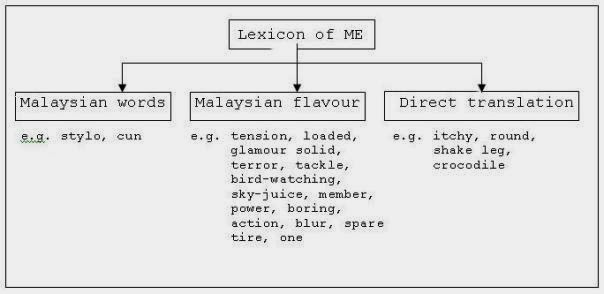 |
| Adapted from: Zaidan Ali Jassem, 1994 |
OBJECTIVE
The research aims to see whether the use of ME lexical items is understood and accepted at the international level by engaging in the IRC. Several ME lexical items are selected and used to find out whether the use of such words is understood and accepted.
RESEARCH DESIGN
In an effort to seek answers to the questions that have been raised by the researchers of this project, the researchers need to collect data. Only by collecting data, can the researchers be able to come to any sort of conclusion about the level of understanding and acceptability that non native speakers of Malaysian English might have towards the use of lexical items originating from Malaysian English in the IRC. Consequently, in an effort to collect the much needed data, the researchers of this project have decided to take to the field and experience for themselves the reactions that they would encounter if they were to use Malaysian English lexical items in the IRC.
THE INSTRUMENTS
In conducting this project, there are basically two types of instrumentation that are deemed necessary in order for the project to succeed. On one hand, a list of Malaysian English lexical items. This list serves the purpose of providing a pool of lexical items from which the researchers of this project will randomly use to gauge the attitude of non Malaysians towards their use. On the other hand, there is the need for a computer with Internet access. This computer will serve the purpose of providing the researchers with a way to get into the chat rooms where the Malaysian lexical items will be used.
THE SUBJECTS
The subjects in this research are simply non Malaysians who are speakers of the English language, regardless of the fact that the language might not be their first language. In the context of this research, there is also no need for the subjects to be of a specific gender or age. This is simply because of the fact that these two factors are of no importance. However, the subjects must be foreigners and not Malaysians because of the simple fact that Malaysians would be familiar with the lexical items that are to be used in this project. In addition, because of the fact that Malaysians would be familiar with the lexical items used, they would also in all likely show no reaction to the use of such lexical items.
THE PROJECT’S FINDINGS
Generally, it is believed that the use of the Malaysian English lexical items in the IRC is understood and accepted. The use of the Malaysian English lexical items is understood simply because most of the participants managed to respond accurately to what the researchers attempted to convey even though the researchers used Malaysian English. A lot of examples can be drawn out to justify the claim. For example:
1. B1: lines 27 – 28 (see Appendix ME)
In this example, it is clear that the respondents understood what the researchers meant by the use of ‘member’ and responded accurately to the question by stating that she had no Malaysian friends.
2. C1: lines 9 – 10
Here the researchers asked about the participant’s feeling over the loss of Holland in the world cup using the word ‘tension’. Amazingly, she understood what the researchers tried to ask and answered the question appropriately.
3. C1: lines 17 – 18
Although the researchers repeated the word ‘glamour’ twice, this did not resulted in the participant had no idea of what the researchers were trying to ask. Instead, she gave a very good response to the question by describing the items that she liked.
4. C1: lines 19 – 20
The researchers attempted to ensure that the response that was given by the participant in the previous example was not accidental. Therefore, once again they use doubled word ‘round’ to look into the response that would be given. Similar to the previous one, the respondent successfully answered the question posed.
5.C1: lines 24 – 25
In this instance, the researchers made use of the word ‘solid’ to test whether the participant could understand, then answering the speaker’s question. She responded well by claiming that she had that kind of body since she worked out everyday.
6. D1: lines 25 – 26
Similar to the first instance (B1), this participant managed to understand what the researchers meant by the word ‘member’. She frankly gave the answer ‘ no’ in answering the question.
7. D1: lines 32 – 33
In this example, it is clear that the participant understood the compliment ‘wowwww!!!! So power onelah’, that was given by the researcher when she responded to the response by trying to be humble ‘normal’.
On the other hand, there were several occurrences where the participants did not understand the use or meaning of the Malaysian English lexical items. This however did not impede the communication from continuing. For example, when they came across such expression, some of the participants actually took the initiative to ask for the meaning of such words. When they were given the explanation, they showed that they accepted the explanation given. There are a lot of examples that can be used to show this point, they are:
1. A1: lines 3- 6
In this example, this particular ‘chatter’ asked the researchers about the meaning of the phrase ‘shake leg’. As the researchers explained the meaning of the phrase, the participant later showed that she now understood what did the researchers mean by the use of the words when she responded ‘ahh.. I see’.
2. A1: lines 7- 12
In this instance, the researchers suggested a new meaning of the phrase ‘bird watching’ to the respondent when she failed to give the required answer. Realizing that the phrase now carried a new meaning, she tried to verify her assumption about the association of girls with birds at the speakers place. When she was asked later about any terms that were used to refer to boys, she claimed that there were no ‘special’ terms used to refer to boys. This shows that the participant accepted the use of phrase since she regarded the use of such phrase as ’special’.
3. B1: line 11- 18
Here, the participant faced a similar problem as the first respondent because she did not understand the use of the phrase ‘shake leg’. Therefore, she decided to ask for the meaning of the words. Making use of the meaning provided by the speakers, she then posed a question to the researchers on the same topic. She showed that she accepted the new meaning given by elaborating on her liking.
4. B1: lines 23-26
The use of “sky juice”, as predicted, caused the participant to fail in grasping the meaning. However, as the researchers explained the meaning of the word, the participant make an attempt to guess what did the researchers meant by the use of the words. She referred the words to ‘rain’. Then, she showed that she accepted the meaning of the words when she included the expression ‘…hahaha…’ which implied that she felt very easy with the explanation.
4. D1: lines 13- 16
Similar to the previous example, this particular participant also did not understand the meaning of the words ‘sky juice’. However, after being explained about the meaning of the words, she then indicated that she accepted the meaning. This is illustrated when she gave her personal views on ‘sky juice’ by stating that was ‘the best thirst quencher’.
6. D1: lines 4- 9
Here, the participant discovered that she did not understand the use of ‘so glamour one’. Later, she indicated that she accepted the use of the phrase when she asked for apology for not being able to understand the use of the words earlier.
7. D1: lines 67- 72
In this example, the participant asked the speakers about the use of ‘so action one’. She showed her acceptance on the use of the words when she borrowed the meaning of the words to deny the allegation made by the researchers about her.
Besides suggesting that they accepted the use of the Malaysian English lexical items, they also indicated that such a use did not deter them from having a casual type of conversation. For example, one of the participants has expressed her liking on the researchers. This could be due to the fact that, they use such a ‘unique’ expression to express their views. This is illustrated by the second respondent (B1) in line 50 who confessed
‘ I really like your company too
so I’m hoping to bump into you again’
This same participant was also found to be ‘generous’ because she offered her e-mail address to the speakers.(B1: lines 56& 60) when she realized that she could not continue to chat. This also indicates that she felt very easy and comfortable chatting with the researchers. In other words, she did not find it troubling for herself to understand and accept the use of the Malaysian English lexical items. In another case, the last participant (E1) indicated that she accepted the use of such lexical items by accepting the researchers’ invitation to play sports even though she was constrained by the physical location factor.
However, despite the numerous instances in which the participants of the research managed to understand and accept the use of Malaysian English lexical items in the IRC, there were exceptions. Basically, these exceptions can be divided into two categories. Firstly, there is the category in which the research participants could not understand the meaning of the Malaysian English lexical item used, and requested further clarification. Examples, of such instances are listed below:
1. A1: line 7 – 10
In this example, despite the fact that the ‘chatter’ actually accepted the use of such a lexical item, upon inquiry, the ‘chatter’ admitted to the researchers that she did not actually understand the meaning of the lexical item used. Thus, prompting the need for the researchers to have to explain to her the actual meaning of the lexical item.
2. B1: line 11 – 13
In this instance, the ‘chatter’ did not seem to mind the use of such lexical items. However, she revealed to the researchers her lack of understanding by nonchalantly asking why the researchers ‘shook their legs.’
3. B1: line 23 – 26
In this example, the ‘chatter’ is again confronted with the use of an unfamiliar lexical item. Here, she simply asks straight away what is the meaning of the lexical item. Once told of its meaning, the ‘chatter’ conveys her new found sense of understanding, and also presumably her sense of acceptance, in a very delighted tone.
4. D1: line 7 – 9
In this instance, the ‘chatter’ signals her lack of understanding by ending the question phrase with the use of multiple question marks. The researchers, obligingly provide her with the meaning of the lexical item. In a show of acceptance of the lexical items usage, the ‘chatter’ even goes to the extent of apologising to the researchers for her lack of understanding.
4. D1: line 14 – 16
As for this example, the ‘chatter’ opts for a different approach in signalling her lack of understanding. For she simply asks in a very direct manner, the meaning of the lexical item that she does not understand. Upon being provided with the lexical items meaning, the ‘chatter’ reveals her acceptance of the lexical items usage by using a compliment.
6. D1: line 36 – 37
With this example, the researchers not only have to accommodate the ‘chatters’ lack of understanding, but also for the very first time, the ‘chatters’ first hint of unacceptability for the use of such a lexical item. This ‘hint’ of unacceptability is assumed by the researchers to have manifested itself in the form of the capitalisation of all the letters in the phrase, “NO BORING BORING ONE.” This assumption is proven to correct a few lines later when the ‘chatter’ asked the researchers to just use plain English.
7. D1: line 45 – 46
Here, the ‘chatter’ not only reveals her lack of understanding, but also her displeasure of having to cope with the usage of such lexical items by using a multitude of question marks. Thus, it would only be logical to rationalise that the participant no longer finds the use of Malaysian English lexical items acceptable.
8. D1: lines 70, 83 and 88.
Again and again, the ‘chatter’ reveals her lack of understanding along with her dislike of the usage of such lexical items by using a multitude of question marks.
Secondly, there is also the category in which the research participants could not understand the meaning of the Malaysian English lexical items used, and simply avoided the matter of asking for further clarification by changing to new topic of conversation. Examples of such instances are listed below:
1. C1: lines 34 – 35
From this example, it is presumed that the ‘chatter’ tries to hide her lack of understanding by simply switching to a completely different topic. In the eyes of the researchers, this ploy of hers did not manage to achieve its objectives. However, because of the fact that the ‘chatter’ switches topics, the researchers are not able to determine whether or not she has accepted the use of the lexical item. This is simply because there is no response to analyse.
2. E1: lines 22 – 23
As for this particular example, the ‘chatter’ is again deemed to be trying to hide her lack of understanding by switching to a completely new topic. Once again, the researchers quickly catch on to this ploy of hers. As with the above example, the researchers are again unable to determine whether or not the ‘chatter’ finds the use of such lexical items acceptable simply because there is no response to analyse.
Besides that, There are also instances where the ideas or messages which the researcher tried to convey did not get across. Examples of such instances are listed below:
1. A1: lines 7 – 9
Here, we can see that the respondent took the meaning of “bird-watching” literally. The word was mentioned earlier, but she did not question it, assuming the meaning is watching birds, while the intended meaning was watching girls. However, when given a short explanation of the meaning of “bird watching” and asked of the names used in her place, she did not reacted negatively, and this signals acceptance.
2. C1: lines 30- 32
The subject understood the meaning of “tackle” as in the tackling skill in sports (for example, rugby or football). Perhaps, that is why she replied “depends where” which is unexpected and somehow funny.
3. D1: lines 48 – 52
From this example, we can see that the subject understood the word “crocodile” differently than the one intended by the researcher. She responded negatively (“Gross!!!”) to the word before the short explanation was given to her. Though she had accepted the meaning of the word after that, it is evident that the idea did not get across to her earlier.
4. D1: 57 – 60)
Here, again the idea did not get across. The subject hesitated to answer to the question “do you mind if I tackle you?”, and understood it differently than the one intended by the researcher. At this point, she started to be angry and seemed to be offended by the question. When asked to clarify her answer, she stated that she would mind and she is not “like that”. The researcher was actually trying to “make a pass at her” here, but in line 73, she stated that “what pass? I missed that”, showing very clearly that she did not understand the use of “tackle”.
Other than the exceptions mentioned above, there are also injection of makers to reflect paralinguistic makers, which of positive and negative nature. Paralinguistic makers of the positive nature can be seen in:
1. A1: lines 6 – 8
The chatter she responded “ah… I see”, which is signalling understanding to the explanation given by the researcher. This is clearly a positive response in the chat. However, in line 8, the subject indicated a negative attitude by inserting “@#$%” at the end of her question. Though the reason of her typing in the symbols is not clear, the symbols are usually used to show a response of a negative nature.
2. D1: line 5,
In this instance, the subject responded with a paralinguistic marker “Huh!!!!”, which has a negative connotation. It is evident here that the subject did not understand the phrase used and responded negatively to it. However, in the following lines, we can see that she accepted the word after given an explanation on it.
3. D1: line 39
From this line, the subject is displaying negative attitude when she inserted “@##$%**&^” after her question. Here, the symbols indicated that the subject was irritated and annoyed with the use of ME words, due to the fact that she could not understand most of them.
4. D1: line 49
The subject used “GROSS!!!!” in responding to the word “crocodile”, indicating irritation and disgust. It is clear here that she did not understand how the word is used and the connotation the word carries in Malaysia, and with her own understanding, was disgusted with the use of it. When researcher asked her if she knows the connotation of the word “crocodile” here, she promptly asked “WHAT?!!!!”, which evidently showing irritation and annoyance. However, after explaining what the word means, she responded well to the researcher’s chatting.
5. D1: line 58
When asked whether the researcher could “tackle” the chatter, she showed hesitation with “……..uh……yah” as she answered the question. Here, she was not sure of the meaning of the word “tackle” and thus, applied her own understanding to it. As expected, from the proceeding lines, it is evident that she misunderstood the word “tackle”.
6. D1: line 70
In this extraction, the subject asked for the meaning of “Action one” with several question marks. Starting from this point onwards, she asked for the meaning of ME lexical items with several question marks, such as in lines 83 and 88, as we can see “spare tire?????” and “blur?????”. We can say that the question marks are used to show irritation and annoyance because she could not understand the meaning of the words.
In short, we can say that the injections of paralinguistic markers which were used by the subjects reflected their attitudes, which could be of positive or negative nature.
SUMMARY OF FINDINGS
In general, we believe that the use of the Malaysian lexical items in the Internet Relay Chat as being understood and accepted. These two claims can be supported by a few number of instances during the course of interaction. First, we managed to engage in the IRC with a number of respondents who actually chatted with us. During the course, there were no instances of anybody who left in the middle of the interaction. In other words, these people continued to ‘chat’ with us for a certain period of time until we quitted or they said goodbye. Second, the use of the Malaysian English lexical items posed minimal difficulty to the respondents. This case is very unique as the words connote different meanings in Malaysian English compared to that of the Standard English. It is assumed that the use of the words was understood and accepted by at least, these groups of respondents who actually made use of the contexts to grasp the ideas conveyed by the researchers.
Among the Malaysian English lexical items that were used throughout the course of the interaction are those words that fall under the Malaysian Flavour words, Direct Translation words and words that are borrowed from the Malaysia context that have been accepted as the lexicon of Malaysian English.
The list of the words are listed below:
Category 1 (Malaysian Flavour)
| WORDS | PLACE OF OCCURRENCE |
| 1. Tension | C1 |
| 2. Loaded | C1 |
| 3. Glamour | C1 |
| 4. Solid | A1& E1 |
| 5. Terror | C1 |
| 6. Tackle | C1,D1&E1 |
| 7. Bird-watching | B1& C1 |
| 8. Sky juice | B1& D1 |
| 9. Member | B1& E1 |
| 10. Power | E1& D1 |
| 11. Boring | D1 |
| 12. Blur | D1 |
| 13. Spare tire | D1 |
| 14. Action | D1 |
Category 2 ( Direct Translation)
| WORDS | PLACE OF OCCURRENCE |
| 1. Itchy | C1& D1 |
| 2. Round | C1 |
| 3. Shake leg | B1& C1 |
| 4. Crocodile | D1 |
| 5. Spare tire | D1 |
Category 3 (Direct Translation)
| WORDS | PLACE OF OCCURRENCE |
| 1. Stylo | C1 |
| 2. One | E1 |
IMPLICATIONS OF FINDINGS IN THE ELT METHODOLOGY
Since the finding suggests that the use of Malaysian English in terms of its lexical items was understood and accepted in the IRC domain, the use of Malaysian English should not be limited. Instead, it should be encouraged because it gives students opportunity to express their views in a more expressive manner. Feeling that they are not imposed to follow any standard, they will be able to talk more confidently.
Furthermore, this will also gives them the opportunity to gradually pick up the language. The stress should be focused on the fluency and not the accuracy. They should be encouraged to talk even their utterances are peculiar. As long as they are understood, they should not be constrained. This will give learners the confidence that they need to speak in the second language. Gradually over the time, they will start to learn about the correct forms of the language and become better second language users. However, the use of Malaysian English should not be suppressed because it gives a sense of identity to its users.
CONCLUSION
The positive result that was acquired in the course of the interactions, implies that users of the IRC are generally tolerant to the use of English in the cyber domain. Because the context of the interaction opens to anybody regardless of their origins and language, many are aware that the users of the IRC may not necessarily be native speakers of English. Instead, they realize that a lot of the users could be the second, third or foreign language speakers. Hence, a lot of them chat with open mind thus, becoming less concerned about the accuracy of the utterances. They are more interested to focus on the content of the interactions as they are more important. The same treatment that is adopted in the ‘world’ should be extended to the ESL classroom because it has the resemblance with the typical daily conversation. In addition, it also suggests that accuracy is only perceived as a secondary factor in communicating effectively.
However depending on the individuals that we ‘chat’ with, some might come across chatters who will be very concerned over the accuracy of the language. The failure to follow the norms may result in situation where one could be given negative remarks, and others. These then may lead to failure of communication where one may encounter those who do not understand the use of those the words. The situation can be aggravated if those participants refuse to accept the use of the Malaysian English lexical items.
Reference
Crystal, D. 1991. A Dictionary of Linguistics and Phonetics. Cambridge : Blackwell Dr.
Zaidan Ali Jassem. 1994. Malaysian English: A Sociolinguistics and TESL/TEFL Perspective. Kuala Lumpur : Pustaka Antara.
Siti Lailatun Abdul Shookor. 1990. The effectiveness of the KBSM English syllabus in dealing with word-stress and intonation patterns. Academic exercise. UKM
Thursday, 27 December 2012
Let's Get Fuzzy!
Get Fuzzy is my personal favourite comic series by Darby
Conley. It centers around Rob Wilco and his two pets, dog Satchel Pooch
and cat Bucky Katt. Get Fuzzy has been published by UFS since 1999 and appears in various newspapers worldwide, but not in Malaysia.
More of Get Fuzzy:
www.gocomics.com/getfuzzy
en.wikipedia.org
Why is this here?
This comic strip is extra special for all of its homonym confusion, malapropism, mismatched proverbs and crossbred metaphors. A gem!
However, let’s not risk killing the joke:
“Explaining a joke is like dissecting a frog. You understand it better but the frog dies in the process.” ― E.B. White
.
More of Get Fuzzy:
www.gocomics.com/getfuzzy
en.wikipedia.org
 |
| From www.gocomics.com. Click on image for larger size. |
Why is this here?
This comic strip is extra special for all of its homonym confusion, malapropism, mismatched proverbs and crossbred metaphors. A gem!
However, let’s not risk killing the joke:
“Explaining a joke is like dissecting a frog. You understand it better but the frog dies in the process.” ― E.B. White
.
Wednesday, 21 November 2012
Pair words with alliteration and rhyme in Bahasa Malaysia
Sound is an interesting feature of a language. While it is not
compulsory for a language to have sound (e.g.: sign language, depending
on how you define “language”), it is a feature closely linked to a
speech community’s world view, common sense and experience in their
environment.
In Bahasa Malaysia (BM), according to Tham (1990), sounds and combination of sounds are to create affectivity. Pair words which employ alliteration and rhyme in particular, play important roles in extension of meaning (mostly) and shift of meaning. Such uses create dramatic effects which ensure interest and sympathy among the interlocutors. This form of reduplication also achieves precision in conveying shades and nuances of meaning of the primary word. Zainal Abidin Ahmad (cited in Tham, 1990) suggested that the use of alliteration in pair words is “to strengthen and intensify the ordinary meaning of the primary word and to imply indefiniteness, continuity, association and inclusion.”
In this study, pair words consist of a primary word (base word) which has semantic values and can occur in other linguistic contexts, and a secondary word which do not. In writing, these pair words are separated by a hyphen.
The following are examples of pair words in BM. The pair words contribute to the extension of meaning of the primary words, unless indicated otherwise. The list is not exhaustive.
Note:
*Examples are from Tham (1990).
# Shift of meaning.
As we can observe, in both groups (pair words with alliteration and rhyme), there is no specific pattern of how the initial or final sounds of the primary words are replaced in the secondary words. Generally, both primary word and secondary word have equal number of syllables. However, we can see the process of affixation in a few of the pair words above. The secondary word in geli-geleman is suffixed with the bound morpheme [eman] and the secondary word in awang-gemawang is prefixed with [gem]. In the pair word tali-temali (all varieties of ropes) bound morpheme [em] is infixed after the first consonant /t/ in the secondary word. We can also observe change of spelling of the secondary word in porak-peranda, where only the consonant sounds /p/ and /r/ of the primary word are retained.
Further detailed analysis is required to see if there is a pattern in the replacement of sounds, affixation process and/or dropping of syllables in pair words with alliteration and rhyme. Worthy to look at is the production of sounds – both place and manner of articulation.
References:
Tham, SC. (1990). A Study of the Evolution of the Malay Language. Singapore: Singapore University Press.
Zainal Abidin Safarwan. (2002). Kamus Besar Bahasa Melayu Utusan. Kuala Lumpur: Utusan Pub.
.
In Bahasa Malaysia (BM), according to Tham (1990), sounds and combination of sounds are to create affectivity. Pair words which employ alliteration and rhyme in particular, play important roles in extension of meaning (mostly) and shift of meaning. Such uses create dramatic effects which ensure interest and sympathy among the interlocutors. This form of reduplication also achieves precision in conveying shades and nuances of meaning of the primary word. Zainal Abidin Ahmad (cited in Tham, 1990) suggested that the use of alliteration in pair words is “to strengthen and intensify the ordinary meaning of the primary word and to imply indefiniteness, continuity, association and inclusion.”
In this study, pair words consist of a primary word (base word) which has semantic values and can occur in other linguistic contexts, and a secondary word which do not. In writing, these pair words are separated by a hyphen.
The following are examples of pair words in BM. The pair words contribute to the extension of meaning of the primary words, unless indicated otherwise. The list is not exhaustive.
Pair words with alliteration in BM
| Primary words | Secondary words |
| gerak (move) | gerak-geri (movement of all sorts)* |
| teka (guess) | teka-teki (crossword/puzzles)* |
| sekali (once) | sekali-sekala (once a while)* |
| tali (rope) | tali-temali (all varieties of ropes)* |
| susup (crawl under) | susup-sasap (to enter stealthily)* |
| kelip (to flicker, to open and close alternately) | kelip-kelap (flashes of light continuously) |
| tabrak (hit, collision) | tabrak-tubrok (all sorts of collision) |
| geli (ticklish) | geli-geleman (repugnance feeling) |
| geliang (to writhe, wriggle) | geliang-geliut (all sorts of wriggling) |
| porak (disorderly) | porak-peranda (chaos) |
Pair words with rhyme in BM
| Primary words | Secondary words |
| senang (easy) | senang-lenang (extreme comfort)* |
| hina (lowly, base) | hina-dina (downtrodden, poor people)* |
| remeh (unimportant, trivial) | remeh-temeh (negligible, superfluous)* |
| sayur (vegetables) | sayur-mayur (all sorts of vegetables)* |
| tunggang (ride) | tunggang-langgang (hurrying in disorderly manner)# |
| tungkus (wrapping) | tungkus-lumus (to toil, work hard)# |
| tetek (breasts) | tetek-bengek (negligible, superfluous)# |
| awang (floating) | awang-gemawang (unreliable, uncertain) |
| kacau (disturbance) | kacau-bilau (chaos) |
| cerai (separate) | cerai-berai (in pieces, beyond repair) |
| segar (fresh) | segar-bugar (new, young, healthy) |
*Examples are from Tham (1990).
# Shift of meaning.
As we can observe, in both groups (pair words with alliteration and rhyme), there is no specific pattern of how the initial or final sounds of the primary words are replaced in the secondary words. Generally, both primary word and secondary word have equal number of syllables. However, we can see the process of affixation in a few of the pair words above. The secondary word in geli-geleman is suffixed with the bound morpheme [eman] and the secondary word in awang-gemawang is prefixed with [gem]. In the pair word tali-temali (all varieties of ropes) bound morpheme [em] is infixed after the first consonant /t/ in the secondary word. We can also observe change of spelling of the secondary word in porak-peranda, where only the consonant sounds /p/ and /r/ of the primary word are retained.
Further detailed analysis is required to see if there is a pattern in the replacement of sounds, affixation process and/or dropping of syllables in pair words with alliteration and rhyme. Worthy to look at is the production of sounds – both place and manner of articulation.
References:
Tham, SC. (1990). A Study of the Evolution of the Malay Language. Singapore: Singapore University Press.
Zainal Abidin Safarwan. (2002). Kamus Besar Bahasa Melayu Utusan. Kuala Lumpur: Utusan Pub.
.
Saturday, 21 July 2012
Combinatoric irregularity in the words for local citizens of countries and regions
Combinatoric irregularity is most prevalent in morphology. An area
where this issue particularly stands out is in the lexeme for local
citizens of countries/regions.
First, let’s look at how G.W. Bush’s uses them (from Combinatoric Irregularity):
There’s a reason why G.W. Bush’s idiolect is called “Bushism”.
The following are names of countries and the words for their local citizens.
Local citizens of countries/regions with –n/–an suffix:
Local citizens of countries/regions with –ian/–ean suffix:
Local citizens of countries/regions with –ese suffix:
Local citizens of countries/regions with –i suffix:
Local citizens of countries/regions with –er suffix:
Local citizens of countries/regions with –man/–woman suffix:
*Also sometimes used without this suffix
Local citizens of countries/regions with irregular forms or without any suffix:
As we can from the lists above, most names of local citizens of countries/regions are derived from the country or region itself plus –n/an/ean/ian suffix. Because this ‘regular’ ending is prevalent, many speakers of English tend to generalize the use of the suffix with other countries/regions as well, as G.W. Bush has shown us.
Unfortunately, the only way of learning the combinatoric irregularity is by memorization. This has been proven a tough task for both native and non-native speakers of English.
It would make an interesting research to investigate why such irregularity takes place. Does the native language of the country/region contribute to it? Does the history (the founding of these countries/regions) influence the designation of suffix (or lack of)?
References:
Oxford Concise English Dictionary (9th Edition).
Linguistics 001: Lecture 7: Morphology: The peculiar nature of morphology. http://ling.upenn.edu/courses/ling001/morphology.html
.
First, let’s look at how G.W. Bush’s uses them (from Combinatoric Irregularity):
| “If the East Timorians decide to revolt, I’m sure I’ll have a statement.”
(The New York Times, June 16, 1999)
“Keep good relations with the Grecians.”
(The Economist, June 12, 1999)
“Kosovians can move back in.”
(CNN Inside Politics, April 9, 1999)
|
There’s a reason why G.W. Bush’s idiolect is called “Bushism”.
The following are names of countries and the words for their local citizens.
Local citizens of countries/regions with –n/–an suffix:
Countries
|
Local Citizens
|
| Albania | Albanian |
| Algeria | Algerian |
| America | American |
| Andorra | Andorran |
| Angola | Angolan |
| Antigua | Antiguan |
| Armenia | Armenian |
| Australia | Australian/Aussie |
| Austria | Austrian |
| Belgium | Belgian |
| Belize | Belizean |
| Bolivia | Bolivian |
| Bosnia | Bosnian |
| Brunei | Bruneian |
| Bulgaria | Bulgarian |
| Burundi | Burundian |
| Cambodia | Cambodian |
| Cape Verde Islands | Cape Verdean |
| Chile | Chilean |
| Colombia | Colombian |
| Comoros | Comoron |
| Cuba | Cuban |
| Djibouti | Djiboutian |
| Dominica | Dominican |
| Equatorial Guinea | Equatorial Guinean |
| Eritrea | Eritrean |
| Ethiopia | Ethiopian |
| Fiji | Fijian |
| Georgia | Georgian |
| Guinea | Guinean |
| Guatemala | Guatemalan |
| Haiti | Haitian |
| Honduras | Honduran |
| Hungary | Hungarian |
| Italy | Italian |
| India | Indian |
| Indonesia | Indonesian |
| Jamaica | Jamaican |
| Kenya | Kenyan |
| Latvia | Latvian |
| Liberia | Liberian |
| Libya | Libyan |
| Lithuania | Lithuanian |
| Macedonia | Macedonian |
| Malawi | Malawian |
| Malaysia | Malaysian |
| Mali | Malian |
| Mauritania | Mauritanian |
| Mauritius | Mauritian |
| Mexico | Mexican |
| Micronesia | Micronesian |
| Moldova | Moldovan |
| Mongolia | Mongolian |
| Montenegro | Montenegrin |
| Morocco | Moroccan |
| Mozambique | Mozambican |
| Namibia | Namibian |
| Nauru | Nauruan |
| Nicaragua | Nicaraguan |
| Niger | Nigerien |
| Nigeria | Nigerian |
| North Korea | North Korean |
| Papua New Guinea | Papua New Guinean |
| Paraguay | Paraguayan |
| Romania | Romanian |
| Russia | Russian |
| Rwanda | Rwandan |
| St. Lucia | St. Lucian |
| Singapore | Singaporean |
| South Africa | South African |
| South Korea | South Korean |
| Sri Lanka | Sri Lankan |
| Syria | Syrian |
| Tanzania | Tanzanian |
| Tonga | Tongan |
| Tobago | Tobagan/Tobagonian |
| Tunisia | Tunisian |
| Tuvalu | Tuvaluan |
| Uganda | Ugandan |
| Ukraine | Ukrainian |
| Uruguay | Uruguayan |
| Venezuela | Venezuelan |
| Western Samoa | Western Samoan |
| Zambia | Zambian |
| Zimbabwe | Zimbabwean |
Local citizens of countries/regions with –ian/–ean suffix:
Countries
|
Local Citizens
|
| Argentina | Argentinean |
| Bahamas | Bahamian |
| Barbados | Barbadian |
| Belarus | Belarusian/Byelorussian |
| Brazil | Brazilian |
| Cameroon | Cameroonian |
| Canada | Canadian |
| Chad | Chadian |
| Ecuador | Ecuadorian |
| Egypt | Egyptian |
| El Salvador | El Salvadorian |
| Ghana | Ghanaian |
| Grenada | Grenadian |
| Iran | Iranian |
| Jordan | Jordanian |
| Laos | Laotian |
| Maldives | Maldivian |
| Norway | Norwegian |
| Panama | Panamanian |
| St. Vincent | St. Vincentian |
| Sierra Leone | Sierra Leonian |
| Trinidad | Trinidadian |
| Zaire | Zairean |
Local citizens of countries/regions with –ese suffix:
Countries
|
Local Citizens
|
| Benin | Beninese |
| Bhutan | Bhutanese |
| Burkina | Burkinese |
| Burma | Burmese |
| China | Chinese |
| Congo | Congolese |
| Gabon | Gabonese |
| Guyana | Guyanese |
| Japan | Japanese |
| Lebanon | Lebanese |
| Macao | Macanese |
| Malta | Maltese |
| Nepal | Nepalese |
| Portugal | Portuguese |
| Senegal | Senegalese |
| Siam | Siamese |
| Sudan | Sudanese |
| Taiwan | Taiwanese |
| Togo | Togolese |
| Vietnam | Vietnamese |
Local citizens of countries/regions with –i suffix:
Countries
|
Local Citizens
|
| Azerbaijan | Azerbaijani |
| Bahrain | Bahraini |
| Bangladesh | Bangladeshi |
| Iraq | Iraqi |
| Israel | Israeli |
| Kuwait | Kuwaiti |
| Oman | Omani |
| Pakistan | Pakistani |
| Qatar | Qatari |
| Saudi Arabia | Saudi/Saudi Arabian |
| Somalia | Somali |
| Yemen | Yemeni |
Local citizens of countries/regions with –er suffix:
Countries
|
Local Citizens
|
| Falkland Islands | Falkland Islander |
| Greenland | Greenlander |
| Iceland | Icelander |
| Luxembourg | Luxembourger/ Luxembourgian |
| New Zealand | New Zealander |
| Solomon Islands | Solomon Islander |
| Suriname | Surinamer/ Surinamese |
| Virgin Islands | Virgin Islander |
Local citizens of countries/regions with –man/–woman suffix:
*Also sometimes used without this suffix
Countries
|
Local Citizens
|
| France | Frenchman/Frenchwoman |
| Ireland | Irishman/Irishwoman |
| Netherlands | Dutchman/Dutchwoman |
Local citizens of countries/regions with irregular forms or without any suffix:
Countries
|
Local Citizens
|
| Afghanistan | Afghan |
| Botswana | Tswana |
| Croatia | Croat/Croatian |
| Cyprus | Cypriot |
| Czech Republic | Czech |
| Denmark | Dane |
| Finland | Finn |
| Germany | German |
| Greece | Greek |
| Kazakhstan | Kazakh |
| Kyrgyzstan | Kyrgyz |
| Madagascar | Malagasay/ Madagascan |
| Monaco | Monégasque/Monacan |
| Peru | Peruvian |
| Philippines | Filipino (male)/Filipina (female) |
| Poland | Pole |
| Scotland | Scott |
| Serbia | Serb/Serbian |
| Slovakia | Slovak |
| Spain | Spaniard |
| Seychelles | Seychellois |
| Slovenia | Slovene/Slovenian |
| Swaziland | Swazi |
| Sweden | Swede |
| Switzerland | Swiss |
| Tajikistan | Tajik/Tadjik |
| Thailand | Thai |
| Turkey | Turk |
| Turkmenistan | Turkmen/Turkoman |
| United Kingdom | Briton/Brit |
| Uzbekistan | Uzbek |
| Yugoslavia | Yugoslav |
As we can from the lists above, most names of local citizens of countries/regions are derived from the country or region itself plus –n/an/ean/ian suffix. Because this ‘regular’ ending is prevalent, many speakers of English tend to generalize the use of the suffix with other countries/regions as well, as G.W. Bush has shown us.
Unfortunately, the only way of learning the combinatoric irregularity is by memorization. This has been proven a tough task for both native and non-native speakers of English.
It would make an interesting research to investigate why such irregularity takes place. Does the native language of the country/region contribute to it? Does the history (the founding of these countries/regions) influence the designation of suffix (or lack of)?
References:
Oxford Concise English Dictionary (9th Edition).
Linguistics 001: Lecture 7: Morphology: The peculiar nature of morphology. http://ling.upenn.edu/courses/ling001/morphology.html
.
Subscribe to:
Posts (Atom)