Showing posts with label Discourse/Pragmatics. Show all posts

Tuesday, 12 November 2013

The use of Malaysian English lexical items in the IRC international

By : Mafuzah Aris, Syazril Izwann, Mohd Khairuddin Abdullah

INTRODUCTION

This research focuses on the lexical items of Malaysian corpus of English. According to Zaidan (1994), Malaysian English lexical items include Malaysian words (MW), Malaysian flavour (MF) words, and direct translation (DT) words. Malaysian words are words which are unique to Malaysians (dialect) and its use can only be found in Malaysia. Malaysian flavour words are words which are English words, but its use is localized. Other speakers of English would not use the words like they are used in Malaysia mainly because these words are very culturally biased. Direct translation words are the words which are translated from Malay, Indian or Chinese into English. The lexicon of ME is summarised in the table below:
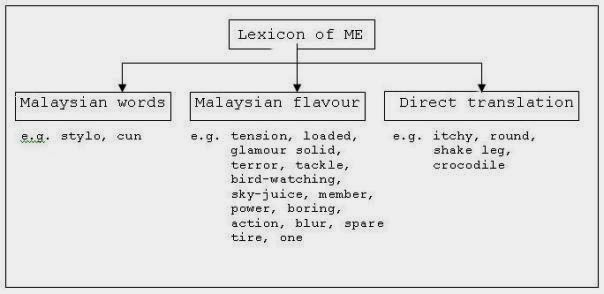
Adapted from: Zaidan Ali Jassem, 1994

OBJECTIVE

The research aims to see whether the use of ME lexical items is understood and accepted at the international level by engaging in the IRC. Several ME lexical items are selected and used to find out whether the use of such words is understood and accepted.

RESEARCH DESIGN

In an effort to seek answers to the questions that have been raised by the researchers of this project, the researchers need to collect data. Only by collecting data, can the researchers be able to come to any sort of conclusion about the level of understanding and acceptability that non native speakers of Malaysian English might have towards the use of lexical items originating from Malaysian English in the IRC. Consequently, in an effort to collect the much needed data, the researchers of this project have decided to take to the field and experience for themselves the reactions that they would encounter if they were to use Malaysian English lexical items in the IRC.

THE INSTRUMENTS

In conducting this project, there are basically two types of instrumentation that are deemed necessary in order for the project to succeed. On one hand, a list of Malaysian English lexical items. This list serves the purpose of providing a pool of lexical items from which the researchers of this project will randomly use to gauge the attitude of non Malaysians towards their use. On the other hand, there is the need for a computer with Internet access. This computer will serve the purpose of providing the researchers with a way to get into the chat rooms where the Malaysian lexical items will be used.

THE SUBJECTS

The subjects in this research are simply non Malaysians who are speakers of the English language, regardless of the fact that the language might not be their first language. In the context of this research, there is also no need for the subjects to be of a specific gender or age. This is simply because of the fact that these two factors are of no importance. However, the subjects must be foreigners and not Malaysians because of the simple fact that Malaysians would be familiar with the lexical items that are to be used in this project. In addition, because of the fact that Malaysians would be familiar with the lexical items used, they would also in all likely show no reaction to the use of such lexical items.

THE PROJECT’S FINDINGS


Generally, it is believed that the use of the Malaysian English lexical items in the IRC is understood and accepted. The use of the Malaysian English lexical items is understood simply because most of the participants managed to respond accurately to what the researchers attempted to convey even though the researchers used Malaysian English. A lot of examples can be drawn out to justify the claim. For example:

1. B1: lines 27 – 28 (see Appendix ME)

In this example, it is clear that the respondents understood what the researchers meant by the use of ‘member’ and responded accurately to the question by stating that she had no Malaysian friends.

2. C1: lines 9 – 10

Here the researchers asked about the participant’s feeling over the loss of Holland in the world cup using the word ‘tension’. Amazingly, she understood what the researchers tried to ask and answered the question appropriately.

3. C1: lines 17 – 18

Although the researchers repeated the word ‘glamour’ twice, this did not resulted in the participant had no idea of what the researchers were trying to ask. Instead, she gave a very good response to the question by describing the items that she liked.

4. C1: lines 19 – 20

The researchers attempted to ensure that the response that was given by the participant in the previous example was not accidental. Therefore, once again they use doubled word ‘round’ to look into the response that would be given. Similar to the previous one, the respondent successfully answered the question posed.

5.C1: lines 24 – 25

In this instance, the researchers made use of the word ‘solid’ to test whether the participant could understand, then answering the speaker’s question. She responded well by claiming that she had that kind of body since she worked out everyday.

6. D1: lines 25 – 26

Similar to the first instance (B1), this participant managed to understand what the researchers meant by the word ‘member’. She frankly gave the answer ‘ no’ in answering the question.

7. D1: lines 32 – 33

In this example, it is clear that the participant understood the compliment ‘wowwww!!!! So power onelah’, that was given by the researcher when she responded to the response by trying to be humble ‘normal’.

On the other hand, there were several occurrences where the participants did not understand the use or meaning of the Malaysian English lexical items. This however did not impede the communication from continuing. For example, when they came across such expression, some of the participants actually took the initiative to ask for the meaning of such words. When they were given the explanation, they showed that they accepted the explanation given. There are a lot of examples that can be used to show this point, they are:

1. A1: lines 3- 6

In this example, this particular ‘chatter’ asked the researchers about the meaning of the phrase ‘shake leg’. As the researchers explained the meaning of the phrase, the participant later showed that she now understood what did the researchers mean by the use of the words when she responded ‘ahh.. I see’.

2. A1: lines 7- 12

In this instance, the researchers suggested a new meaning of the phrase ‘bird watching’ to the respondent when she failed to give the required answer. Realizing that the phrase now carried a new meaning, she tried to verify her assumption about the association of girls with birds at the speakers place. When she was asked later about any terms that were used to refer to boys, she claimed that there were no ‘special’ terms used to refer to boys. This shows that the participant accepted the use of phrase since she regarded the use of such phrase as ’special’.

3. B1: line 11- 18

Here, the participant faced a similar problem as the first respondent because she did not understand the use of the phrase ‘shake leg’. Therefore, she decided to ask for the meaning of the words. Making use of the meaning provided by the speakers, she then posed a question to the researchers on the same topic. She showed that she accepted the new meaning given by elaborating on her liking.

4. B1: lines 23-26

The use of “sky juice”, as predicted, caused the participant to fail in grasping the meaning. However, as the researchers explained the meaning of the word, the participant make an attempt to guess what did the researchers meant by the use of the words. She referred the words to ‘rain’. Then, she showed that she accepted the meaning of the words when she included the expression ‘…hahaha…’ which implied that she felt very easy with the explanation.

4. D1: lines 13- 16

Similar to the previous example, this particular participant also did not understand the meaning of the words ‘sky juice’. However, after being explained about the meaning of the words, she then indicated that she accepted the meaning. This is illustrated when she gave her personal views on ‘sky juice’ by stating that was ‘the best thirst quencher’.

6. D1: lines 4- 9

Here, the participant discovered that she did not understand the use of ‘so glamour one’. Later, she indicated that she accepted the use of the phrase when she asked for apology for not being able to understand the use of the words earlier.

7. D1: lines 67- 72

In this example, the participant asked the speakers about the use of ‘so action one’. She showed her acceptance on the use of the words when she borrowed the meaning of the words to deny the allegation made by the researchers about her.

Besides suggesting that they accepted the use of the Malaysian English lexical items, they also indicated that such a use did not deter them from having a casual type of conversation. For example, one of the participants has expressed her liking on the researchers. This could be due to the fact that, they use such a ‘unique’ expression to express their views. This is illustrated by the second respondent (B1) in line 50 who confessed

‘ I really like your company too

so I’m hoping to bump into you again’

This same participant was also found to be ‘generous’ because she offered her e-mail address to the speakers.(B1: lines 56& 60) when she realized that she could not continue to chat. This also indicates that she felt very easy and comfortable chatting with the researchers. In other words, she did not find it troubling for herself to understand and accept the use of the Malaysian English lexical items. In another case, the last participant (E1) indicated that she accepted the use of such lexical items by accepting the researchers’ invitation to play sports even though she was constrained by the physical location factor.

However, despite the numerous instances in which the participants of the research managed to understand and accept the use of Malaysian English lexical items in the IRC, there were exceptions. Basically, these exceptions can be divided into two categories. Firstly, there is the category in which the research participants could not understand the meaning of the Malaysian English lexical item used, and requested further clarification. Examples, of such instances are listed below:

1. A1: line 7 – 10

In this example, despite the fact that the ‘chatter’ actually accepted the use of such a lexical item, upon inquiry, the ‘chatter’ admitted to the researchers that she did not actually understand the meaning of the lexical item used. Thus, prompting the need for the researchers to have to explain to her the actual meaning of the lexical item.

2. B1: line 11 – 13

In this instance, the ‘chatter’ did not seem to mind the use of such lexical items. However, she revealed to the researchers her lack of understanding by nonchalantly asking why the researchers ‘shook their legs.’

3. B1: line 23 – 26

In this example, the ‘chatter’ is again confronted with the use of an unfamiliar lexical item. Here, she simply asks straight away what is the meaning of the lexical item. Once told of its meaning, the ‘chatter’ conveys her new found sense of understanding, and also presumably her sense of acceptance, in a very delighted tone.

4. D1: line 7 – 9

In this instance, the ‘chatter’ signals her lack of understanding by ending the question phrase with the use of multiple question marks. The researchers, obligingly provide her with the meaning of the lexical item. In a show of acceptance of the lexical items usage, the ‘chatter’ even goes to the extent of apologising to the researchers for her lack of understanding.

4. D1: line 14 – 16

As for this example, the ‘chatter’ opts for a different approach in signalling her lack of understanding. For she simply asks in a very direct manner, the meaning of the lexical item that she does not understand. Upon being provided with the lexical items meaning, the ‘chatter’ reveals her acceptance of the lexical items usage by using a compliment.

6. D1: line 36 – 37

With this example, the researchers not only have to accommodate the ‘chatters’ lack of understanding, but also for the very first time, the ‘chatters’ first hint of unacceptability for the use of such a lexical item. This ‘hint’ of unacceptability is assumed by the researchers to have manifested itself in the form of the capitalisation of all the letters in the phrase, “NO BORING BORING ONE.” This assumption is proven to correct a few lines later when the ‘chatter’ asked the researchers to just use plain English.

7. D1: line 45 – 46

Here, the ‘chatter’ not only reveals her lack of understanding, but also her displeasure of having to cope with the usage of such lexical items by using a multitude of question marks. Thus, it would only be logical to rationalise that the participant no longer finds the use of Malaysian English lexical items acceptable.

8. D1: lines 70, 83 and 88.

Again and again, the ‘chatter’ reveals her lack of understanding along with her dislike of the usage of such lexical items by using a multitude of question marks.

Secondly, there is also the category in which the research participants could not understand the meaning of the Malaysian English lexical items used, and simply avoided the matter of asking for further clarification by changing to new topic of conversation. Examples of such instances are listed below:

1. C1: lines 34 – 35

From this example, it is presumed that the ‘chatter’ tries to hide her lack of understanding by simply switching to a completely different topic. In the eyes of the researchers, this ploy of hers did not manage to achieve its objectives. However, because of the fact that the ‘chatter’ switches topics, the researchers are not able to determine whether or not she has accepted the use of the lexical item. This is simply because there is no response to analyse.

2. E1: lines 22 – 23

As for this particular example, the ‘chatter’ is again deemed to be trying to hide her lack of understanding by switching to a completely new topic. Once again, the researchers quickly catch on to this ploy of hers. As with the above example, the researchers are again unable to determine whether or not the ‘chatter’ finds the use of such lexical items acceptable simply because there is no response to analyse.

Besides that, There are also instances where the ideas or messages which the researcher tried to convey did not get across. Examples of such instances are listed below:

1. A1: lines 7 – 9

Here, we can see that the respondent took the meaning of “bird-watching” literally. The word was mentioned earlier, but she did not question it, assuming the meaning is watching birds, while the intended meaning was watching girls. However, when given a short explanation of the meaning of “bird watching” and asked of the names used in her place, she did not reacted negatively, and this signals acceptance.

2. C1: lines 30- 32

The subject understood the meaning of “tackle” as in the tackling skill in sports (for example, rugby or football). Perhaps, that is why she replied “depends where” which is unexpected and somehow funny.

3. D1: lines 48 – 52

From this example, we can see that the subject understood the word “crocodile” differently than the one intended by the researcher. She responded negatively (“Gross!!!”) to the word before the short explanation was given to her. Though she had accepted the meaning of the word after that, it is evident that the idea did not get across to her earlier.

4. D1: 57 – 60)

Here, again the idea did not get across. The subject hesitated to answer to the question “do you mind if I tackle you?”, and understood it differently than the one intended by the researcher. At this point, she started to be angry and seemed to be offended by the question. When asked to clarify her answer, she stated that she would mind and she is not “like that”. The researcher was actually trying to “make a pass at her” here, but in line 73, she stated that “what pass? I missed that”, showing very clearly that she did not understand the use of “tackle”.

Other than the exceptions mentioned above, there are also injection of makers to reflect paralinguistic makers, which of positive and negative nature. Paralinguistic makers of the positive nature can be seen in:

1. A1: lines 6 – 8

The chatter she responded “ah… I see”, which is signalling understanding to the explanation given by the researcher. This is clearly a positive response in the chat. However, in line 8, the subject indicated a negative attitude by inserting “@#$%” at the end of her question. Though the reason of her typing in the symbols is not clear, the symbols are usually used to show a response of a negative nature.

2. D1: line 5,

In this instance, the subject responded with a paralinguistic marker “Huh!!!!”, which has a negative connotation. It is evident here that the subject did not understand the phrase used and responded negatively to it. However, in the following lines, we can see that she accepted the word after given an explanation on it.

3. D1: line 39

From this line, the subject is displaying negative attitude when she inserted “@##$%**&^” after her question. Here, the symbols indicated that the subject was irritated and annoyed with the use of ME words, due to the fact that she could not understand most of them.

4. D1: line 49

The subject used “GROSS!!!!” in responding to the word “crocodile”, indicating irritation and disgust. It is clear here that she did not understand how the word is used and the connotation the word carries in Malaysia, and with her own understanding, was disgusted with the use of it. When researcher asked her if she knows the connotation of the word “crocodile” here, she promptly asked “WHAT?!!!!”, which evidently showing irritation and annoyance. However, after explaining what the word means, she responded well to the researcher’s chatting.

5. D1: line 58

When asked whether the researcher could “tackle” the chatter, she showed hesitation with “……..uh……yah” as she answered the question. Here, she was not sure of the meaning of the word “tackle” and thus, applied her own understanding to it. As expected, from the proceeding lines, it is evident that she misunderstood the word “tackle”.

6. D1: line 70

In this extraction, the subject asked for the meaning of “Action one” with several question marks. Starting from this point onwards, she asked for the meaning of ME lexical items with several question marks, such as in lines 83 and 88, as we can see “spare tire?????” and “blur?????”. We can say that the question marks are used to show irritation and annoyance because she could not understand the meaning of the words.

In short, we can say that the injections of paralinguistic markers which were used by the subjects reflected their attitudes, which could be of positive or negative nature.

SUMMARY OF FINDINGS

In general, we believe that the use of the Malaysian lexical items in the Internet Relay Chat as being understood and accepted. These two claims can be supported by a few number of instances during the course of interaction. First, we managed to engage in the IRC with a number of respondents who actually chatted with us. During the course, there were no instances of anybody who left in the middle of the interaction. In other words, these people continued to ‘chat’ with us for a certain period of time until we quitted or they said goodbye. Second, the use of the Malaysian English lexical items posed minimal difficulty to the respondents. This case is very unique as the words connote different meanings in Malaysian English compared to that of the Standard English. It is assumed that the use of the words was understood and accepted by at least, these groups of respondents who actually made use of the contexts to grasp the ideas conveyed by the researchers.

Among the Malaysian English lexical items that were used throughout the course of the interaction are those words that fall under the Malaysian Flavour words, Direct Translation words and words that are borrowed from the Malaysia context that have been accepted as the lexicon of Malaysian English.

The list of the words are listed below:  

Category 1 (Malaysian Flavour)
 
WORDS PLACE OF OCCURRENCE
1. Tension C1
2. Loaded C1
3. Glamour C1
4. Solid A1& E1
5. Terror C1
6. Tackle C1,D1&E1
7. Bird-watching B1& C1
8. Sky juice B1& D1
9. Member B1& E1
10. Power E1& D1
11. Boring D1
12. Blur D1
13. Spare tire D1
14. Action D1

Category 2 ( Direct Translation)
 
WORDS PLACE OF OCCURRENCE
1. Itchy C1& D1
2. Round C1
3. Shake leg B1& C1
4. Crocodile D1
5. Spare tire D1

Category 3 (Direct Translation)
 
WORDS PLACE OF OCCURRENCE
1. Stylo C1
2. One E1

IMPLICATIONS OF FINDINGS IN THE ELT METHODOLOGY

Since the finding suggests that the use of Malaysian English in terms of its lexical items was understood and accepted in the IRC domain, the use of Malaysian English should not be limited. Instead, it should be encouraged because it gives students opportunity to express their views in a more expressive manner. Feeling that they are not imposed to follow any standard, they will be able to talk more confidently.

Furthermore, this will also gives them the opportunity to gradually pick up the language. The stress should be focused on the fluency and not the accuracy. They should be encouraged to talk even their utterances are peculiar. As long as they are understood, they should not be constrained. This will give learners the confidence that they need to speak in the second language. Gradually over the time, they will start to learn about the correct forms of the language and become better second language users. However, the use of Malaysian English should not be suppressed because it gives a sense of identity to its users.

CONCLUSION
 
The positive result that was acquired in the course of the interactions, implies that users of the IRC are generally tolerant to the use of English in the cyber domain. Because the context of the interaction opens to anybody regardless of their origins and language, many are aware that the users of the IRC may not necessarily be native speakers of English. Instead, they realize that a lot of the users could be the second, third or foreign language speakers. Hence, a lot of them chat with open mind thus, becoming less concerned about the accuracy of the utterances. They are more interested to focus on the content of the interactions as they are more important. The same treatment that is adopted in the ‘world’ should be extended to the ESL classroom because it has the resemblance with the typical daily conversation. In addition, it also suggests that accuracy is only perceived as a secondary factor in communicating effectively.

However depending on the individuals that we ‘chat’ with, some might come across chatters who will be very concerned over the accuracy of the language. The failure to follow the norms may result in situation where one could be given negative remarks, and others. These then may lead to failure of communication where one may encounter those who do not understand the use of those the words. The situation can be aggravated if those participants refuse to accept the use of the Malaysian English lexical items.

Reference

Crystal, D. 1991. A Dictionary of Linguistics and Phonetics. Cambridge : Blackwell Dr.

Zaidan Ali Jassem. 1994. Malaysian English: A Sociolinguistics and TESL/TEFL Perspective. Kuala Lumpur : Pustaka Antara.

Siti Lailatun Abdul Shookor. 1990. The effectiveness of the KBSM English syllabus in dealing with word-stress and intonation patterns. Academic exercise. UKM


Friday, 22 January 2010

Turn-taking in Internet Chat

What is Yahoo! Chat?

This study utilizes chat logs obtained specifically from Yahoo! Chat. It is a chat system provided by Yahoo! Inc. for free. It is a popular electronic environment which people enter in order to interact with others from around the globe via the Internet, at any hour of the day or night. It can be accessed from Yahoo! Messenger or from http://chat.yahoo.com. Before anyone can join Yahoo! Chat, they must first have a Yahoo! ID with Yahoo.com.

Yahoo! Chat is relatively easy to learn. It contains hundreds of channels, in which different conversations are held. The types of channels vary widely. Some are identified by the name of a country. Other channels are for people with common interests. There are also channels geared towards particular age groups. Each channel has different rooms so that it would not be too crowded in any particular public channel.

Communication using the Yahoo! Chat is written, but it is also synchronous. It is a written (typed) form of communication that is transmitted, received and responded to within a time frame similar to spoken communication.

In Yahoo! Chat, users can manipulate the display on the chat window, such as font type, font size, font colour, emoticons and the background of the chat window (only available in Yahoo! Messenger).


Turn-taking

●   spoken conversation can be said to follow a normative ideal of precisely alternating turns,  it refers to the timing of the transition from one speaker turn to the next, which is ideally supposed to occur with no (or minimal) gap, and no overlap between speakers.

●   alternating because it is expected that participants will take turns speaking in orderly fashion. Thus, in dyadic exchanges, one person speaks, the other responds; the first speaks again, the second takes the following turn, and so forth.

●  Researches on conversational interaction shows simultaneous feedback has an important role as it signals listenership, timing turn-taking and maintaining continuous interaction

●  CMC, in contrast, exhibits numerous violations of both the “no gap, no overlap” principle and the principle of orderly turn alternation

●    Computer networks – originally intended for data transmission, not social interaction. Thus, researchers in CMC found – various limitations imposed on group interaction by the properties of the medium, such as high production and reception, and “chaos”.

●   One of the properties of the medium which are obstacles to interaction – lack of simultaneous feedback. Online chat is text-based, and chat participants rely on fewer channels than face-to-face interaction for transmission of the message. Because users do not see other participants, they do not have access to paralinguistic and non-verbal information, which are equally important as the verbal information in interaction.

●   Another feature is the fact that most free chat systems make use of messages are sent in their entirety when the message originator presses “send” or “return”, rather than one keystroke at a time. Therefore, participants cannot respond while to message is being typed, and they do not even know that are being addressed to until a complete message appears on the screen. As a result, discontinuity and overlap within turn sequence occur.

●   Another problem is disrupted turn adjacency, which is due to CMC systems transmitting messages linearly, in the order received by the system. Thus in multi-participant interactions, a message may be separated in linear order from a previous message it is responding to, if other messages are been sent in the meantime. Delays in message transmission, or “lag”, also result in “speaking turns” appearing in chaotic sequence. When adjacency is disrupted, users may experience difficulty in tracking sequential exchanges, and interaction may become fragmented as a result.

●   In online chat, overlap, disrupted adjacency and interleaved exchange are very common. Time taken to type a message and system lag in multi-participant interaction cause speaking turns to be lines away from one another, if messages from other participants intervene. This can be seen in the example 1 (messages generated automatically by Yahoo! Chat system are excluded from this analysis).

●   In the sample above, because of the number of participants the chat room in the study is high, exchanges were overlap and interleaved. Here, we can see that the participants respond upwards to a previous participant in each case.

●   One interaction is between platothedick and selena_serene, fisk_au and CookedSoose, and another is between blue_eyed_jagged_edged and selena_serene. We can see that selena_serene was engaged for a moment in two interactions at the same time.

●   Later (line 88), fisk_au initiated another conversation with the rest of the participants in which the responded to. Example 1 shows that exchanges overlap, rather than in sequence, and turns are often disrupted by other messages in between.

Table 1: Turn-taking (messages generated automatically by Yahoo! Chat system are excluded from this analysis)


Table 2: The exchange

71. CookedSoose: hello selena
73. selena_serene: soosey
74. fisk_au: selena
75. just4nz: Good morning Selena
76. selena_serene: fisky
77. platothedick: selena
78. blue_eyed_jagged_edged: hi slee
79. selena_serene: pluto
80. platothedick: i’m old today
81. platothedick: i feel ancient
82. selena_serene: is it your Birthday?
83. fisk_au: happy b’day
84. blue_eyed_jagged_edged: slee you lost your pretty font again
85. selena_serene: heh heh
86. platothedick: i think i have a complex
87. CookedSoose: it’s your birthday plato????
88. CookedSoose: happy birthday dear plato
89. fisk_au: I like this colour
90. platothedick: funny enough gilly it is
91. CookedSoose: happy birthday dear plato!
92. fisk_au: should I change?
93. platothedick: thanks
94. selena_serene: fisk,..no,..it looks like cat vomit
95. platothedick: fisk no one reads it anyway
96. blue_eyed_jagged_edged: yes fisk change


Thursday, 15 October 2009

Conversational Analysis of Internet Chat: Linguistics characteristics and interaction

INTRODUCTION

Chat systems is one of the computer-mediated communication (CMC) systems which is a multi-user synchronous communication facility that is available all over the world to people with access to the Internet network of computer systems. They are intended to be a tool for social interaction between spatially dispersed people using the medium of computers.

Interaction on chat systems involves a deconstruction of traditional assumptions about the dynamics of communication, and the construction of alternative systems called “Internet language” (Reid, 1991).

CONVERSATIONAL ANALYSIS

Conversational Analysis which was advanced by Sacks, Schegloff and Jefferson, is basically a “rigorously empirical approach which avoids premature theory construction. The methods are essentially inductive; search is made for recurring patterns across many records of naturally occurring conversations” (Levinson, 1983: 287). The data is based on real people in real life conversing with each other and how language is used to get their intention and message across. Unlike Discourse Analysis, CA does not restrict data to categorisation. Instead, CA focuses on the systematic properties of the sequential organization of conversation, in the way in which utterances are designed to manage it (Jamaliah Mohd Ali, 2004).

Although talk may appear as irregular, it is highly systematic. Thus, the aim of CA is to examine the rules that underlie conversations and towards which the participants accommodate. So, other than analysing the general rules and structure of talk, CA also analyse the regularities in more specific kinds of talks (Discourse Analysis, 2003).

DATA AND METHODS

This study examines logs of Yahoo! Chat interactions taken from a single computer. The raw data consists of two logs of Yahoo! Chat interactions in two public channels, which are Professors’ Chat (Room 1) and Study Group (Room 4), with each log running approximately half an hour. Although the channels are geared towards certain groups of people, these rooms are accessible by anyone with a Yahoo! ID. At the time of logging, both channels supported substantial levels of interaction. There were no fixed agendas or topics being discussed; participants generally talk about something that someone brought up. The logs also witness interactions being carried out in English, although this is not a requirement under Yahoo! Chat. This is could be because the chat rooms are not regional, which perhaps would see the participants use the regional language. While voice and video communication is turned on, they were not utilized by the participants.

The objective of the study is to look at the linguistic characteristics that the participants or chatters display, which includes typography, spelling, and the emoticons, how and why they are used as they occurred in public channel interactions. The study will also look at turn-taking found in the chat logs and how conversation and interaction take place with the merging of spoken and written language in one medium. Since the interactions in the chat rooms consist of the combination of human and computer-produced utterance and transmission, the study will also take into consideration how the mediation (the computer and Internet) affects the interaction.

FINDINGS

1. Linguistic Characteristics of Yahoo! Chat

Computer-mediated communication has created new opportunities for real-time interaction among geographically dispersed individuals sitting at their computer keyboards. People engage in written conversation in the new linguistic genre, which combines characteristics of both written and oral language (Bechar-Israeli, 1996). The real-time, synchronous transmission of utterances between participants gives a very face-to-face conversational feel (Reid, 1991). They type their messages, and the text of these messages appears on the screens of their interlocutors.

Because language does not look as it does anymore in CMC due to the new linguistic genre, it becomes less transparent. As a result, it heightens meta-linguistic awareness. They are conscious of their audience and pay special attention to the display of communicative competence, to how their messages are displayed (Bauman, 1975, 1977 cited in Danet, Ruedenberg-Wright and Rosenbaum-Tamari, 1998). This is to ensure that they achieve the purpose of communication, that is to be heard and understood by other interlocutors.

Generally, since the messages are typed at a keyboard, there is a tendency to use conventions of written English, particularly spelling. However, a number of distinctive practices of spelling are found in the channels. This can be seen in Example 1:

Example 1 : Spelling

Sample 1.1. : “Professors' Chat:1”

InteractionSubstitution for :
2.old_lamp_lighter: isn't that a coco – coincidence
5.platothedick: i hang out in perv rooms about 22 hours a day, the other two i'm in parent chatperv – pervert
82.fisk_au: happy b'dayb’day – birthday
105.fisk_au: 1 nono - know
145.CookedSoose: rather defanged him, then, didn itdidn – didn’t
176.fisk_au: rectum? damn near kilt emem – them

Sample 1.2. : “Study Group:4”

InteractionSubstitution for :
9.mush_bear15: thats why men sucksthats – that’s
18.mush_bear15: man dont care bout the feelings of a girldont – don’t
bout – about
32.sweetsunshinebrightenyou: we're juz finejuz – just
46.mush_bear15: not 4 a woman4 – for
50.priyanka_mishra_lko: what r u doingr – are
u – you
52.sweetsunshinebrightenyou: i think that's silly, if u would die for someone u loved, coz, why dont u find another one?coz – because
dont – don’t
u – you
60.mush_bear15: rytryt – right
63.sweetsunshinebrightenyou: i'm telling the truth man, i mean if u wanna keep survive, why dont u think like that?wanna – want to
75.mush_bear15: yupyup – yes
76.mush_bear15: its ok to have a debateits – it’s
78.sweetsunshinebrightenyou: yea, its fun!yea - yes
87.sweetsunshinebrightenyou: so, mush bear, how r ya?r - are
ya - you
110.mush_bear15: nopenope - no
118.sonu_477: yaya - yes
143.sweetsunshinebrightenyou: well, i think every problems will have the solutions and all we have to do is, juz face it, coz soon or later it will endjuz – just
coz – because
146.sweetsunshinebrightenyou: well i have ever sad, but that wont stop mewont – won’t
168.sweetsunshinebrightenyou: i cc - see
180.loudpraying: CAN U FURTHER UR EXPLAINATION?ur – your
185.sweetsunshinebrightenyou: so wat do u think?wat - what
193.mush_bear15: UR ABSOLUTELY RYTur – you’re
ryt – right

The practices in Example 1 show that are several instances where the spellings diverge from standard written English. The most common in the study are substituting “you” with “u” or “ya” and “are” with “r”. There are also instances of simplification of words, such as “b’day” for “birthday”, “perv” for “pervert”, “ur” for “you are” and “ryt” for “right”.

Other than some different ways of spelling, other distinctive practices found in the chat logs are short-hand form of communication, the dropping of apostrophe and hyphen, the dropping of initial capital letters for proper nouns and beginning of sentence, and lowercase for “I”. This can be observed in Example 2 below:

Example 2 : Short-hand Forms

Sample 2.1. : “Professors’ Chat:1”

InteractionSubtitution for :
CookedSoose: LOL it's too early to spell!!!LOL – laughing out loud
63.old_lamp_lighter: g m selenag m – good morning
213.selena_serene: omgomg – oh, my God

Sample 2.2. : “Study Group:4”

InteractionSubtitution for :
223.loudpraying: LOLLOL – laughing out loud
163.mush_bear15: any1any1 - anyone

The chat participants also use short-hand form of communication as in example 2 above, substituting “laughing out loud” (to indicate the person is laughing) for “LOL” being the most common. Other short-hand forms are “g m” for “good morning”, “omg” for “oh, my God” and “any1” for “anyone”.

All these spellings would be considered “vernacularizing” changes, and we would expect to find them used especially among users of a particular channel (Paolillo, 1999). These linguistic features somehow is similar with the sounds of spoken English, such as “ya”, “yea” or “yup” for “yes” and “coz” for “because”. This is one way the chat participants use to create the face-to-face conversational feel in the medium. The dropping of apostrophe or hyphen, the dropping of initial capital letters for proper nouns and beginning of sentence, and small case for “I” as noted earlier could also be due to the fact that these written English characteristics would be invisible in spoken communication.

There are a few reasons why the chat participants are using unconventional spelling and short-hand for in the chat rooms. Because the interaction is carried out in the medium and messages are sent out using the keyboard, participants typed as fast as they can as so not to lose their turn in the interaction. Due to the fact that messages on the screen scrolls up when new messages come in (including messages generated automatically by Yahoo! Chat) , participants want to stay in the frame and not to be too far behind in their responses, as that may make them to lose the floor.

It was also observed that in the Professors’ Chat, the participants utilized the conventional conversation transcription method, where uppercase is used to indicate raising of voice on the word or sentence, either to stress a point, shout or yell. Otherwise, all of the chat participants use lowercase consistently. For example:

Example 3 : Uppercase (“Professors’ Chat:1”)

InteractionPurpose :
6.CookedSoose: so it's YOUR fault plato!To blame only platothedick for bringing all the perverts into the chat room.
68.blue_eyed_jagged_edged: I am REALLY glad you gave me that image platoBeing sarcastic to platothedick, with the stress on the word “really”.
96.CookedSoose: HAPPY BIRTHDAY DEAR PLAAAAAAAAAAAATOOOOOOOOOOOOTo indicate shouting of “Happy Birthday” in an excited manner to platothedick.
The multiple “A” and “O” are to show loudness of the shout.
137.CookedSoose: morning PROP!!!!!!!!!!!!To indicate excitement to see prop by shouting his name.
152.blue_eyed_jagged_edged: look at this...just fucking LOOK at it...To indicate irritation, calling attention to the following statement.
163.blue_eyed_jagged_edged: I mean for fuck's SAKETo indicate irritation, with stress on the word “sake”
169.selena_serene: it's ALIVETo stress the word “alive”, as if surprise, in a jocular manner.
117.blue_eyed_jagged_edged: look at THISTo indicate irritation, calling attention to the subsequent statement.
200.selena_serene: YESSSSSSSTo indicate excitement in agreeing to a suggestion.
208.selena_serene: GLORIA,..G L O R I A ......gloria.........To indicate singing and shouting the name “Gloria”.

In Example 3 above, we can see that the chat participants use uppercase is used to indicate raising of voice on a particular word or sentence, whether it is to stress a point, shout or yell. This is perhaps done with specific intention in mind, such as blaming (line 6), being sarcastic (line 68), showing excitement (lines 96, 137, 200), showing irritation (lines 152, 163) and showing loudness (lines 169, 208). This shows that the chat participants are aware of the conventional conversation transcription method and know how to use and manipulate it as paralinguistic markers in chat rooms to compensate the lack of visual and auditory clues to communicate with others.

2. Emoticons

Emoticons in CMC are facial expressions made by a certain combinations of keystrokes, usually producing an image of a face sideways. They are icons for the expression of emotion, often indicating non-seriousness or playfulness, and are considered as an aspect of paralinguistics. Generally emoticons are used in online chats, E-mails, or online message boards (Danet, Ruedenberg-Wright and Rosenbaum-Tamari, 1998).

In this study, it was found that chat participants did not make use of emoticons a lot. Most of the time, they played with words to express their intention and emotions, especially chat participants in the Professors’ Chat:1. However, chat participants in Study Group:4 used it quite frequently, most of the time to show their emotions in reference to statements or questions. The following are examples of emoticons and the purpose of their use in the study (emoticons which are not part of the conversations are excluded from this analysis).

Example 4 : Emoticons

Sample 4.1. : “Professors’ Chat:1”

InteractionPurpose
15.just4nz: every chatroom needs its own resident pariah - Let Plato be the delegated one :DThe emoticon is a grinning face used to indicate that he is joking.
140.propagumbhis: Gilly *L*The emoticon is a type of smiley used to greet CookedSoose and indicate that he is pleased to see her there.

Sample 4.2. : “Study Group:4”

InteractionPurpose
68.loudpraying: :-BThe emoticon is a face with two teeth showing (implying a typical nerd), used to indicate that he has nothing more to say and his argument ends there.
89.loudpraying: ;-)The emoticon is a winking face, to indicate that he is joking.
136.sweetsunshinebrightenyou: i almost never! :DTo indicate that she is joking.
192.sweetsunshinebrightenyou: :/The emoticon is a confused face, to show that she is confused.
207.mush_bear15: :DTo indicate that she is laughing to sweetsunshinebrightenyou’s joke about someone they both know.
222.sweetsunshinebrightenyou: :)To show that she is in agreement to loudpraying’s funny statement.
226.mush_bear15: >:)The emoticon is known as “evil smile”, here it is used to indicate that she agrees to loudpraying’s ridicule on someone they both know.
229.sweetsunshinebrightenyou: i'm 17 f, and call me Dee :)To show that she is introducing herself in a friendly manner.
233.sweetsunshinebrightenyou: :)To show that she is pleased to meet others in the chat room.
244.sweetsunshinebrightenyou: nice meeting u :)Smiling to mush_bear15, to show that she is pleased to meet mush_bear15.

From example 4 above, we can see that chat participants use emoticons to compensate the lack of visual and auditory clues in the interaction on the Internet. The use of emoticons is seen as a display of awareness on the part of the chat participants of the importance of visual and auditory clues in interaction. To replace emoticons with words would take more time to type them, so the use of emoticons can also be seen as a short cut to get messages across.

3. Turn-taking

Turn-taking in spoken conversation can be said to follow a normative ideal of precisely alternating turns, it refers to the timing of the transition from one speaker turn to the next, which is ideally supposed to occur with no (or minimal) gap, and no overlap between speakers. It is alternating because it is expected that participants will take turns speaking in an orderly fashion. Thus, in dyadic exchanges, one person speaks, the other responds; the first speaks again, the second takes the following turn, and so forth. CMC, in contrast, exhibits numerous violations of both the “no gap, no overlap” principle and the principle of orderly turn alternation (Herring, 1999). Researches on conversational interaction shows simultaneous feedback has an important role as it signals listenership, timing turn-taking and maintaining continuous interaction (Mclaughlin, 1984).

Interaction on the Internet in the study has shown successful turn-taking taking place, where there is no overlap and minimal gap between the exchanges and one speaker speaks at one time. For example:

Example 5 : No overlap and no gap

6.platothedick: i hang out in perv rooms about 22 hours a day, the other two i'm in parent chat
7.CookedSoose: so it's YOUR fault plato!
8.platothedick: what is my fault?
9.CookedSoose: you bring all the pervs back here with you
10.platothedick: it probably is
11.CookedSoose: lol

In the example above, we can see the exchanges between platothedick and CookedSoose are not interrupted and there is no overlap or gap. Both of them take the floor in the instance they see the message from the other appears on their screen.

There are also instances where the chatter (speaker) selected which chat participant to speak next by producing the first part of the adjacency pair, such as in a greeting or a question, although they are not always successful because of the multi-participant nature of the chat room. Some examples of adjacency pairs (greetings) are as follows:

Example 6 : Adjacency pairs (Greetings)

Sample 6.1

61.nflfirefighter: Morning Selena
65.selena_serene: hello nfl

Sample 6.2

71.CookedSoose: hello selena
73.selena_serene: soosey

However, although turn-taking in Internet chat is similar to spoken communication, researchers in CMC have found that there are various limitations imposed on group interaction by the properties of the medium, such as high production and reception, and “chaos”. One of the properties of the medium which are obstacles to interaction is the lack of simultaneous feedback which is due to the features of CMC. Online chat is text-based, and chat participants rely on fewer channels than face-to-face interaction for transmission of the message. Because users do not see other participants, they do not have access to paralinguistic and non-verbal information, which are equally important as the verbal information. Another feature is the fact that most free chat systems make use of messages are sent in their entirety when the message originator presses “send” or “return”, rather than one keystroke at a time. Therefore, participants cannot respond while message is being typed, and they do not even know that are being addressed to until a complete message appears on the screen (Herring, 1999). As a result, discontinuity and overlap within turn sequence occur.

Another problem is disrupted turn adjacency, which is due to CMC systems transmitting messages linearly, in the order received by the system. Thus in multi-participant interactions, a message may be separated in linear order from a previous message it is responding to, if other messages are been sent in the meantime (Herring, 1999). We can see this in Example 7 below (messages generated automatically by Yahoo! Chat system are excluded from this analysis):

Example 7a : Overlapping and interleaved interaction in Professors’ Chat:1

71.CookedSoose: hello selena
73.selena_serene: soosey
74.fisk_au: selena
75.just4nz: Good morning Selena
76.selena_serene: fisky
77.platothedick: selena
78.blue_eyed_jagged_edged: hi slee
79.selena_serene: pluto
80.platothedick: i'm old today
81.platothedick: i feel ancient
82.selena_serene: is it your Birthday?
83.fisk_au: happy b'day
84.blue_eyed_jagged_edged: slee you lost your pretty font again
85.selena_serene: heh heh
86.platothedick: i think i have a complex
87.CookedSoose: it's your birthday plato????
88.CookedSoose: happy birthday dear plato
89.fisk_au: I like this colour
90.platothedick: funny enough gilly it is
91.CookedSoose: happy birthday dear plato!
92.fisk_au: should I change?
93.platothedick: thanks
94.selena_serene: fisk,..no,..it looks like cat vomit
95.platothedick: fisk no one reads it anyway
96.blue_eyed_jagged_edged: yes fisk change

In the sample above, because of the number of participants the chat room in the study is high, exchanges are overlapped and interleaved. Here, we can see that the participants respond upwards to a previous participant in each case. One interaction is between platothedick and selena_serene, fisk_au and CookedSoose, and another is between blue_eyed_jagged_edged and selena_serene. We can see that selena_serene was engaged for a moment with two interactions at the same time with platothedick and blue_eyed_jagged_edged (lines 82 – 85). Later (line 88), fisk_au initiated another conversation with the rest of the participants, which they responded to. Example 7a shows that exchanges overlap and turns are often disrupted by other messages in between. These patterns of interaction can be represented (based on Herring, 1999) in Example 7b:

Example 7b : Overlapping and interleaved interaction in Professors’ Chat:1


In online chat, overlap, disrupted adjacency and interleaved exchange are very common. The lack of simultaneous feedback, time taken to type a message and multiple conversations and interactions in one chat room cause speaking turns to be lines away from one another. As a result turn-taking appears to be chaotic and incoherent.

However, although online interaction lacks certain important features of spoken communication, this study observed that chat participants were able to adapt to the medium in order to make the interaction successful (based on Herring, 1999). In turn-taking, they have created methods of signaling listenership and holding the floor, despite the nature of the medium and CMC.

In signaling listenership, some of the chat participants use emoticons, short-hand forms of communication (such as LOL), “heh heh” and “oh”. It is important because “practices such as these heighten the interactivity of CMC by signaling listenership and encouraging others to continue” (Herring, 1999). We can see this in Example 8 below:

Example 8 : Signaling listenership

Sample 8.1 : Study Group:4

220.mush_bear15: HE DONT KNOW HOW TO CHAT
221.mush_bear15: THATS ALL
222.sweetsunshinebrightenyou: :)

Sample 8.2 : Professors’ Chat:1

9.CookedSoose: you bring all the pervs back here with you
10.platothedick: it probably is
11.CookedSoose: lol

Sample 8.3 : Professors’ Chat:1

84.blue_eyed_jagged_edged: slee you lost your pretty font again
85.selena_serene: heh heh

Sample 8.4 : Professors’ Chat:1

167.fisk_au: it twitched
169.wickedly_innocent1: ohhhhh

The chat participants in the study were also found to be able to indicate to others that they are still holding the floor, specifically to those whom they are talking to, although messages from other chatters sometimes interleaved. They are able to do this quite successfully because those in the conversation were found not interrupting the message flow. Basically, the chat participants use two methods of holding the floor, which are sending incomplete sentences until they are finished talking (as in Example 9) and using multiple full-stops (as in Example 10).

Example 9 : Holding the floor (incomplete sentences)

Sample 9.1 : Professors’ Chat:1

23.platothedick: i've frozen or something
24.platothedick: but
26.platothedick: my penis still tingles

Sample 9.2 : Professors’ Chat:1

156.fisk_au: looks
158.fisk_au: at
159.fisk_au: 'it'

Sample 9.3 : Study Group:4

7.mush_bear15: depression
10.mush_bear15: gives teenagers
11.mush_bear15: stress

Sample 9.4 : Study Group:4

58.mush_bear15: nope
59.mush_bear15: she's
60.mush_bear15: ryt

Example 10 : Holding the floor (multiple full-stops)

Sample 10.1 : Professors’ Chat:1

153.blue_eyed_jagged_edged: look at this...just fucking LOOK at it...
160.blue_eyed_jagged_edged: 'How are we to decide whether the man or woman we send to parliament is earning their keep?'

Sample 10.2 : Professors’ Chat:1

221.fisk_au: I went to school with a kid clled Grammar
222.fisk_au: oh
224.fisk_au: wait...
226.fisk_au: it was Grahame

As we can see, although online chat lacks features of face-to-face interaction, chat participants in the study were found to be able to compensate that lacking with their creativity to ensure communication in online chat is successful.

CONCLUSION

To conclude, interaction on chat systems on the Internet has produced a new set of systems called the Internet language. This new system of communication differs from the conventional type of communication because it is a result of convergence of both written and spoken language in one medium. Despite the weaknesses due to the nature of the medium, communication in online chat can be considered as successful in getting the message across, similar to spoken communication.

BIBLIOGRAPHY

Bechar-Israeli, H. (1996). FROM TO : Nicknames, play, and identity on internet relay chat. Journal of Computer-Mediated Communication, 1, 2. Retrieved 19th January 2004 from http://www/ascusc.org/jmcm/vol1/issue2/bechar

Bruckman, A. (2003). Chat (Online). Microsoft Encarta Encyclopedia Deluxe 2004. Microsoft Corporation.

Byrne, E. (1994). The Formation of Relationships on Internet Relay Chat (IRC). A thesis submitted to the University of Western Sydney, Nepean as partial fulfilment for the degree of Bachelor of Arts (Honours) in Applied Communication Studies. http://www.irchelp.org/irchelp/communication-research/academic/byrne-e-cyberfusion-1993/thesis1.html

Comer, D.E. (2003). The Internet. Microsoft Encarta Encyclopedia Deluxe 2004.Microsoft Corporation.
Computer User High-Tech Dictionary (2004). Retrieved 26th January 2004 from http://www.computeruser.com/resources/dictionary.html

Danet, B., Ruedenberg-Wright, L. and Rosenbaum-Tamari, Y. (1998). Hmmm...Where's That Smoke Coming From? Journal of Computer-Mediated Communication, 2, 4. Retrieved 19th January 2004 from http://www.ascusc.org/jcmc/vol2/issue4/danet.html

Discourse Analysis (Textlinguistics, Pragmatics, Conversational Analysis, Critical Discourse Analysis). (2003). Retrieved 01st March 2004 from http://emile.uni-graz.at/pub/02w/2003-03-0100.PDF
Herring, S. (1999). Interactional Coherence in CMC. Journal of Computer-Mediated Communication, 4, 4. Retrieved 19th January 2004 from http://www.ascusc.org/jcmc/vol4/issue4/herring.html

Jamaliah Mohd Ali. (2004). Pragmatics: Conversational Analysis. Language and Linguistics Faculty, UM.
Levinson, S.C. (1983). Pragmatics. Cambridge : Cambridge University Press

McLaughlin M. L. (1984). Conversation: How Talk Is Organized.Beverly Hills: Sage Publications.
Paolillo, J. (1999). The Virtual Speech Community: Social Network and Language
Variation on IRC. Journal of Computer-Mediated Communication, 4, 4. Retrieved 19th January 2004 from http://www.ascusc.org/jcmc/vol4/issue4/paolillo.html

Reid, E. (1991). Electropolis: Communication and community on Internet Relay Chat. Unpublished electronic paper adapted from a B.A. Honors thesis, Dept. of History, University of Melbourne, Australia. Retrieved 19th January 2004 from http://irchelp.org/irchelp/communication-research/academic/academic-reid-e-electropolis-1991.html