Introduction
According to Fromkin and Rodman (1993), knowing a language means
knowing what sounds are in that particular language and what sounds are
not. This subconscious knowledge of the language is revealed when a
speaker pronounces sounds from another language. For example, if a
person is a native-speaker of English, he may substitute English sounds
for sounds which are not familiar to him. This is also true in cases of
intonation patterns.
Stress
Before going into intonation, it would be useful to look at stress
first. Malay and English have different stress patterns. Thomson
(1996) pointed out that English is a stress-timed language. Stress is
important and has its own functions in the language. Native speakers of
English more often than not, rely on the stress patterns (and
intonation) to infer and identify meanings of words or utterances
because different stress could mean differently. The stress syllables
in an English sentence occur at regular intervals. They are usually
longer and louder than the unstressed, often with a higher pitch. The
unstressed syllables must be made to fit in-between the stressed
syllables and do not disturb or change the “beat” or “rhythm”. The
unstressed syllables are reduced and said quickly and quietly.
However, Malay, being a syllable-timed language, the stress falls in
the same place in the sentence each time, making it predictable. Juliah
(1993) stated that stress does exist in Malay, but it does not have any
particular significant function. The stressed syllables are generally
produced with equal length and loudness. According to Platt and Weber
(1980), in a syllable-timed rhythm, “all syllables, stressed or
unstressed, recur at equal interval of time, such as –’or —’ extending
up to —–’.”
Intonation
Hawkins (1984) believes that there are three basic properties in intonation. They are:
1. It is universal, which every language makes use of intonation,
and spoken language is not monotonous. For example, English makes use
of changes in tone as part of the sentence phrase, while the Chinese
uses it as lexical distinction,
2. Intonation has its own functions and purposes in spoken language, and not for “decorative purposes”,
3. Intonation is systematic because each speaker has to use the same pattern for the same purpose.
As we already know, intonation plays a lot of roles in an English
utterance. Many linguists have suggested several functions of
intonation. Roach (1991) stated that there are four functions of
intonation in English which are often proposed. They are:
1. It enables the speakers to express their emotions or attitudes,
and this function is called attitudinal function of intonation. For
example, a bored person would likely to use a level tone when answering a
question.
2. Intonation also helps to produce the prominent effect on syllables
that need to be perceived as stressed. This will mark out the word
as the most important in the utterance. For example (as given in
Roach), (a) is non- emphatic and (b) is emphatic:
(a) It was very BOring.
(b) It was VEry boring.
This intonation function is called the accentual function.
3. Intonation plays a role in grammar, which is called the
grammatical function of intonation. The listener is better able to
identify the grammar and syntactic structure of what is being said.
For instance, in differentiating whether an utterance is a question
or a statement.
4. Finally, intonation also has a discourse function. In a
conversation, for example, it helps the listener to recognise whether
the information is new or already given, and to give the appropriate
and expected response.
Roach (1991) added that though the functions of intonation is
identified and categorised, these functions can sometimes overlap. For
example, attitudinal function may overlap with the discourse function of
intonation.
Intonation in Malay
Stress does not play an important role in Malay. Ramish (1971) says
that (as cited in Suhaila, 1994) Malay words are not distinguished by
the contrast of stress. Malay speakers do not depend on stress to give
emphasis, but they change the word order to do it.
However, intonation does have its own part in Malay utterances. It
is used in spoken Malay mainly to express emotions and attitudes. The
patterns may differ from English intonation. Checketts (1993) stated
that Malay speakers who speak English have the tendency not to use the
rising tone, such in English, to signal lists or sequences of verbs. In
addition to that, a rising tone is always used at the end of a
statement or list.
In terms of attitudinal function of intonation, the stress could fall
almost anywhere in an utterance, depending on what is emphasised. A
rising, falling, falling-rising and rising-falling tones are used
somehow quite differently from English. As an example given by
Checketts (1993), in giving a list of items, Malay speakers of English
tend to use a falling tone with each item. Due to the differences,
English as second language learners, specifically Malay students whose
mother tongue is Malay, encounter difficulties in acquiring the correct
patterns of English intonation and stress patterns.
Intonation in English
Intonation has an equal importance with stress in English. As we
have seen before, intonation in English has several functions. In
addition to that, Roach (1991) stated several typical intonation
occurrences in English:
1. Falling tone is used to show finality and usually neutral.
2. Rising tone has many functions, for example, are in listing, yes/no questions, and incomplete statement.
3. Falling-rising tone is used mainly in limited agreement or having reservations, and excitement.
4. Rising-falling tone is used in expressing strong feeling of agreement/disagreement or in being sarcastic.
Though intonation in English is said to have several functions,
Carnie (1998) believes that intonation is actually a “realisation of
semantics, rather than syntax.” He added that this is due to the nature
of intonation itself, and the fact that people draw inferences from
what is said and how it is said.
Reference
Checketts, S. 1993. Thoughts on Pronunciation. New Straits Times, 27 October: 30
Roach, P. 1991. English Phonetics and Phonology : a practical course (2nd ed.). Cambridge : Cambridge University Press.
Suhaila Sulong. 1994. A study on the B.Ed. TESL students’ usage of word stress patterns in speech. Academic exercise. University Kebangsaan Malaysia.
Thomson, D. 1996. Second Language Acquisition. PPP-ITM : Mass Lecture.
Hawkins, P. 1984. Introducing Phonology. London : Hutchinson
Juliah Mohamad Beon.1993. Stress and meaning : Malay UKM students’ ability to apply English word stress. Academic exercise. University Kebangsaan Malaysia.
Fromkin and Rodman. 1993. An Introduction to Language. New York : Holt, Rinehart, and Winston
Carnie, A. 1998. Review : Watt : Phonology and Semiology of Intonation. http://emich.edu/~linguist/issues/9/9.847.html

Showing posts with label Malaysia. Show all posts
Showing posts with label Malaysia. Show all posts
Thursday, 28 January 2016

Tuesday, 29 December 2015
English in Malaysia: General overview
English as an international language
It is undeniable that English is the most
common and the most important language in the world. The speakers can be
found almost anywhere, whether native or non-native. The expansion and
acceptance of English is still growing. According to Zaharuddin (1993),
this widespread use of English is due to two successive periods where
two English speaking countries dominated the world with their wealth,
strength, economic power and advanced technology. During the period of
the 19th century, the English controlled the world trade. After that,
from the 20th century onwards, the United States of America takes over.
Malaysia learns English as a result of the British colonisation, similar
to other countries which have had the same experience, and takes the
language as the second language because of its importance in development
and modernisation.
Presently, Zaharuddin (1993) stated that
English is used by a number of countries totalling about 600 million
people. Half of the population is native speakers while the other half
is of the non-native speakers. Since English is still expanding, it is
estimated that the number of non-native speakers of English may exceed
the number of native speakers. Strevens (1980) stated that it would be
an area of interest, since “the larger the total number of users, the
larger the number of differentiated versions of the language which will
develop.”
The position of English language in Malaysia
Due to colonisation, English was introduced
to Malaysia, and has become the second language. Presently, it is an
international language and is used as the language in international
relations, and in exchanging knowledge and technology.
According to Platt (1982), English has had a
comparatively long history in Malaysia. It was only since a few decades
ago that it is taught to almost all school children. Historically, the
Malays were the main ethnic group until the 19th century. They lived
mainly along the coasts and rivers. Though there were a number Indian
and Chinese merchants who settled here during the 15th century, a great
number of them arrived after the establishment of British. Platt (1982)
says that English colonies grew rapidly. When Kuala Lumpur became the
capital of the federation, with the development of the British
administration, the importance and use of English increased. However,
then, Malay or pidginised Malay was used as a tool of communication
between the ethnic groups. A local “English-based pidgin” did not
develop, but the basic Pidgin English was used to communicate with the
Europeans here.
Since the independence in 1957, English has
had changes in its roles and functions. In government’s effort to unify
the multi-racial Malaysia and create a sense of identity, Bahasa Melayu
has been chosen to be the national language. Juliah (1993) stated that
being the national language, it is also the official language and the
medium of instruction. Therefore, every Malaysian citizen has to acquire
it. According to Asmah (1983), as an official language, Malay is used
orally or in written form in official and formal communications in
government administration. As a medium of instruction, Malay is the
medium used in schools and other educational institutions. Juliah (1993)
added that due to its significant status and role in communication and
language teaching, Malay has been made as a compulsory subject in all
schools and institutions run by the government. With this new
educational policy, Malay is gaining more and more prestige and
importance.
With the upgrading of Malay, English was
phased out from being the official and prestigious language. Its
position has been reduced to the second language, and its usage is very
limited. In the public sector, English is no longer important. In
academic field, English is learned mainly because it offers access to
higher academic pursuits and certain positions in employment. Although
English is a compulsory subject, students do not have to pass it in
public examinations. Juliah (1993) says that this has caused indifferent
attitude and lack of motivation towards studying the language. Besides
that, with Malay being the official language, there is a limited usage
of English outside the classrooms, and even outside the English periods.
These factors could be the reasons why the level of English proficiency
among Malaysian students has declined seriously since the independence.
English in the Malaysian Education system
Though Malay is chosen as the national and
official language, the government realises the importance of English as a
tool for international communication and development. Therefore,
English is taken as the second language in this country.
In the education system, English is made a
compulsory subject to all students. The education system has been
designed to produce students who are able to communicate effectively in
English. Asmah (1983) stated that in terms of speaking skills, the goal
of it is to teach students so that they can be understood not only by
other Malaysians, but also by other English speaking communities in the
world. This can be seen in the Upper Secondary School Curriculum
Specification (form four and five) where the aims are:
The English Language Programme for the upper
secondary school level aims at building and extending upon the
proficiency of the students from the lower secondary school level so as
to equip them with the skills and knowledge of English to communicate in
certain job situations; and also to provide points of take-off for
various post-secondary school needs.
References
Asmah Hj. Omar. 1982. Language and society in Malaysia. Kuala Lumpur : Dewan Bahasa dan Pustaka
Juliah Mohamad Beon.1993. Stress and meaning : Malay UKM students’ ability to apply English word stress. Academic exercise. University Kebangsaan Malaysia
Platt and Weber. 1980. English in Singapore and Malaysia: status, features, functions. Oxford : Oxford University Press
Strevens, P. 1980. Teaching English as an International Language. Oxford : Pergamon Press
Zaharuddin Yaacob. 1993. Intonation Patterns of Malaysian newscasters : a pilot study. Academic exercise. University Kebangsaan Malaysia.
Saturday, 28 November 2015
Sound System of Bahasa Malaysia
According to Abdullah Hassan and Heah ,
originally there were 19 consonant sounds, six vowel sounds and three
diphthongs, which are /ai/ as in pantai /pantai/, /au/ as in pulau
/pulau/ and /oi/ as in sepoi /səpoi/ in Malay. Presently, although many
linguists believe that in Malay, there is no consonant cluster in
spelling, it does exist in Malay phonology. For example, words such as Kelang, Terengganu and seteru, are pronounced as /klaŋ/, /trəŋganu/ and /sətru/ respectively .
Malay consonant sounds are basic in the
sense that the pronunciation is mainly in the supraglottal organs (only
two glottal sounds), no pharyngealised sounds (unlike Arabic) and no
clicks (unlike some African dialects). Table 1 below demonstrates
original consonant sounds in Malay (-V refers to voiceless sounds and +V
are voiced sounds).

Table 2: Original consonant sounds in Malay (BM)
Malay vowel sounds are also simple and
basic, in the sense that every vowel sound is distinct and none is
similar to one another in terms of lax or tense vowel sounds (such in
English as in short /i/ and long /i:/). Table 2 demonstrates vowel
sounds (monophthongs) in Malay.
| Height of Tongue | Degree of Retraction of Tongue | |||||
| Front | Central | Back | ||||
| i | u | |||||
| High | ||||||
| e | ə | o | ||||
| Middle | ||||||
| Low | ||||||
| a | ||||||
Table 3: Vowel sounds in Malay (BM)
However, due to language transfer and borrowing from Arabic and English, the Malay sound system has dramatically changed. We now have 26 consonant sounds and six diphthongs. Table 3 below illustrates the change which Malay consonant sound system experienced due to language transfer and borrowing.

Table 3: New (current) consonant sounds in Malay (BM)
Thursday, 29 October 2015
Analysis of Derivational Morphemes in Malay
Earlier borrowing from the three languages
saw more of whole-word transfer, including the affixes which come with
the lexical items. However, in the course of time, education and
knowledge of these languages had created an awareness of the meanings of
specific morphemes. Therefore, later, morphemes of the languages are
also transferred into Malay and used with other Malay lexical items.
In Malay, there are four types of
derivational affixes: prefixes, suffixes, infixes and confixes. The
following tables demonstrate affixes in Malay and their functions.
Prefixation is when a bound morpheme is
added in front of the lexical item in the pre-positioning. In Malay,
sometimes prefixes alter the word class of the lexical items.
| Prefix | Meaning in Malay | Example | |
| 1. | be | 1. to put on or wear | berseluar
berbaju bertopi |
| 2. to own or to show something | berumah
berada |
||
| 3. to change a word into a verb | bercukur
berjalan belajar bekerja |
||
| 2. | ke | 1. to change a word into a noun | ketua
kehendak |
| 2. to show collectiveness | kedua-dua
kesemua |
||
| 3. to show position (numeral) | ketiga
keduapuluh |
||
| 3. | se | 1. to show only one | sejenis
sepadan sebaya seribu |
| 2. to indicate entirety | sekampung
senegara sedunia se-Malaysia |
||
| 4. | ter | to change a word into an adjective | terendam
tersayang teroboh tersenyum |
| 5. | me | to change a word into a verb | meyakin
melawat mendarat mencuba membawa membaling mengasah mengecap mengebom menyurat menyapu |
| 6. | pe | to change a word into a noun | pewangi
pemakai pembawa penjahit pendengar pengedar penulis pemanis pertapa pelajar |
| 7. | memper | 1. to indicate extra effort | memperdalam
memperkaya memperluas |
| 2. to treat as something | memperhamba memperisteri | ||
| 8. | di | to change a word into a verb | diumum
diumpat diskru |
| 9. | juru | to show a person who is an expert in an area/field | juruterbang
jurukimia jururawat juruoptik juruprogram jurutaip juruwang juruukur jurugambar jurubahasa juruaudit jurulatih |
Table 10: Prefixes in Malay.
As the table above demonstrates, there are
nine derivational prefixes in Malay. These prefixes are have several
functions, such as to change a lexeme into a verb (prefix be, me and di), change a lexeme into a noun (ke and pe) and change a lexeme into an adjective (ter). Other functions of prefixes are, prefix be is also used with other lexical items to show action of wearing (such as berseluar) and to own or to show something (such as berumah), prefix ke is also used to show collectiveness (such as kesemua) and numeral position (such as ketiga), prefix se is used to indicate singularity (such as sejenis) and entirety (such as sekampung), prefix memper is used to indicate extra effort (such as memperkaya) and to treat as something (such as memperhamba), and prefix juru is used to show a person who is an expert in a area (such as juruterbang).
Suffixation is a process where a bound
morpheme is placed at the back of a lexical item, in post-positioning.
In Malay, most of the times suffixes alter the word class of the lexical
items involved.
| Suffix | Meaning in Malay | Example | |
| 1. | an | to change a word into a noun | masakan
minuman hinaan jaminan |
| 2. | kan | to change a word into a verb | tingkatkan
timbunkan tetapkan |
| 3. | i | 1. to show imperative | sayangi
takuti kaburi |
| 2. to change a word into a verb | lindungi naiki |
Table 11: Suffixes in Malay.
There are only three derivational suffixes in Malay, which are an, kan and i. Suffix an is used to change a lexeme into a noun (such as masak becomes masakan), and suffix kan and i are used to change a lexeme into a verb (such as tingkat becomes tingkatkan, and saying becomes sayangi).
Infixation in Malay occurs when a bound
morpheme is inserted within a lexical item, right after the initial
consonant. Generally, infixes do not change the word-class of the
lexical items.
| Infix | Meaning in Malay | Example | |
| 1. | en | to form a new lexical item of almost similar characteristics | tenusu (from tusu/susu) |
| 2. | er | seruling (from suling)
keruping (from kuping) rerambut (from rambut) gerigi (from gigi) |
|
| 3. | el | kelemumur (from kemumur)
telunjuk (from tunjuk) jelajah (from jajah) |
Table 12: Infixes in Malay.
According to Heah, infixation is an obsolete
morphological process which was revived recently to create lexical
items. In Malay, there are only three infixes, which are en, er and el.
Confixation is a process where a bound
morpheme occurs in front of and at the back of a lexical item, in
pre-position and post-position. Most of the times, confixes change the
word-class of the lexemes involved.
| Confix | Meaning in Malay | Example | |
| 1. | me…i | 1. having attributes of something | meragui membasahi |
| 2. to indicate repeated action | memukuli | ||
| 3. to change a word into a verb | membanjiri
menasihati mengotori |
||
| 2. | me…kan | 1. to cause something to happen | menaikkan
mengakibatkan menakutkan |
| 2. to change a word into a verb | membetulkan
mencalonkan mengambilkan melarikan |
||
| 3. | ke…an | 1. having attributes ofsomething | kejahatan
ketaatan kehausan kebiruan |
| 2. to change a word into a noun | kehadiran kedudukan | ||
| 4. | memper…i | 1. to indicate becomingsomething | mempereloki memperteguhi |
| 2. to change a word into a verb | mempersenjatai mempelajari | ||
| 5. | memper…kan | to change a word into a verb | mempersuamikan
memperdebatkan memperlagukan |
| 6. | pe…an | to change a word into a noun | perbuatan
pengambilan pembinaan |
Table 13: Confixes in Malay.
As demonstrated in the table above, there are six derivational confixes in Malay, which are me_i, me_kan, ke_an, memper_i, memper_kan and ke_an. One of the main functions of confixes is to change a lexeme into a noun, as in confix ke_an and pe_an.
In the Tables 10 and 12, we can observe that in morphemes be, me and pe, each has a few allomorphs. The allomorphs for morpheme be are {be} as in bekerja, {ber} as in bermain and {bel} as in belajar. Allomorphs for morpheme me (in both prefix and confix categories) are {me} as in melawat, {men} as in mendarat, {mem} as in membaling, {meng} as in mengasah, {menge} as in mengebom and {meny} as in menyurat. Allomorphs for morpheme pe (in both prefix and confix categories) are {pe} as in pewangi, {pem} as in pemakai, {pen} as in penjahit, {peng} as in pengedar, {penge} as in pengecat, {per} as in pertapa and {pel} as in pelajar.
This is perhaps due to the influence of the sounds after the morphemes
in the lexical items, known as phonological conditioning. Thus, we can
say that, for example, the morpheme pe is phonologically realized as seven different allomorphs based on the place of articulation.
References
Tatabahasa Bahasa Melayu (2004). Retrieved on 5th Sept. 2004 from http://tatabahasabm.tripod.com/tata/index.htm.
Loga Baskaran (2003). General Linguistics: Phonetics and Phonology (Lecture notes). Faculty of Languages and Linguistics: University of Malaya.
Heah, L.H.C. (1989). The Influence of English on Lexical Expansion of Bahasa Malaysia. Kuala Lumpur: Dewan Bahasa dan Pustaka.
Monday, 16 February 2015
"Puteh and Mary" by Chuah Guat Eng vs. "Stranded in Semenyih" by Ethel Hume
Introduction
This paper attempts to analyse the ways in which Chuah Guat Eng’s Puteh and Mary are different from Ethel Hume’s Stranded in Semenyih in terms of the perception, cultural stereotypes, position of authority, and gender issues.
Perception
It is inevitable that both Chuah and Hume have different perceptions, which are evident in their narrations, due to the fact that they have different backgrounds and beliefs, among others. We can see the differences from the titles, in their views of cultures or beliefs of others, and the voices or points of view of the narrations.
The title can tell quite a lot about a writer’s perception or opinion of the incident that they have written. In the case of Stranded in Semenyih, the title has already given us the idea that the writer has a negative perception of the place (Semenyih) from the word “stranded”. “Stranded” according to the Longman Dictionary means, “in a very unfavourable position or situation, especially alone among dangers and unable to get away,” (p.1044). The word is used, though we know that Hume and her team were not in a great danger or unable to get away from Semenyih. However, in Chuah’s narration, she has chosen Puteh and Mary as the titles, which are the names of the main characters in the narration. The use of the names is very neutral and tells us that the story is about the characters Puteh and Mary. Basically, the titles in Chuah’s narration do not indicate any negative perception.
Another difference in perception is towards other’s culture or beliefs. In Stranded in Semenyih, the narrator makes fun of the native’s culture and beliefs. This is evident when the narrator sits at a place marked as “kramat” (p.175). This shows that she is not sensitive and does not have any respect to the native’s belief – the place is marked and she is told about it, yet she chooses to sit there. Another incident is when she ridicules the native’s belief that a man could turn into a tiger at will, as she says, “next time I get a fit nerves I shall know it is the tiger-spirit entering me,” (p. 177). Here, we can see that the narrator shows lack of respect and even makes fun of the native’s beliefs. Puteh and Mary, on the contrary, show no sign of teasing or making fun of the native’s beliefs. For example, the writer shows respect to Yusuf’s religion (Islam) and what he believes, as she states what is in his thoughts, “Do you not see it is Allah’s will that shameful deeds should not be hidden?….” (p.200). The writer has shown sensitivity towards Malay’s religion. Yusuf has faith in Allah, and thus, it is his right to practice what he believes. It is evident here that both writers have different perceptions towards the other’s culture or beliefs.
Besides that, another difference between Hume and Chuah’s is the point of view or voice of narrator. Hume’s has the first person point of view. This makes the perception and narration very subjective and at certain places, quite judgmental. For example, the writer used “tailless cat” to refer to the natives, giving the connotation that they are cowards. Another instance is when she is referring to the Tamils as “Klings” and “coolies”, offensive words to the Indians. No voice is given to the natives to express their opinions, except for the Singh, whose utterances are full of grammatical errors, and to the people on the street at the end of the story when they say “Tabek, tabek!”.
However, in Puteh and Mary, the third person point of view has been rather fair to all characters. The view is almost objective where the writer does not judge or give opinions, but the characters do, where the voices in their thoughts are stated. Readers are given the sense that they are part of the story, and know what is going on in the characters’ minds. For example, in Mary, Simon thinks that if Ah Foo was a dog, his tail would be wagging (p.142). Similarly, at the beginning of Puteh, we are presented with Yusuf’s thoughts about what the villagers might think of the baby (p.199-200), as in it is Yusuf who makes the judgment based on his situation, not the writer.
Cultural stereotype
Cultural stereotype is another difference that Chuah’s and Hume’s has. In Stranded in Semenyih, Hume stated many racial stereotypes, where the natives are seen as a group (giving the notion of a race) and generalisation is made upon that race. For example, the Chinese are associated with gambling (p.178), and having yellow faces (p.180). The Malays are criticised for having a theory that the wife is only “the chattel of the man,” which means a wife is an object, rather than the literal meaning of “wife”, that is “the woman to whom a man is married” (Longman Dictionary). The Tamils are called “Klings” and “coolies” (unskilled workers). Finally, the Singhalese are said to enjoy sharing information, especially when they do not have to worry about being correct. The races are generalised that their individual differences and abilities are unseen.
However, in Puteh and Mary, we are able to see the natives as individuals with their own character and abilities. For example, Mak Cik Zainab who likes to spread stories around the village (not the general Malays), and Ah Foo who are loyal and a good servant, and Ah Soh who is good in doing the laundry. Yusuf, a Malay farmer, is not said to think that Puteh is his “object” or chattel, but more to his wife, a woman he learns to love (p.208). Other than that, we are taken to Simon’s mind to see that there are Chinese who are not yellow, but white, earth-beige and brown (p.143). Here, we can see that the natives are not seen as a race, but individuals with their own characteristics.
Position of authority/power
Position of authority is another way how the two writers are different. In Stranded in Semenyih, the English are seen as superior, and the natives always inferior. For instance, “Malay houses, English bungalows” (p.175), stating the stereotype that the Malays live in houses only and not in bungalows, the label “coolies” for Tamils (p.178), and the natives’ salute to the English (p.180) as an act of respect. As stated before, the natives are not given plenty of voice, and when they are (the Singh and people in the street) perhaps it is just to show that they are of lower intelligence and inferior than the English. According to Zawiah (1994), the English, particularly the Victorians, believed that it was important to impose the superiority of the English values and institutions to ensure “progress” or civilisation. Because the natives are not seen as civilised, they are looked down upon, such as “a cluster of chicken” (p.179). This happens because, according to Zawiah (1994), the English feels superior and seen as superior by the natives, which causes them to be “marginalised, suppressed and silenced.”
In Puteh and Mary, on the contrary, the English are not really seen superior. They are still seen as human, such as Simon who is capable of feeling uneasy when Mary is staring at him, and conscious of his own complexion when compared to Mary’s. Here, we can see that other than judging others or the natives, he also judges himself (his physical feature). This also shows an alternative view that it is not only the English who is looking at the natives (as in Hume’s observation towards the natives), but they are also being looked at (here, by Mary). Puteh and Mary also tell us that the natives have their own pride and honour, not as inferior objects. For instance, Yusuf’s decision to move from his village when the baby is born is due to face and honour (p.200), and the Malay Communist guerrillas and the Indian army are fighting and risking their lives to repossess what they have lost, is also for their pride and honour (p.209).
Gender
Another difference in Hume and Chuah’s narrations is the gender issues. In Stranded in Semenyih, the native women, particularly the Malays, are said to be weak, mere “objects” and chattel of the man (p.176). Here, they are referred to as the property of men, not individuals. However, being a female traveller and independent, Hume thinks that she is more superior to the native women. On the contrary, Puteh and Mary show us that the native women are actually human, not objects or chattel of the men. For example, Yusuf, as we have seen earlier, does not refer or think of Puteh as his “object” or chattel, but more as his wife, the woman he learns to love (p.208). Both Yusuf and Puteh respect one another. In addition to that, when they finally talk to each other, they spare each other’s feelings by not telling things that might cause anger or offence (p.209).
Moreover, it is not true that according the Malay theory that a woman is the chattel of her husband. Zawiah (1994) states that “the Malay woman is brought up to regard her husband as the head of the family. Her duty is to look after the well-being of her man and children.” Therefore, Hume’s claim that Malay women are “objects” is misleading. Puteh or Mary’s silence is also another question: is it out of weakness or strength? Perhaps, her silence is out of strength because she endures all the pain and hardship in her life alone, not sharing them with anyone. This disagrees to Hume’s view that native women are weak.
Conclusion
To conclude, there are four ways in which Hume’s Stranded in Semenyih and Chuah’s Puteh and Mary are different; which are, in their perception, cultural stereotypes, position of authority and gender issues.
Bibliography
Longman Dictionary. 1998. Longman Dictionary of Contemporary English. England : Longman Group
Mass Lecture: Comparative Literature. 1998. Faculty of Language Studies: Universiti Kebangsaan Malaysia
Zawiah Yahya. 1994. Resisting Colonialist Discourse. Bangi: Universiti Kebangsaan Malaysia.
This paper attempts to analyse the ways in which Chuah Guat Eng’s Puteh and Mary are different from Ethel Hume’s Stranded in Semenyih in terms of the perception, cultural stereotypes, position of authority, and gender issues.
Perception
It is inevitable that both Chuah and Hume have different perceptions, which are evident in their narrations, due to the fact that they have different backgrounds and beliefs, among others. We can see the differences from the titles, in their views of cultures or beliefs of others, and the voices or points of view of the narrations.
The title can tell quite a lot about a writer’s perception or opinion of the incident that they have written. In the case of Stranded in Semenyih, the title has already given us the idea that the writer has a negative perception of the place (Semenyih) from the word “stranded”. “Stranded” according to the Longman Dictionary means, “in a very unfavourable position or situation, especially alone among dangers and unable to get away,” (p.1044). The word is used, though we know that Hume and her team were not in a great danger or unable to get away from Semenyih. However, in Chuah’s narration, she has chosen Puteh and Mary as the titles, which are the names of the main characters in the narration. The use of the names is very neutral and tells us that the story is about the characters Puteh and Mary. Basically, the titles in Chuah’s narration do not indicate any negative perception.
Another difference in perception is towards other’s culture or beliefs. In Stranded in Semenyih, the narrator makes fun of the native’s culture and beliefs. This is evident when the narrator sits at a place marked as “kramat” (p.175). This shows that she is not sensitive and does not have any respect to the native’s belief – the place is marked and she is told about it, yet she chooses to sit there. Another incident is when she ridicules the native’s belief that a man could turn into a tiger at will, as she says, “next time I get a fit nerves I shall know it is the tiger-spirit entering me,” (p. 177). Here, we can see that the narrator shows lack of respect and even makes fun of the native’s beliefs. Puteh and Mary, on the contrary, show no sign of teasing or making fun of the native’s beliefs. For example, the writer shows respect to Yusuf’s religion (Islam) and what he believes, as she states what is in his thoughts, “Do you not see it is Allah’s will that shameful deeds should not be hidden?….” (p.200). The writer has shown sensitivity towards Malay’s religion. Yusuf has faith in Allah, and thus, it is his right to practice what he believes. It is evident here that both writers have different perceptions towards the other’s culture or beliefs.
Besides that, another difference between Hume and Chuah’s is the point of view or voice of narrator. Hume’s has the first person point of view. This makes the perception and narration very subjective and at certain places, quite judgmental. For example, the writer used “tailless cat” to refer to the natives, giving the connotation that they are cowards. Another instance is when she is referring to the Tamils as “Klings” and “coolies”, offensive words to the Indians. No voice is given to the natives to express their opinions, except for the Singh, whose utterances are full of grammatical errors, and to the people on the street at the end of the story when they say “Tabek, tabek!”.
However, in Puteh and Mary, the third person point of view has been rather fair to all characters. The view is almost objective where the writer does not judge or give opinions, but the characters do, where the voices in their thoughts are stated. Readers are given the sense that they are part of the story, and know what is going on in the characters’ minds. For example, in Mary, Simon thinks that if Ah Foo was a dog, his tail would be wagging (p.142). Similarly, at the beginning of Puteh, we are presented with Yusuf’s thoughts about what the villagers might think of the baby (p.199-200), as in it is Yusuf who makes the judgment based on his situation, not the writer.
Cultural stereotype
Cultural stereotype is another difference that Chuah’s and Hume’s has. In Stranded in Semenyih, Hume stated many racial stereotypes, where the natives are seen as a group (giving the notion of a race) and generalisation is made upon that race. For example, the Chinese are associated with gambling (p.178), and having yellow faces (p.180). The Malays are criticised for having a theory that the wife is only “the chattel of the man,” which means a wife is an object, rather than the literal meaning of “wife”, that is “the woman to whom a man is married” (Longman Dictionary). The Tamils are called “Klings” and “coolies” (unskilled workers). Finally, the Singhalese are said to enjoy sharing information, especially when they do not have to worry about being correct. The races are generalised that their individual differences and abilities are unseen.
However, in Puteh and Mary, we are able to see the natives as individuals with their own character and abilities. For example, Mak Cik Zainab who likes to spread stories around the village (not the general Malays), and Ah Foo who are loyal and a good servant, and Ah Soh who is good in doing the laundry. Yusuf, a Malay farmer, is not said to think that Puteh is his “object” or chattel, but more to his wife, a woman he learns to love (p.208). Other than that, we are taken to Simon’s mind to see that there are Chinese who are not yellow, but white, earth-beige and brown (p.143). Here, we can see that the natives are not seen as a race, but individuals with their own characteristics.
Position of authority/power
Position of authority is another way how the two writers are different. In Stranded in Semenyih, the English are seen as superior, and the natives always inferior. For instance, “Malay houses, English bungalows” (p.175), stating the stereotype that the Malays live in houses only and not in bungalows, the label “coolies” for Tamils (p.178), and the natives’ salute to the English (p.180) as an act of respect. As stated before, the natives are not given plenty of voice, and when they are (the Singh and people in the street) perhaps it is just to show that they are of lower intelligence and inferior than the English. According to Zawiah (1994), the English, particularly the Victorians, believed that it was important to impose the superiority of the English values and institutions to ensure “progress” or civilisation. Because the natives are not seen as civilised, they are looked down upon, such as “a cluster of chicken” (p.179). This happens because, according to Zawiah (1994), the English feels superior and seen as superior by the natives, which causes them to be “marginalised, suppressed and silenced.”
In Puteh and Mary, on the contrary, the English are not really seen superior. They are still seen as human, such as Simon who is capable of feeling uneasy when Mary is staring at him, and conscious of his own complexion when compared to Mary’s. Here, we can see that other than judging others or the natives, he also judges himself (his physical feature). This also shows an alternative view that it is not only the English who is looking at the natives (as in Hume’s observation towards the natives), but they are also being looked at (here, by Mary). Puteh and Mary also tell us that the natives have their own pride and honour, not as inferior objects. For instance, Yusuf’s decision to move from his village when the baby is born is due to face and honour (p.200), and the Malay Communist guerrillas and the Indian army are fighting and risking their lives to repossess what they have lost, is also for their pride and honour (p.209).
Gender
Another difference in Hume and Chuah’s narrations is the gender issues. In Stranded in Semenyih, the native women, particularly the Malays, are said to be weak, mere “objects” and chattel of the man (p.176). Here, they are referred to as the property of men, not individuals. However, being a female traveller and independent, Hume thinks that she is more superior to the native women. On the contrary, Puteh and Mary show us that the native women are actually human, not objects or chattel of the men. For example, Yusuf, as we have seen earlier, does not refer or think of Puteh as his “object” or chattel, but more as his wife, the woman he learns to love (p.208). Both Yusuf and Puteh respect one another. In addition to that, when they finally talk to each other, they spare each other’s feelings by not telling things that might cause anger or offence (p.209).
Moreover, it is not true that according the Malay theory that a woman is the chattel of her husband. Zawiah (1994) states that “the Malay woman is brought up to regard her husband as the head of the family. Her duty is to look after the well-being of her man and children.” Therefore, Hume’s claim that Malay women are “objects” is misleading. Puteh or Mary’s silence is also another question: is it out of weakness or strength? Perhaps, her silence is out of strength because she endures all the pain and hardship in her life alone, not sharing them with anyone. This disagrees to Hume’s view that native women are weak.
Conclusion
To conclude, there are four ways in which Hume’s Stranded in Semenyih and Chuah’s Puteh and Mary are different; which are, in their perception, cultural stereotypes, position of authority and gender issues.
Bibliography
Longman Dictionary. 1998. Longman Dictionary of Contemporary English. England : Longman Group
Mass Lecture: Comparative Literature. 1998. Faculty of Language Studies: Universiti Kebangsaan Malaysia
Zawiah Yahya. 1994. Resisting Colonialist Discourse. Bangi: Universiti Kebangsaan Malaysia.
Sunday, 16 November 2014
New approach to teaching English
This is quite old, but I still find it relevant and helpful.
By Mohd Fazli Ibrahim
08 January 2001
Teaching a second language to children at an early age ensures a greater chance of obtaining proficiency and a high level of comprehension, writes MOHD FAZLI IBRAHIM.
MEET Amanda, a six-year-old kindergarten pupil in Gombak. Like other children her age, she passes her time in playschool learning to listen, speak, read and write in good Bahasa Malaysia.
Meeting her for the first time, I was entertained by her rendition of nasyid tunes from Raihan and was invited to join her in a game of nenek-nenek si bongkok tiga. She also confided in me that her favourite cartoon is Sailor Moon, a Japanese series dubbed in Bahasa.
Despite her sounding and acting like a Malay child, however, Amanda has wavy blonde hair and her features are clearly Caucasian.
The truth is, Amanda was born in Albania, and Malay is her second language.
Her parents are undergraduates at the International Islamic University in Gombak. Like so many other children of different nationalities at the university's playschool, Amanda receives her instruction in Bahasa Malaysia. Enrolled at the age of four, she was able to acquire a firm grasp of the language from that time.
Amanda still speaks Albanian with her parents. She is living proof that early instruction in a second language is a more effective way of ensuring proficiency and a higher level of comprehension.
Teach them early and the results would come quickly. In no time, children exposed to a second language are able to understand and communicate effectively with each other, without abandoning the use of the home language.
The need to acquire a second language has become an issue of survival in today’s world. The debate raging about the effectiveness of English teaching in schools has caused parental worrying to reach an all-time high.
It seems our youngsters’ standard of English is below par, not enough to help them in a world where English is becoming the main language of technology, commerce, communication and education. It is time to consider new approaches to teach it effectively.
A recent report in the Chronicle of Higher Education, a tertiary education publication in the US, highlighted the growing importance of English as a second language in universities around the world.
Such is the demand for the language that many universities have found ways to circumvent policies that imposed the use of national languages in favour of lessons in English. Lessons taught in English have become the norm, not the exception, even in countries where the language was not the main communicative medium until recently.
Several factors have motivated the growing emergence of English as the language of education. The most obvious, perhaps, is the emergence of the US as the sole superpower after the Cold War.
Its triumph touched off the integration of smaller national economies into a single globalised economy. Of course, to do business in a global economy, you would need to speak the global language first, which means learning English.
English is also the language of information technology and the Internet.
The growing use of the Internet and the important part it plays in driving the new global economy has popularised English beyond the traditional areas of commerce and communication.
Being the language of chatrooms, e-mail and cool new sites, English is accepted as the universal medium of communication in cyberspace.
The third contributing factor is the vast amount of knowledge and literature written in English. A large amount of university textbooks are published in English, covering almost all the fields of the arts and sciences.
The strong foundation laid down for the use of English, especially in education, resulted in the growing number of institutions offering courses in English. In a way, courses taught are popular because students wish to improve their learning skills in a language that is set to grow in tandem with the world economy.
Universities and colleges are also benefiting financially from the move as they seek to attract foreign students. The introduction of courses in English increases the institutions’ marketability to international students, bringing in much-needed tuition money. This trend can even be seen in Kuala Lumpur, with the growing number of public and private institutions opening their doors to foreign students.
English is indispensable if we are to develop an information technology-based economy.
Many people I know feel that 12 years of English instruction imposed by the national curriculum have failed to bring any improvement in the language capabilities of the Malaysian student.
The students produced by this system not only lack the basics of conversational English, they have also shown deficiency in writing skills.
Of course, they still use English after their own fashion.
The Malaysianisation of English has done away with proper semantics of the original language, replacing it with a haphazard system only Malaysians can understand. Perhaps, it is this process of adapting the language to the local idiom that has led to its gradual decline.
Often, even English teachers are not immune to this process. Many have opted to instruct students in Malaysianised English rather than suffer being misunderstood.
No, I am not saying that we should go back to the Pukka accents of the English spoken by the orang putih-planter back in pre-independence days. Nor am I suggesting that we all become English literature professors, ever ready to impress the public with a quotation from Shakespeare.
What we need at this juncture is to find ways to bring English language skills up to the standards acceptable globally. Other alternatives to the present curriculum must be investigated to arrest the decline and improve the quality of the language used in educational institutions.
One thing is certain. Young minds are easily impressionable when it comes to language learning. Living examples such as Amanda strengthen my conviction that second language teaching should begin with the young.
An alternative that can be experimented with is the language immersion technique, where young students are placed under the charge of a bilingual teacher.
Initially, the students would communicate with the teachers in their mother tongue while the teacher replies in the second language. Gradually, these students would develop a firm grasp of the second language, enough to allow them to use it themselves.
While the lessons would continue in the new language for some time, the mother tongue would be reintroduced later, when the targeted proficiency level has been reached.
The system has met with reasonable success in Quebec, Canada in the 1960s. English-speaking parents, in order to help their children learn and understand French, the dominant language of the province, initiated the approach. The immersion method has allowed their children to acquire better proficiency in French compared to students taught through conventional methods.
Their mother tongue abilities also did not seem to suffer due to the experience, and in some cases may even seem to improve.
In conclusion, educational policy-makers in Malaysia should consider strongly any approach that could improve the teaching of English. Perhaps it is high time we adopted an approach that concentrates on quality in place of one that concentrates solely on the quantity of instruction.
Maybe our curriculum experts can learn a few things from Amanda.
------------------------------------
By Mohd Fazli Ibrahim
08 January 2001
Teaching a second language to children at an early age ensures a greater chance of obtaining proficiency and a high level of comprehension, writes MOHD FAZLI IBRAHIM.
MEET Amanda, a six-year-old kindergarten pupil in Gombak. Like other children her age, she passes her time in playschool learning to listen, speak, read and write in good Bahasa Malaysia.
Meeting her for the first time, I was entertained by her rendition of nasyid tunes from Raihan and was invited to join her in a game of nenek-nenek si bongkok tiga. She also confided in me that her favourite cartoon is Sailor Moon, a Japanese series dubbed in Bahasa.
Despite her sounding and acting like a Malay child, however, Amanda has wavy blonde hair and her features are clearly Caucasian.
The truth is, Amanda was born in Albania, and Malay is her second language.
Her parents are undergraduates at the International Islamic University in Gombak. Like so many other children of different nationalities at the university's playschool, Amanda receives her instruction in Bahasa Malaysia. Enrolled at the age of four, she was able to acquire a firm grasp of the language from that time.
Amanda still speaks Albanian with her parents. She is living proof that early instruction in a second language is a more effective way of ensuring proficiency and a higher level of comprehension.
Teach them early and the results would come quickly. In no time, children exposed to a second language are able to understand and communicate effectively with each other, without abandoning the use of the home language.
The need to acquire a second language has become an issue of survival in today’s world. The debate raging about the effectiveness of English teaching in schools has caused parental worrying to reach an all-time high.
It seems our youngsters’ standard of English is below par, not enough to help them in a world where English is becoming the main language of technology, commerce, communication and education. It is time to consider new approaches to teach it effectively.
A recent report in the Chronicle of Higher Education, a tertiary education publication in the US, highlighted the growing importance of English as a second language in universities around the world.
Such is the demand for the language that many universities have found ways to circumvent policies that imposed the use of national languages in favour of lessons in English. Lessons taught in English have become the norm, not the exception, even in countries where the language was not the main communicative medium until recently.
Several factors have motivated the growing emergence of English as the language of education. The most obvious, perhaps, is the emergence of the US as the sole superpower after the Cold War.
Its triumph touched off the integration of smaller national economies into a single globalised economy. Of course, to do business in a global economy, you would need to speak the global language first, which means learning English.
English is also the language of information technology and the Internet.
The growing use of the Internet and the important part it plays in driving the new global economy has popularised English beyond the traditional areas of commerce and communication.
Being the language of chatrooms, e-mail and cool new sites, English is accepted as the universal medium of communication in cyberspace.
The third contributing factor is the vast amount of knowledge and literature written in English. A large amount of university textbooks are published in English, covering almost all the fields of the arts and sciences.
The strong foundation laid down for the use of English, especially in education, resulted in the growing number of institutions offering courses in English. In a way, courses taught are popular because students wish to improve their learning skills in a language that is set to grow in tandem with the world economy.
Universities and colleges are also benefiting financially from the move as they seek to attract foreign students. The introduction of courses in English increases the institutions’ marketability to international students, bringing in much-needed tuition money. This trend can even be seen in Kuala Lumpur, with the growing number of public and private institutions opening their doors to foreign students.
English is indispensable if we are to develop an information technology-based economy.
Many people I know feel that 12 years of English instruction imposed by the national curriculum have failed to bring any improvement in the language capabilities of the Malaysian student.
The students produced by this system not only lack the basics of conversational English, they have also shown deficiency in writing skills.
Of course, they still use English after their own fashion.
The Malaysianisation of English has done away with proper semantics of the original language, replacing it with a haphazard system only Malaysians can understand. Perhaps, it is this process of adapting the language to the local idiom that has led to its gradual decline.
Often, even English teachers are not immune to this process. Many have opted to instruct students in Malaysianised English rather than suffer being misunderstood.
No, I am not saying that we should go back to the Pukka accents of the English spoken by the orang putih-planter back in pre-independence days. Nor am I suggesting that we all become English literature professors, ever ready to impress the public with a quotation from Shakespeare.
What we need at this juncture is to find ways to bring English language skills up to the standards acceptable globally. Other alternatives to the present curriculum must be investigated to arrest the decline and improve the quality of the language used in educational institutions.
One thing is certain. Young minds are easily impressionable when it comes to language learning. Living examples such as Amanda strengthen my conviction that second language teaching should begin with the young.
An alternative that can be experimented with is the language immersion technique, where young students are placed under the charge of a bilingual teacher.
Initially, the students would communicate with the teachers in their mother tongue while the teacher replies in the second language. Gradually, these students would develop a firm grasp of the second language, enough to allow them to use it themselves.
While the lessons would continue in the new language for some time, the mother tongue would be reintroduced later, when the targeted proficiency level has been reached.
The system has met with reasonable success in Quebec, Canada in the 1960s. English-speaking parents, in order to help their children learn and understand French, the dominant language of the province, initiated the approach. The immersion method has allowed their children to acquire better proficiency in French compared to students taught through conventional methods.
Their mother tongue abilities also did not seem to suffer due to the experience, and in some cases may even seem to improve.
In conclusion, educational policy-makers in Malaysia should consider strongly any approach that could improve the teaching of English. Perhaps it is high time we adopted an approach that concentrates on quality in place of one that concentrates solely on the quantity of instruction.
Maybe our curriculum experts can learn a few things from Amanda.
Thursday, 15 May 2014
“Biawak” in Malay figurative language
On 8th March 2014, MH370 went missing. In the
subsequent days, suddenly, almost everyone is a theorist, plane expert, SAR
expert and a comedian. The internet has provided an open platform for the general
public, including those without any thinking/rational capacity to express their
thoughts and opinions, uninhibitedly.
At the height of senseless and irrational speculations about the flight disappearance, this was shared with me:
.jpg)
Biawak: the animal
In Malay (Malaysia), “biawak” is a type of varanus, living mostly in the forest. There are many types of its species, but a common one when spoken about in Malaysia is the monitor lizard.
The lexeme “biawak” can also be used as a verb, as in “membiawak”, which means to crawl, slither or slide (like a monitor lizard).
Connotation of “biawak” in Malay
Generally, the noun “biawak” carries negative connotation in Malay. This is due to the fact that a monitor lizard eats small animals, vermin, dead animals and decaying flesh (although some species do eat vegetation), and it scavenges human waste too. It is perceived as ugly and highly temperamental. All these characteristics contribute to an unpleasant reputation.
“Biawak” in Malay figurative language
Figurative language such as similes, metaphors, idioms, idiomatic expressions and proverbs is very culturally specific. How it is structured, rhymed and intended to mean depends very much on real-world experience and perception of its native speakers. In the case of “biawak”, its status and how it is perceived are clearly depicted in how it is used in our figurative language.
i. Simile and metaphor
ii. Idiom and idiomatic expression
iii. Proverb
As we can see above, figurative expressions associated with
“biawak” in Malay all carry negative connotation and meaning; even its body parts, such as the tail and tongue. All the negative connotation is mostly due to the bad press these types of lizards is getting - perhaps the killing of livestock and/or destruction of farms. In an agricultural society, that simply means loss of means of income, and any animal which causes harm to livelihood is declared war upon.
In short, to be called a "biawak" is never a good thing in Malay.While it is an important animal in the eco-system, it is obviously under-appreciated and resented by the society. Reaction is generally hostile towards "biawak" (unless of course, you eat it, but that's a different story altogether).
References
Ding Choo Ming. (2009). Beberapa Sifat, Asal Usul dan Kepengarangan Peribahasa Melayu. Sari - International Journal of the Malay World and Civilisation 27(2) (2009): 3-26
http://prpm.dbp.gov.my/. Retrieved on 1st April 2014.
http://www.peribahasaindonesia.com/. Retrieved on 1st April 2014.
http://www.himpunanperibahasa.com/. Retrieved on 1st April 2014.
At the height of senseless and irrational speculations about the flight disappearance, this was shared with me:
Biawak: the animal
In Malay (Malaysia), “biawak” is a type of varanus, living mostly in the forest. There are many types of its species, but a common one when spoken about in Malaysia is the monitor lizard.
The lexeme “biawak” can also be used as a verb, as in “membiawak”, which means to crawl, slither or slide (like a monitor lizard).
Connotation of “biawak” in Malay
Generally, the noun “biawak” carries negative connotation in Malay. This is due to the fact that a monitor lizard eats small animals, vermin, dead animals and decaying flesh (although some species do eat vegetation), and it scavenges human waste too. It is perceived as ugly and highly temperamental. All these characteristics contribute to an unpleasant reputation.
“Biawak” in Malay figurative language
Figurative language such as similes, metaphors, idioms, idiomatic expressions and proverbs is very culturally specific. How it is structured, rhymed and intended to mean depends very much on real-world experience and perception of its native speakers. In the case of “biawak”, its status and how it is perceived are clearly depicted in how it is used in our figurative language.
i. Simile and metaphor
| Simile and metaphor | Literal | Meaning |
| Biawak hidup | A living monitor lizard | A useless and/or burdensome person |
| Bagai biawak mengulangi bangkai | Like a monitor lizard frequenting a carcass (to eat) | A man who likes to go to a brothel/immoral place; where there are immoral women, there are immoral men |
| Bagai lidah biawak | Of a monitor lizard tongue | A liar; an untrustworthy person |
| Bagai memegang ekor biawak | Like grabbing a monitor lizard’s tail | Doing something dangerous |
ii. Idiom and idiomatic expression
| Idiom and idiomatic expression | Literal | Meaning |
| Biawak kudung masuk kampung | A legless monitor lizard entering the village | A well-known bad/immoral/ corrupt person; a thief |
| Mendukung biawak hidup | Carrying a living monitor lizard | An unnecessary occupation which is burdensome and/or dangerous; having a wife or child who is troublesome |
| Merendah terbang biawak | A monitor lizard flying low | A woman who shows herself off to men; an arrogant person |
| Niat di hati hendak memeluk gunung, sudah terpeluk biawak celaka/sial | One intended to embrace the mountain, but ended up embracing a wretched monitor lizard | One hoped for something good, but ended up with something bad |
| Menanti biawak duduk | Waiting for a monitor lizard to sit (like a human) | Hoping/waiting for something impossible |
iii. Proverb
| Proverb | Literal | Meaning | ||
| Seperti biawak, masakan hilang kesatnya | A monitor lizard does not lose its roughness (of skin) | A person of no manners speaks harshly. | ||
| Bila pula biawak duduk? | When does a monitor lizard sit? | A question with an impossible answer; asking for the impossible. | ||
In short, to be called a "biawak" is never a good thing in Malay.While it is an important animal in the eco-system, it is obviously under-appreciated and resented by the society. Reaction is generally hostile towards "biawak" (unless of course, you eat it, but that's a different story altogether).
References
Ding Choo Ming. (2009). Beberapa Sifat, Asal Usul dan Kepengarangan Peribahasa Melayu. Sari - International Journal of the Malay World and Civilisation 27(2) (2009): 3-26
http://prpm.dbp.gov.my/. Retrieved on 1st April 2014.
http://www.peribahasaindonesia.com/. Retrieved on 1st April 2014.
http://www.himpunanperibahasa.com/. Retrieved on 1st April 2014.
Tuesday, 28 January 2014
Language Shift of Banjarese in Sungai Manik, Perak
1.0 INTRODUCTION
There are many causes of language shift in a
community. According to Ignace (1998), some of the causes are the
shrinking of a minority group (perhaps due to migration and
intermarriage), education and social mobility, and lack of planning of
the particular language.
In Malaysia, under Malay ethnic group, one
of the sub-ethnic groups is Banjar. There are approximately 221,000 of
Banjar population in Malaysia (Joshua Project, 2000). They are a
minority group in Malaysia and they scatter all over the peninsula from
Penang to Tawau, Sabah (Mohd Salleh, 2003).
The Banjar is an interesting group to study
because they belong to two different communities. First, they belong to
the minority Banjar community, by their common Banjarese and land of
origin. Second, they belong to the Malay community, under the umbrella
of Malay ethnic group, the native of South-east Asia. In Malaysia,
because the Banjar are scattered and living within the majority groups
(mainly the Malays), they have assimilated into the mainstream
community. In come cases, it is total assimilation where they do not
speak Banjarese anymore and lead their life as the Malay (Muhammad
Salleh, 1998).
2.0 AIM OF THE RESEARCH
The aim of the research is to observe and
analyse if the language shift or language maintenance phenomenon takes
place in the bilingual Banjar community in Sungai Manik, Perak Darul
Ridzuan. If such is taking place, the research will also try to find
reasons to explain the phenomenon.
3.0 METHODOLOGY
Being a small scale research, this study
focuses only on a bilingual Banjar family in Sungai Manik. The exact
time of the migration of first generation of the family to Malaya cannot
be verified. However, the oldest member of the family (68 years old;
will be referred to as OG1 henceforth) is the forth generation of their
descendants. OG1 is the only person in the generation who is still
staying in Sungai Manik. Her husband has passed away in 1986. They had
five children together; three of their children are working and residing
in other parts of Malaysia, one (the oldest child; will be referred to
as SG1 henceforth) who is married to a Javanese is residing not far from
the house, and another (the third child; will be referred to as SG3
henceforth) is living in the family house with OG1.
SG1 and her husband have three children; the
oldest (17 years old; will be referred to as TG1 henceforth) and the
third (five years old; will be referred to as TG3 henceforth) are living
with them, and the second (14 years old) are studying at a religious
school in Chemor, Perak Darul Ridzuan. SG1 and her two children frequent
OG1’s residence almost every day, especially during the day for a chat
with OG1 and SG3. TG3 is particularly fond of OG1 and SG3 and sometimes
visits the residence on his own and stays over night.
According to Denzin (1978, cited in Patton,
1990), in collecting data in a research, no single method is adequate to
any problem “because each method reveals different aspects of empirical
reality, multiple methods of observations must be employed.” Thus, the
researcher decided to use two methods to gather data. The methods are
observations and interviews. In order to collect data for the research,
the researcher went to the respondents’ residence (OG1 and SG3) to
observe and interview all the respondents. It was possible to observe
all the respondents in one setting because they life very with near one
another. However, the respondents did not allow their conversations or
the interviews to be recorded because they were not comfortable with it.
Therefore, the researcher stayed at OG1’s residence for three days to
observe and take down notes of their conversations. The researcher had
made it clear beforehand the purpose of the study and the reasons why
observation and interview were carried out.
4.0 FINDINGS OF RESEARCH
Sungai Manik, Perak Darul Ridzuan covers
quite a large area, with population estimated to be about 3500 people
(SMKSA School Data, 2003). The entire population is mainly made up of
Malays, with very few Chinese in the area who are shop owners and run
their business there. Sub-ethnic groups of Malay in the area include the
Banjar, Javanese, Mendailing and Siamese. The population is mainly
farmers, working in paddy plantation and palm oil estate.
From the interviews with the respondents,
the researcher found that only OG1, SG1 and SG3 understand Banjarese and
Malay completely. TG1 and TG3 have very limited command of the language
and do not use it when conversing with other respondents.
OG1 is a Banjar who was married to another
Banjar from the community. OG1 uses Banjarese with all her children, but
being in a Malay community, she and her children also learned Malay.
She has had a limited education, and has not stayed anywhere outside
Sungai Manik. However, she occasionally visits her sister who is in Alor
Star and her children who are in other parts of Malaysia. OG1 does mix
around in the neighbourhood and goes to Quranic and religious classes
held for the veterans by the religious teachers in the community. These
classes are held in Malay, because it is a shared language amongst the
different sub-ethnic groups.
In the duration of the observation, it was
observed that OG1 used Banjarese to speak with her children, SG1 and
SG3, and they responded in Banjarese. SG1 and SG3 were also observed to
have used Banjarese and Malay when they communicate with each other.
However, OG1, SG1 and SG3 used Malay when they were speaking to TG1 and
TG3, and they responded in Malay. Sometimes OG1 would mix her sentences
with Banjarese words (but SG1 and SG3 do not at all) and the children
understood her nonetheless. However, OG1 did not use a full Banjarese
sentence or that many Banjarese words with the children because she is
aware that they do not know much Banjarese. Here, we can see that OG1
was using a communicative strategy called codeswitching.
The term codeswitching in this research is
to mean the use of two languages, in this case, Malay and Banjarese.
According to David (2003), codeswitching can be viewed as a
communicative strategy use in the process of language shift. It is an
achievement strategy to get meaning across to the listener, perhaps due
to differences in proficiency between members of the same community.
This is perhaps true in the case of OG1 and her grandchildren. However,
in the case of the sisters (SG1 and SG3), they said they codeswitch
because they are “too lazy” to think for words when they talk. When they
talk, they think of what they want to say and then say it with whatever
words that come to their minds, whether they are in Malay or Banjarese.
The following are some examples of
codeswitches in the data. Malay is in italics and Banjarese are
underlined. In Example A, in the conversation between the sisters, SG3
asked her sister (SG1) to clean up the dining table. After a while, she
(SG3) asked her again if she had cleaned it.
Example A:
| SG3 | Along, dah pulit meja tu? Kadak bida pun, aku tengok. (Along, have you cleaned the table? It doesn’t look any different to me.) |
| SG1 | Sudah la. |
OG1 uses the codeswitching strategy is when
talking to her grandchildren because they are not proficient in
Banjarese. In Example B, all the respondents were having lunch at OG1’s
residence. Being very young, TG3’s table manners still need guidance. He
took some food in the dish plate with his hands and OG1 scolded him for
that.
Example B:
| TG3 | Tok, Muiz nak ni. (Tok, I want some of this.) |
| OG1 | Eh! Jangan jumput dengan tangan! Guna sudu ni. Tangan kamu tu rigat. (Do not pick it with your hand. Use the spoon. Your hand is dirty. |
5.0 REASONS FOR LANGUAGE SHIFT
5.1 Intermarriage
There are several possible reasons for
language shift in the family and also in the community. One of the most
important reasons is intermarriage. According to David and Nambiar
(2003), intermarriage can be a negative influence in the retention of
the mother tongue of the parents. In the family, the children, TG1 and
TG3, use only Malay to communicate with OG1, SG1 and SG3. Although
sometimes OG1 would use several Banjarese words when she talks to them,
they always respond in full Malay sentences. This could be because Malay
is their mother tongue, the language being spoken at home by their
parents. Here, Malay is used in SG2’s family because it is a shared
language with the father who is a Javanese. He does not speak Banjarese,
and nor does she speak Javanese. Thus, Malay is chosen for
communication.
5.2 Malay as Language of Opportunity
Another possible cause for language shift is
opportunities which come with Malay. Malay is seen as a language of
opportunity in Malaysia because it is the national language, while
Banjarese, according to the respondents, is a “dead-end” language.
Ridler and Pons-Ridler (1984) suggested that the choice of language
reflects the working of the market. People choose a language that will
benefit them in a long run. In addition to that, Schiffman (1998) stated
that language shift in the minority group is inevitable when the
language of the minority is seen as a language which does not help the
speakers to improve their socio-economy and social mobility. Thus, the
minority group will shift to the dominant language.
5.3 Migration
Other than that, migration is also another
reason why language shift is taking place in the community. Grimes
(2001) noted that sociolinguists agree that migration, either voluntary
or forced, is a cause of language shift. When the members of a
community migrate, the remaining community shrinks in size and thus,
they are less likely to be able to maintain their language. As we can
see in the family, three of OG1’s children are working and residing
outside Sungai Manik. The same is happening to other families as well.
This could be due to more employment opportunities with better salary in
urban areas than in Sungai Manik. With education and wanting to improve
their standard of living, some of the Banjar here (as well as other
sub-ethnic groups) have migrated mainly to Ipoh, Kuala Lumpur and as far
as Johor Bahru to look for employment.
5.4 Little Difference between Lifestyle, Custom and Culture
Another possible cause of language shift in
the family and community is because there is very little difference in
terms of lifestyle, custom and culture between the Banjar and Malay. The
Banjar feel that they belong in their community and they feel almost as
comfortable as in a Malay community. The respondents informed the
researcher that they do not feel and have not been treated like an
outsider when they are in a Malay group of friends. Although Banjarese
is still their “intimate language”, the use of Malay does not make them
feel “less” Banjar. Therefore, we can see that because the respondents
are comfortable using Malay, do not see the need to maintain and use
Banjarese, and do not feel their culture and custom are threatened by
using Malay. As a result they tend to use more Malay in their family and
community.
5.5 The National Education policy
The National Education policy could also be a
reason for language shift in the Banjar community. According to Grimes
(2001), the desire to build a nation by a people has contributed to
language shift in several countries, although it does not cause
universal shift of the language. This is because the minor sub-ethnic
languages are not given attention at all in education policies drawn up
by the government. In the case of the Banjar, they are educated in
government schools with Malay being the medium of instruction. Thus,
they are more familiar with Malay because it is the language they use
outside their home. Banjarese is used only at home with their parent and
siblings.
5.6 Modernization
In the area of Sungai Manik, modernization
could also be a reason for language shift. Grimes (2001) noted that
modernization, among other things, is a factor which accompanies
language shift. In Sungai Manik, paddy plantation is being modernized
and systematized by the state government to improve the production and
quality of rice in the area. Therefore, some officers are posted there
to train the locals on how to manage their rice plots, how to use the
machines, the management of irrigation and so on. As modernization takes
place, the people in the area also work together to ensure everyone
benefits from the modernization and changes. Thus, they communicate
using Malay as the lingua franca in the area. The frequent use of the
language makes it more dominant than other sub-ethnic languages.
6.0 CONCLUSION
From the small family being studied, we can
see that the third generation especially, has shifted from Banjarese to
Malay. Although the second generation is fluent in the language and uses
it at home with the first generation and their siblings, the third
generation seems to have very limited command in the language.
REFERENCES
Alfani Daud. (2000). Islam dalam Masyarakat Banjar. Fakultas Ushuluddin IAIN Antasari.
Banjar Association of Malaysia (1998). Sejarah Orang Banjar di Malaysia. <http://www.geocities.com/Tokyo/Palace/5830/Pbanjar.htm >
David, M.K. (2003). Communicative Strategies in Sindhi Homes in Malaysia. In Watt, R.J. (Ed.). Multilingua: Journal of Cross-cultural And Interlanguage Communication: 22. pp.65-78
David, M.K. and Nambiar, M. (2003).
Exogamous Marriages and out-migration: Language shift of Catholic
Malayalees in Malaysia. In Watt, R.J. (Ed.). Multilingua: Journal of Cross-cultural And Interlanguage Communication: 22. pp. 141-150.
Grimes, B.F. (2001). Global language viability. In Osamu Sakiyama (ed.), Endangered Languages of the Pacific Rim: Lectures on endangered languages 2. From Kyoto conference 2000, 45-68. ELPR Publication Series C002. ELPR.: Osaka, Japan < http://www.sil.org/sociolx/ndg-lg-grimes_topics.html>
Ignace, M.B. (1998). A Handbook for Aboriginal Language Program Planning in British Columbia. First Nations Education Steering Committee: British Columbia <http://www.schoolnet.ca/aboriginal/fnesc/inex-e.html>
Khairul Azmi. (1998). Imigrasi Orang Banjar. <http://utamadotmy.com/kb/imigrasi/imig1.html>
Mohd Salleh Sohot. (2003). Fakta Sejarah Orang Banjar. <http://members.tripod.com/~SMLH/Banjar/fakta.html>
Muhammad Salleh. (1998). Orang Banjar di Malaysia. <http://utamadotmy.com/kb/imigrasi/imig2.html>
Patton, M.Q. (1990). Qualitative Evaluation and Research Methods (2nd. Ed.).London: SAGE Publications
Sekolah Menengah Kebangsaan Sultan Abdullah (2003). Data Latarbelakang Masyarakat Setempat. Chenderong Balai.
Schiffman, H. (1998). Language Shift. <http://ccats.sas.upenn.edu/~harolds/messeas/maltamil/node2.html>
Schutt, R.K. (1996). Investigating the Social World: The process and practice of research. Thousand Oaks: Pine Forge Press
Ridler, N.B. and Pons-Ridler, S. (1984) .Language Economics: A Case Study of French. In Journal of Multilingual and Multicultural Development, 5,1 (1984): 57-63.
Tuesday, 12 November 2013
The use of Malaysian English lexical items in the IRC international
By : Mafuzah Aris, Syazril Izwann, Mohd Khairuddin Abdullah
INTRODUCTION
This research focuses on the lexical items of Malaysian corpus of English. According to Zaidan (1994), Malaysian English lexical items include Malaysian words (MW), Malaysian flavour (MF) words, and direct translation (DT) words. Malaysian words are words which are unique to Malaysians (dialect) and its use can only be found in Malaysia. Malaysian flavour words are words which are English words, but its use is localized. Other speakers of English would not use the words like they are used in Malaysia mainly because these words are very culturally biased. Direct translation words are the words which are translated from Malay, Indian or Chinese into English. The lexicon of ME is summarised in the table below:
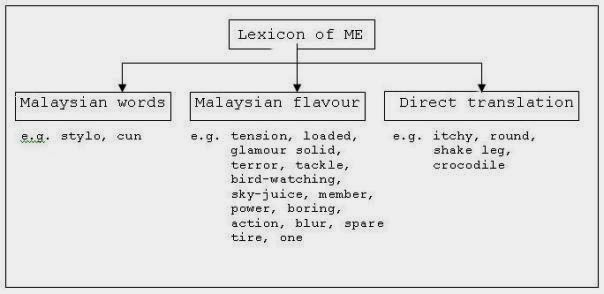 |
| Adapted from: Zaidan Ali Jassem, 1994 |
OBJECTIVE
The research aims to see whether the use of ME lexical items is understood and accepted at the international level by engaging in the IRC. Several ME lexical items are selected and used to find out whether the use of such words is understood and accepted.
RESEARCH DESIGN
In an effort to seek answers to the questions that have been raised by the researchers of this project, the researchers need to collect data. Only by collecting data, can the researchers be able to come to any sort of conclusion about the level of understanding and acceptability that non native speakers of Malaysian English might have towards the use of lexical items originating from Malaysian English in the IRC. Consequently, in an effort to collect the much needed data, the researchers of this project have decided to take to the field and experience for themselves the reactions that they would encounter if they were to use Malaysian English lexical items in the IRC.
THE INSTRUMENTS
In conducting this project, there are basically two types of instrumentation that are deemed necessary in order for the project to succeed. On one hand, a list of Malaysian English lexical items. This list serves the purpose of providing a pool of lexical items from which the researchers of this project will randomly use to gauge the attitude of non Malaysians towards their use. On the other hand, there is the need for a computer with Internet access. This computer will serve the purpose of providing the researchers with a way to get into the chat rooms where the Malaysian lexical items will be used.
THE SUBJECTS
The subjects in this research are simply non Malaysians who are speakers of the English language, regardless of the fact that the language might not be their first language. In the context of this research, there is also no need for the subjects to be of a specific gender or age. This is simply because of the fact that these two factors are of no importance. However, the subjects must be foreigners and not Malaysians because of the simple fact that Malaysians would be familiar with the lexical items that are to be used in this project. In addition, because of the fact that Malaysians would be familiar with the lexical items used, they would also in all likely show no reaction to the use of such lexical items.
THE PROJECT’S FINDINGS
Generally, it is believed that the use of the Malaysian English lexical items in the IRC is understood and accepted. The use of the Malaysian English lexical items is understood simply because most of the participants managed to respond accurately to what the researchers attempted to convey even though the researchers used Malaysian English. A lot of examples can be drawn out to justify the claim. For example:
1. B1: lines 27 – 28 (see Appendix ME)
In this example, it is clear that the respondents understood what the researchers meant by the use of ‘member’ and responded accurately to the question by stating that she had no Malaysian friends.
2. C1: lines 9 – 10
Here the researchers asked about the participant’s feeling over the loss of Holland in the world cup using the word ‘tension’. Amazingly, she understood what the researchers tried to ask and answered the question appropriately.
3. C1: lines 17 – 18
Although the researchers repeated the word ‘glamour’ twice, this did not resulted in the participant had no idea of what the researchers were trying to ask. Instead, she gave a very good response to the question by describing the items that she liked.
4. C1: lines 19 – 20
The researchers attempted to ensure that the response that was given by the participant in the previous example was not accidental. Therefore, once again they use doubled word ‘round’ to look into the response that would be given. Similar to the previous one, the respondent successfully answered the question posed.
5.C1: lines 24 – 25
In this instance, the researchers made use of the word ‘solid’ to test whether the participant could understand, then answering the speaker’s question. She responded well by claiming that she had that kind of body since she worked out everyday.
6. D1: lines 25 – 26
Similar to the first instance (B1), this participant managed to understand what the researchers meant by the word ‘member’. She frankly gave the answer ‘ no’ in answering the question.
7. D1: lines 32 – 33
In this example, it is clear that the participant understood the compliment ‘wowwww!!!! So power onelah’, that was given by the researcher when she responded to the response by trying to be humble ‘normal’.
On the other hand, there were several occurrences where the participants did not understand the use or meaning of the Malaysian English lexical items. This however did not impede the communication from continuing. For example, when they came across such expression, some of the participants actually took the initiative to ask for the meaning of such words. When they were given the explanation, they showed that they accepted the explanation given. There are a lot of examples that can be used to show this point, they are:
1. A1: lines 3- 6
In this example, this particular ‘chatter’ asked the researchers about the meaning of the phrase ‘shake leg’. As the researchers explained the meaning of the phrase, the participant later showed that she now understood what did the researchers mean by the use of the words when she responded ‘ahh.. I see’.
2. A1: lines 7- 12
In this instance, the researchers suggested a new meaning of the phrase ‘bird watching’ to the respondent when she failed to give the required answer. Realizing that the phrase now carried a new meaning, she tried to verify her assumption about the association of girls with birds at the speakers place. When she was asked later about any terms that were used to refer to boys, she claimed that there were no ‘special’ terms used to refer to boys. This shows that the participant accepted the use of phrase since she regarded the use of such phrase as ’special’.
3. B1: line 11- 18
Here, the participant faced a similar problem as the first respondent because she did not understand the use of the phrase ‘shake leg’. Therefore, she decided to ask for the meaning of the words. Making use of the meaning provided by the speakers, she then posed a question to the researchers on the same topic. She showed that she accepted the new meaning given by elaborating on her liking.
4. B1: lines 23-26
The use of “sky juice”, as predicted, caused the participant to fail in grasping the meaning. However, as the researchers explained the meaning of the word, the participant make an attempt to guess what did the researchers meant by the use of the words. She referred the words to ‘rain’. Then, she showed that she accepted the meaning of the words when she included the expression ‘…hahaha…’ which implied that she felt very easy with the explanation.
4. D1: lines 13- 16
Similar to the previous example, this particular participant also did not understand the meaning of the words ‘sky juice’. However, after being explained about the meaning of the words, she then indicated that she accepted the meaning. This is illustrated when she gave her personal views on ‘sky juice’ by stating that was ‘the best thirst quencher’.
6. D1: lines 4- 9
Here, the participant discovered that she did not understand the use of ‘so glamour one’. Later, she indicated that she accepted the use of the phrase when she asked for apology for not being able to understand the use of the words earlier.
7. D1: lines 67- 72
In this example, the participant asked the speakers about the use of ‘so action one’. She showed her acceptance on the use of the words when she borrowed the meaning of the words to deny the allegation made by the researchers about her.
Besides suggesting that they accepted the use of the Malaysian English lexical items, they also indicated that such a use did not deter them from having a casual type of conversation. For example, one of the participants has expressed her liking on the researchers. This could be due to the fact that, they use such a ‘unique’ expression to express their views. This is illustrated by the second respondent (B1) in line 50 who confessed
‘ I really like your company too
so I’m hoping to bump into you again’
This same participant was also found to be ‘generous’ because she offered her e-mail address to the speakers.(B1: lines 56& 60) when she realized that she could not continue to chat. This also indicates that she felt very easy and comfortable chatting with the researchers. In other words, she did not find it troubling for herself to understand and accept the use of the Malaysian English lexical items. In another case, the last participant (E1) indicated that she accepted the use of such lexical items by accepting the researchers’ invitation to play sports even though she was constrained by the physical location factor.
However, despite the numerous instances in which the participants of the research managed to understand and accept the use of Malaysian English lexical items in the IRC, there were exceptions. Basically, these exceptions can be divided into two categories. Firstly, there is the category in which the research participants could not understand the meaning of the Malaysian English lexical item used, and requested further clarification. Examples, of such instances are listed below:
1. A1: line 7 – 10
In this example, despite the fact that the ‘chatter’ actually accepted the use of such a lexical item, upon inquiry, the ‘chatter’ admitted to the researchers that she did not actually understand the meaning of the lexical item used. Thus, prompting the need for the researchers to have to explain to her the actual meaning of the lexical item.
2. B1: line 11 – 13
In this instance, the ‘chatter’ did not seem to mind the use of such lexical items. However, she revealed to the researchers her lack of understanding by nonchalantly asking why the researchers ‘shook their legs.’
3. B1: line 23 – 26
In this example, the ‘chatter’ is again confronted with the use of an unfamiliar lexical item. Here, she simply asks straight away what is the meaning of the lexical item. Once told of its meaning, the ‘chatter’ conveys her new found sense of understanding, and also presumably her sense of acceptance, in a very delighted tone.
4. D1: line 7 – 9
In this instance, the ‘chatter’ signals her lack of understanding by ending the question phrase with the use of multiple question marks. The researchers, obligingly provide her with the meaning of the lexical item. In a show of acceptance of the lexical items usage, the ‘chatter’ even goes to the extent of apologising to the researchers for her lack of understanding.
4. D1: line 14 – 16
As for this example, the ‘chatter’ opts for a different approach in signalling her lack of understanding. For she simply asks in a very direct manner, the meaning of the lexical item that she does not understand. Upon being provided with the lexical items meaning, the ‘chatter’ reveals her acceptance of the lexical items usage by using a compliment.
6. D1: line 36 – 37
With this example, the researchers not only have to accommodate the ‘chatters’ lack of understanding, but also for the very first time, the ‘chatters’ first hint of unacceptability for the use of such a lexical item. This ‘hint’ of unacceptability is assumed by the researchers to have manifested itself in the form of the capitalisation of all the letters in the phrase, “NO BORING BORING ONE.” This assumption is proven to correct a few lines later when the ‘chatter’ asked the researchers to just use plain English.
7. D1: line 45 – 46
Here, the ‘chatter’ not only reveals her lack of understanding, but also her displeasure of having to cope with the usage of such lexical items by using a multitude of question marks. Thus, it would only be logical to rationalise that the participant no longer finds the use of Malaysian English lexical items acceptable.
8. D1: lines 70, 83 and 88.
Again and again, the ‘chatter’ reveals her lack of understanding along with her dislike of the usage of such lexical items by using a multitude of question marks.
Secondly, there is also the category in which the research participants could not understand the meaning of the Malaysian English lexical items used, and simply avoided the matter of asking for further clarification by changing to new topic of conversation. Examples of such instances are listed below:
1. C1: lines 34 – 35
From this example, it is presumed that the ‘chatter’ tries to hide her lack of understanding by simply switching to a completely different topic. In the eyes of the researchers, this ploy of hers did not manage to achieve its objectives. However, because of the fact that the ‘chatter’ switches topics, the researchers are not able to determine whether or not she has accepted the use of the lexical item. This is simply because there is no response to analyse.
2. E1: lines 22 – 23
As for this particular example, the ‘chatter’ is again deemed to be trying to hide her lack of understanding by switching to a completely new topic. Once again, the researchers quickly catch on to this ploy of hers. As with the above example, the researchers are again unable to determine whether or not the ‘chatter’ finds the use of such lexical items acceptable simply because there is no response to analyse.
Besides that, There are also instances where the ideas or messages which the researcher tried to convey did not get across. Examples of such instances are listed below:
1. A1: lines 7 – 9
Here, we can see that the respondent took the meaning of “bird-watching” literally. The word was mentioned earlier, but she did not question it, assuming the meaning is watching birds, while the intended meaning was watching girls. However, when given a short explanation of the meaning of “bird watching” and asked of the names used in her place, she did not reacted negatively, and this signals acceptance.
2. C1: lines 30- 32
The subject understood the meaning of “tackle” as in the tackling skill in sports (for example, rugby or football). Perhaps, that is why she replied “depends where” which is unexpected and somehow funny.
3. D1: lines 48 – 52
From this example, we can see that the subject understood the word “crocodile” differently than the one intended by the researcher. She responded negatively (“Gross!!!”) to the word before the short explanation was given to her. Though she had accepted the meaning of the word after that, it is evident that the idea did not get across to her earlier.
4. D1: 57 – 60)
Here, again the idea did not get across. The subject hesitated to answer to the question “do you mind if I tackle you?”, and understood it differently than the one intended by the researcher. At this point, she started to be angry and seemed to be offended by the question. When asked to clarify her answer, she stated that she would mind and she is not “like that”. The researcher was actually trying to “make a pass at her” here, but in line 73, she stated that “what pass? I missed that”, showing very clearly that she did not understand the use of “tackle”.
Other than the exceptions mentioned above, there are also injection of makers to reflect paralinguistic makers, which of positive and negative nature. Paralinguistic makers of the positive nature can be seen in:
1. A1: lines 6 – 8
The chatter she responded “ah… I see”, which is signalling understanding to the explanation given by the researcher. This is clearly a positive response in the chat. However, in line 8, the subject indicated a negative attitude by inserting “@#$%” at the end of her question. Though the reason of her typing in the symbols is not clear, the symbols are usually used to show a response of a negative nature.
2. D1: line 5,
In this instance, the subject responded with a paralinguistic marker “Huh!!!!”, which has a negative connotation. It is evident here that the subject did not understand the phrase used and responded negatively to it. However, in the following lines, we can see that she accepted the word after given an explanation on it.
3. D1: line 39
From this line, the subject is displaying negative attitude when she inserted “@##$%**&^” after her question. Here, the symbols indicated that the subject was irritated and annoyed with the use of ME words, due to the fact that she could not understand most of them.
4. D1: line 49
The subject used “GROSS!!!!” in responding to the word “crocodile”, indicating irritation and disgust. It is clear here that she did not understand how the word is used and the connotation the word carries in Malaysia, and with her own understanding, was disgusted with the use of it. When researcher asked her if she knows the connotation of the word “crocodile” here, she promptly asked “WHAT?!!!!”, which evidently showing irritation and annoyance. However, after explaining what the word means, she responded well to the researcher’s chatting.
5. D1: line 58
When asked whether the researcher could “tackle” the chatter, she showed hesitation with “……..uh……yah” as she answered the question. Here, she was not sure of the meaning of the word “tackle” and thus, applied her own understanding to it. As expected, from the proceeding lines, it is evident that she misunderstood the word “tackle”.
6. D1: line 70
In this extraction, the subject asked for the meaning of “Action one” with several question marks. Starting from this point onwards, she asked for the meaning of ME lexical items with several question marks, such as in lines 83 and 88, as we can see “spare tire?????” and “blur?????”. We can say that the question marks are used to show irritation and annoyance because she could not understand the meaning of the words.
In short, we can say that the injections of paralinguistic markers which were used by the subjects reflected their attitudes, which could be of positive or negative nature.
SUMMARY OF FINDINGS
In general, we believe that the use of the Malaysian lexical items in the Internet Relay Chat as being understood and accepted. These two claims can be supported by a few number of instances during the course of interaction. First, we managed to engage in the IRC with a number of respondents who actually chatted with us. During the course, there were no instances of anybody who left in the middle of the interaction. In other words, these people continued to ‘chat’ with us for a certain period of time until we quitted or they said goodbye. Second, the use of the Malaysian English lexical items posed minimal difficulty to the respondents. This case is very unique as the words connote different meanings in Malaysian English compared to that of the Standard English. It is assumed that the use of the words was understood and accepted by at least, these groups of respondents who actually made use of the contexts to grasp the ideas conveyed by the researchers.
Among the Malaysian English lexical items that were used throughout the course of the interaction are those words that fall under the Malaysian Flavour words, Direct Translation words and words that are borrowed from the Malaysia context that have been accepted as the lexicon of Malaysian English.
The list of the words are listed below:
Category 1 (Malaysian Flavour)
| WORDS | PLACE OF OCCURRENCE |
| 1. Tension | C1 |
| 2. Loaded | C1 |
| 3. Glamour | C1 |
| 4. Solid | A1& E1 |
| 5. Terror | C1 |
| 6. Tackle | C1,D1&E1 |
| 7. Bird-watching | B1& C1 |
| 8. Sky juice | B1& D1 |
| 9. Member | B1& E1 |
| 10. Power | E1& D1 |
| 11. Boring | D1 |
| 12. Blur | D1 |
| 13. Spare tire | D1 |
| 14. Action | D1 |
Category 2 ( Direct Translation)
| WORDS | PLACE OF OCCURRENCE |
| 1. Itchy | C1& D1 |
| 2. Round | C1 |
| 3. Shake leg | B1& C1 |
| 4. Crocodile | D1 |
| 5. Spare tire | D1 |
Category 3 (Direct Translation)
| WORDS | PLACE OF OCCURRENCE |
| 1. Stylo | C1 |
| 2. One | E1 |
IMPLICATIONS OF FINDINGS IN THE ELT METHODOLOGY
Since the finding suggests that the use of Malaysian English in terms of its lexical items was understood and accepted in the IRC domain, the use of Malaysian English should not be limited. Instead, it should be encouraged because it gives students opportunity to express their views in a more expressive manner. Feeling that they are not imposed to follow any standard, they will be able to talk more confidently.
Furthermore, this will also gives them the opportunity to gradually pick up the language. The stress should be focused on the fluency and not the accuracy. They should be encouraged to talk even their utterances are peculiar. As long as they are understood, they should not be constrained. This will give learners the confidence that they need to speak in the second language. Gradually over the time, they will start to learn about the correct forms of the language and become better second language users. However, the use of Malaysian English should not be suppressed because it gives a sense of identity to its users.
CONCLUSION
The positive result that was acquired in the course of the interactions, implies that users of the IRC are generally tolerant to the use of English in the cyber domain. Because the context of the interaction opens to anybody regardless of their origins and language, many are aware that the users of the IRC may not necessarily be native speakers of English. Instead, they realize that a lot of the users could be the second, third or foreign language speakers. Hence, a lot of them chat with open mind thus, becoming less concerned about the accuracy of the utterances. They are more interested to focus on the content of the interactions as they are more important. The same treatment that is adopted in the ‘world’ should be extended to the ESL classroom because it has the resemblance with the typical daily conversation. In addition, it also suggests that accuracy is only perceived as a secondary factor in communicating effectively.
However depending on the individuals that we ‘chat’ with, some might come across chatters who will be very concerned over the accuracy of the language. The failure to follow the norms may result in situation where one could be given negative remarks, and others. These then may lead to failure of communication where one may encounter those who do not understand the use of those the words. The situation can be aggravated if those participants refuse to accept the use of the Malaysian English lexical items.
Reference
Crystal, D. 1991. A Dictionary of Linguistics and Phonetics. Cambridge : Blackwell Dr.
Zaidan Ali Jassem. 1994. Malaysian English: A Sociolinguistics and TESL/TEFL Perspective. Kuala Lumpur : Pustaka Antara.
Siti Lailatun Abdul Shookor. 1990. The effectiveness of the KBSM English syllabus in dealing with word-stress and intonation patterns. Academic exercise. UKM
Subscribe to:
Posts (Atom)