Introduction
According to Fromkin and Rodman (1993), knowing a language means
knowing what sounds are in that particular language and what sounds are
not. This subconscious knowledge of the language is revealed when a
speaker pronounces sounds from another language. For example, if a
person is a native-speaker of English, he may substitute English sounds
for sounds which are not familiar to him. This is also true in cases of
intonation patterns.
Stress
Before going into intonation, it would be useful to look at stress
first. Malay and English have different stress patterns. Thomson
(1996) pointed out that English is a stress-timed language. Stress is
important and has its own functions in the language. Native speakers of
English more often than not, rely on the stress patterns (and
intonation) to infer and identify meanings of words or utterances
because different stress could mean differently. The stress syllables
in an English sentence occur at regular intervals. They are usually
longer and louder than the unstressed, often with a higher pitch. The
unstressed syllables must be made to fit in-between the stressed
syllables and do not disturb or change the “beat” or “rhythm”. The
unstressed syllables are reduced and said quickly and quietly.
However, Malay, being a syllable-timed language, the stress falls in
the same place in the sentence each time, making it predictable. Juliah
(1993) stated that stress does exist in Malay, but it does not have any
particular significant function. The stressed syllables are generally
produced with equal length and loudness. According to Platt and Weber
(1980), in a syllable-timed rhythm, “all syllables, stressed or
unstressed, recur at equal interval of time, such as –’or —’ extending
up to —–’.”
Intonation
Hawkins (1984) believes that there are three basic properties in intonation. They are:
1. It is universal, which every language makes use of intonation,
and spoken language is not monotonous. For example, English makes use
of changes in tone as part of the sentence phrase, while the Chinese
uses it as lexical distinction,
2. Intonation has its own functions and purposes in spoken language, and not for “decorative purposes”,
3. Intonation is systematic because each speaker has to use the same pattern for the same purpose.
As we already know, intonation plays a lot of roles in an English
utterance. Many linguists have suggested several functions of
intonation. Roach (1991) stated that there are four functions of
intonation in English which are often proposed. They are:
1. It enables the speakers to express their emotions or attitudes,
and this function is called attitudinal function of intonation. For
example, a bored person would likely to use a level tone when answering a
question.
2. Intonation also helps to produce the prominent effect on syllables
that need to be perceived as stressed. This will mark out the word
as the most important in the utterance. For example (as given in
Roach), (a) is non- emphatic and (b) is emphatic:
(a) It was very BOring.
(b) It was VEry boring.
This intonation function is called the accentual function.
3. Intonation plays a role in grammar, which is called the
grammatical function of intonation. The listener is better able to
identify the grammar and syntactic structure of what is being said.
For instance, in differentiating whether an utterance is a question
or a statement.
4. Finally, intonation also has a discourse function. In a
conversation, for example, it helps the listener to recognise whether
the information is new or already given, and to give the appropriate
and expected response.
Roach (1991) added that though the functions of intonation is
identified and categorised, these functions can sometimes overlap. For
example, attitudinal function may overlap with the discourse function of
intonation.
Intonation in Malay
Stress does not play an important role in Malay. Ramish (1971) says
that (as cited in Suhaila, 1994) Malay words are not distinguished by
the contrast of stress. Malay speakers do not depend on stress to give
emphasis, but they change the word order to do it.
However, intonation does have its own part in Malay utterances. It
is used in spoken Malay mainly to express emotions and attitudes. The
patterns may differ from English intonation. Checketts (1993) stated
that Malay speakers who speak English have the tendency not to use the
rising tone, such in English, to signal lists or sequences of verbs. In
addition to that, a rising tone is always used at the end of a
statement or list.
In terms of attitudinal function of intonation, the stress could fall
almost anywhere in an utterance, depending on what is emphasised. A
rising, falling, falling-rising and rising-falling tones are used
somehow quite differently from English. As an example given by
Checketts (1993), in giving a list of items, Malay speakers of English
tend to use a falling tone with each item. Due to the differences,
English as second language learners, specifically Malay students whose
mother tongue is Malay, encounter difficulties in acquiring the correct
patterns of English intonation and stress patterns.
Intonation in English
Intonation has an equal importance with stress in English. As we
have seen before, intonation in English has several functions. In
addition to that, Roach (1991) stated several typical intonation
occurrences in English:
1. Falling tone is used to show finality and usually neutral.
2. Rising tone has many functions, for example, are in listing, yes/no questions, and incomplete statement.
3. Falling-rising tone is used mainly in limited agreement or having reservations, and excitement.
4. Rising-falling tone is used in expressing strong feeling of agreement/disagreement or in being sarcastic.
Though intonation in English is said to have several functions,
Carnie (1998) believes that intonation is actually a “realisation of
semantics, rather than syntax.” He added that this is due to the nature
of intonation itself, and the fact that people draw inferences from
what is said and how it is said.
Reference
Checketts, S. 1993. Thoughts on Pronunciation. New Straits Times, 27 October: 30
Roach, P. 1991. English Phonetics and Phonology : a practical course (2nd ed.). Cambridge : Cambridge University Press.
Suhaila Sulong. 1994. A study on the B.Ed. TESL students’ usage of word stress patterns in speech. Academic exercise. University Kebangsaan Malaysia.
Thomson, D. 1996. Second Language Acquisition. PPP-ITM : Mass Lecture.
Hawkins, P. 1984. Introducing Phonology. London : Hutchinson
Juliah Mohamad Beon.1993. Stress and meaning : Malay UKM students’ ability to apply English word stress. Academic exercise. University Kebangsaan Malaysia.
Fromkin and Rodman. 1993. An Introduction to Language. New York : Holt, Rinehart, and Winston
Carnie, A. 1998. Review : Watt : Phonology and Semiology of Intonation. http://emich.edu/~linguist/issues/9/9.847.html

Showing posts with label ESL. Show all posts
Showing posts with label ESL. Show all posts
Thursday, 28 January 2016

Tuesday, 29 December 2015
English in Malaysia: General overview
English as an international language
It is undeniable that English is the most
common and the most important language in the world. The speakers can be
found almost anywhere, whether native or non-native. The expansion and
acceptance of English is still growing. According to Zaharuddin (1993),
this widespread use of English is due to two successive periods where
two English speaking countries dominated the world with their wealth,
strength, economic power and advanced technology. During the period of
the 19th century, the English controlled the world trade. After that,
from the 20th century onwards, the United States of America takes over.
Malaysia learns English as a result of the British colonisation, similar
to other countries which have had the same experience, and takes the
language as the second language because of its importance in development
and modernisation.
Presently, Zaharuddin (1993) stated that
English is used by a number of countries totalling about 600 million
people. Half of the population is native speakers while the other half
is of the non-native speakers. Since English is still expanding, it is
estimated that the number of non-native speakers of English may exceed
the number of native speakers. Strevens (1980) stated that it would be
an area of interest, since “the larger the total number of users, the
larger the number of differentiated versions of the language which will
develop.”
The position of English language in Malaysia
Due to colonisation, English was introduced
to Malaysia, and has become the second language. Presently, it is an
international language and is used as the language in international
relations, and in exchanging knowledge and technology.
According to Platt (1982), English has had a
comparatively long history in Malaysia. It was only since a few decades
ago that it is taught to almost all school children. Historically, the
Malays were the main ethnic group until the 19th century. They lived
mainly along the coasts and rivers. Though there were a number Indian
and Chinese merchants who settled here during the 15th century, a great
number of them arrived after the establishment of British. Platt (1982)
says that English colonies grew rapidly. When Kuala Lumpur became the
capital of the federation, with the development of the British
administration, the importance and use of English increased. However,
then, Malay or pidginised Malay was used as a tool of communication
between the ethnic groups. A local “English-based pidgin” did not
develop, but the basic Pidgin English was used to communicate with the
Europeans here.
Since the independence in 1957, English has
had changes in its roles and functions. In government’s effort to unify
the multi-racial Malaysia and create a sense of identity, Bahasa Melayu
has been chosen to be the national language. Juliah (1993) stated that
being the national language, it is also the official language and the
medium of instruction. Therefore, every Malaysian citizen has to acquire
it. According to Asmah (1983), as an official language, Malay is used
orally or in written form in official and formal communications in
government administration. As a medium of instruction, Malay is the
medium used in schools and other educational institutions. Juliah (1993)
added that due to its significant status and role in communication and
language teaching, Malay has been made as a compulsory subject in all
schools and institutions run by the government. With this new
educational policy, Malay is gaining more and more prestige and
importance.
With the upgrading of Malay, English was
phased out from being the official and prestigious language. Its
position has been reduced to the second language, and its usage is very
limited. In the public sector, English is no longer important. In
academic field, English is learned mainly because it offers access to
higher academic pursuits and certain positions in employment. Although
English is a compulsory subject, students do not have to pass it in
public examinations. Juliah (1993) says that this has caused indifferent
attitude and lack of motivation towards studying the language. Besides
that, with Malay being the official language, there is a limited usage
of English outside the classrooms, and even outside the English periods.
These factors could be the reasons why the level of English proficiency
among Malaysian students has declined seriously since the independence.
English in the Malaysian Education system
Though Malay is chosen as the national and
official language, the government realises the importance of English as a
tool for international communication and development. Therefore,
English is taken as the second language in this country.
In the education system, English is made a
compulsory subject to all students. The education system has been
designed to produce students who are able to communicate effectively in
English. Asmah (1983) stated that in terms of speaking skills, the goal
of it is to teach students so that they can be understood not only by
other Malaysians, but also by other English speaking communities in the
world. This can be seen in the Upper Secondary School Curriculum
Specification (form four and five) where the aims are:
The English Language Programme for the upper
secondary school level aims at building and extending upon the
proficiency of the students from the lower secondary school level so as
to equip them with the skills and knowledge of English to communicate in
certain job situations; and also to provide points of take-off for
various post-secondary school needs.
References
Asmah Hj. Omar. 1982. Language and society in Malaysia. Kuala Lumpur : Dewan Bahasa dan Pustaka
Juliah Mohamad Beon.1993. Stress and meaning : Malay UKM students’ ability to apply English word stress. Academic exercise. University Kebangsaan Malaysia
Platt and Weber. 1980. English in Singapore and Malaysia: status, features, functions. Oxford : Oxford University Press
Strevens, P. 1980. Teaching English as an International Language. Oxford : Pergamon Press
Zaharuddin Yaacob. 1993. Intonation Patterns of Malaysian newscasters : a pilot study. Academic exercise. University Kebangsaan Malaysia.
Sunday, 16 November 2014
New approach to teaching English
This is quite old, but I still find it relevant and helpful.
By Mohd Fazli Ibrahim
08 January 2001
Teaching a second language to children at an early age ensures a greater chance of obtaining proficiency and a high level of comprehension, writes MOHD FAZLI IBRAHIM.
MEET Amanda, a six-year-old kindergarten pupil in Gombak. Like other children her age, she passes her time in playschool learning to listen, speak, read and write in good Bahasa Malaysia.
Meeting her for the first time, I was entertained by her rendition of nasyid tunes from Raihan and was invited to join her in a game of nenek-nenek si bongkok tiga. She also confided in me that her favourite cartoon is Sailor Moon, a Japanese series dubbed in Bahasa.
Despite her sounding and acting like a Malay child, however, Amanda has wavy blonde hair and her features are clearly Caucasian.
The truth is, Amanda was born in Albania, and Malay is her second language.
Her parents are undergraduates at the International Islamic University in Gombak. Like so many other children of different nationalities at the university's playschool, Amanda receives her instruction in Bahasa Malaysia. Enrolled at the age of four, she was able to acquire a firm grasp of the language from that time.
Amanda still speaks Albanian with her parents. She is living proof that early instruction in a second language is a more effective way of ensuring proficiency and a higher level of comprehension.
Teach them early and the results would come quickly. In no time, children exposed to a second language are able to understand and communicate effectively with each other, without abandoning the use of the home language.
The need to acquire a second language has become an issue of survival in today’s world. The debate raging about the effectiveness of English teaching in schools has caused parental worrying to reach an all-time high.
It seems our youngsters’ standard of English is below par, not enough to help them in a world where English is becoming the main language of technology, commerce, communication and education. It is time to consider new approaches to teach it effectively.
A recent report in the Chronicle of Higher Education, a tertiary education publication in the US, highlighted the growing importance of English as a second language in universities around the world.
Such is the demand for the language that many universities have found ways to circumvent policies that imposed the use of national languages in favour of lessons in English. Lessons taught in English have become the norm, not the exception, even in countries where the language was not the main communicative medium until recently.
Several factors have motivated the growing emergence of English as the language of education. The most obvious, perhaps, is the emergence of the US as the sole superpower after the Cold War.
Its triumph touched off the integration of smaller national economies into a single globalised economy. Of course, to do business in a global economy, you would need to speak the global language first, which means learning English.
English is also the language of information technology and the Internet.
The growing use of the Internet and the important part it plays in driving the new global economy has popularised English beyond the traditional areas of commerce and communication.
Being the language of chatrooms, e-mail and cool new sites, English is accepted as the universal medium of communication in cyberspace.
The third contributing factor is the vast amount of knowledge and literature written in English. A large amount of university textbooks are published in English, covering almost all the fields of the arts and sciences.
The strong foundation laid down for the use of English, especially in education, resulted in the growing number of institutions offering courses in English. In a way, courses taught are popular because students wish to improve their learning skills in a language that is set to grow in tandem with the world economy.
Universities and colleges are also benefiting financially from the move as they seek to attract foreign students. The introduction of courses in English increases the institutions’ marketability to international students, bringing in much-needed tuition money. This trend can even be seen in Kuala Lumpur, with the growing number of public and private institutions opening their doors to foreign students.
English is indispensable if we are to develop an information technology-based economy.
Many people I know feel that 12 years of English instruction imposed by the national curriculum have failed to bring any improvement in the language capabilities of the Malaysian student.
The students produced by this system not only lack the basics of conversational English, they have also shown deficiency in writing skills.
Of course, they still use English after their own fashion.
The Malaysianisation of English has done away with proper semantics of the original language, replacing it with a haphazard system only Malaysians can understand. Perhaps, it is this process of adapting the language to the local idiom that has led to its gradual decline.
Often, even English teachers are not immune to this process. Many have opted to instruct students in Malaysianised English rather than suffer being misunderstood.
No, I am not saying that we should go back to the Pukka accents of the English spoken by the orang putih-planter back in pre-independence days. Nor am I suggesting that we all become English literature professors, ever ready to impress the public with a quotation from Shakespeare.
What we need at this juncture is to find ways to bring English language skills up to the standards acceptable globally. Other alternatives to the present curriculum must be investigated to arrest the decline and improve the quality of the language used in educational institutions.
One thing is certain. Young minds are easily impressionable when it comes to language learning. Living examples such as Amanda strengthen my conviction that second language teaching should begin with the young.
An alternative that can be experimented with is the language immersion technique, where young students are placed under the charge of a bilingual teacher.
Initially, the students would communicate with the teachers in their mother tongue while the teacher replies in the second language. Gradually, these students would develop a firm grasp of the second language, enough to allow them to use it themselves.
While the lessons would continue in the new language for some time, the mother tongue would be reintroduced later, when the targeted proficiency level has been reached.
The system has met with reasonable success in Quebec, Canada in the 1960s. English-speaking parents, in order to help their children learn and understand French, the dominant language of the province, initiated the approach. The immersion method has allowed their children to acquire better proficiency in French compared to students taught through conventional methods.
Their mother tongue abilities also did not seem to suffer due to the experience, and in some cases may even seem to improve.
In conclusion, educational policy-makers in Malaysia should consider strongly any approach that could improve the teaching of English. Perhaps it is high time we adopted an approach that concentrates on quality in place of one that concentrates solely on the quantity of instruction.
Maybe our curriculum experts can learn a few things from Amanda.
------------------------------------
By Mohd Fazli Ibrahim
08 January 2001
Teaching a second language to children at an early age ensures a greater chance of obtaining proficiency and a high level of comprehension, writes MOHD FAZLI IBRAHIM.
MEET Amanda, a six-year-old kindergarten pupil in Gombak. Like other children her age, she passes her time in playschool learning to listen, speak, read and write in good Bahasa Malaysia.
Meeting her for the first time, I was entertained by her rendition of nasyid tunes from Raihan and was invited to join her in a game of nenek-nenek si bongkok tiga. She also confided in me that her favourite cartoon is Sailor Moon, a Japanese series dubbed in Bahasa.
Despite her sounding and acting like a Malay child, however, Amanda has wavy blonde hair and her features are clearly Caucasian.
The truth is, Amanda was born in Albania, and Malay is her second language.
Her parents are undergraduates at the International Islamic University in Gombak. Like so many other children of different nationalities at the university's playschool, Amanda receives her instruction in Bahasa Malaysia. Enrolled at the age of four, she was able to acquire a firm grasp of the language from that time.
Amanda still speaks Albanian with her parents. She is living proof that early instruction in a second language is a more effective way of ensuring proficiency and a higher level of comprehension.
Teach them early and the results would come quickly. In no time, children exposed to a second language are able to understand and communicate effectively with each other, without abandoning the use of the home language.
The need to acquire a second language has become an issue of survival in today’s world. The debate raging about the effectiveness of English teaching in schools has caused parental worrying to reach an all-time high.
It seems our youngsters’ standard of English is below par, not enough to help them in a world where English is becoming the main language of technology, commerce, communication and education. It is time to consider new approaches to teach it effectively.
A recent report in the Chronicle of Higher Education, a tertiary education publication in the US, highlighted the growing importance of English as a second language in universities around the world.
Such is the demand for the language that many universities have found ways to circumvent policies that imposed the use of national languages in favour of lessons in English. Lessons taught in English have become the norm, not the exception, even in countries where the language was not the main communicative medium until recently.
Several factors have motivated the growing emergence of English as the language of education. The most obvious, perhaps, is the emergence of the US as the sole superpower after the Cold War.
Its triumph touched off the integration of smaller national economies into a single globalised economy. Of course, to do business in a global economy, you would need to speak the global language first, which means learning English.
English is also the language of information technology and the Internet.
The growing use of the Internet and the important part it plays in driving the new global economy has popularised English beyond the traditional areas of commerce and communication.
Being the language of chatrooms, e-mail and cool new sites, English is accepted as the universal medium of communication in cyberspace.
The third contributing factor is the vast amount of knowledge and literature written in English. A large amount of university textbooks are published in English, covering almost all the fields of the arts and sciences.
The strong foundation laid down for the use of English, especially in education, resulted in the growing number of institutions offering courses in English. In a way, courses taught are popular because students wish to improve their learning skills in a language that is set to grow in tandem with the world economy.
Universities and colleges are also benefiting financially from the move as they seek to attract foreign students. The introduction of courses in English increases the institutions’ marketability to international students, bringing in much-needed tuition money. This trend can even be seen in Kuala Lumpur, with the growing number of public and private institutions opening their doors to foreign students.
English is indispensable if we are to develop an information technology-based economy.
Many people I know feel that 12 years of English instruction imposed by the national curriculum have failed to bring any improvement in the language capabilities of the Malaysian student.
The students produced by this system not only lack the basics of conversational English, they have also shown deficiency in writing skills.
Of course, they still use English after their own fashion.
The Malaysianisation of English has done away with proper semantics of the original language, replacing it with a haphazard system only Malaysians can understand. Perhaps, it is this process of adapting the language to the local idiom that has led to its gradual decline.
Often, even English teachers are not immune to this process. Many have opted to instruct students in Malaysianised English rather than suffer being misunderstood.
No, I am not saying that we should go back to the Pukka accents of the English spoken by the orang putih-planter back in pre-independence days. Nor am I suggesting that we all become English literature professors, ever ready to impress the public with a quotation from Shakespeare.
What we need at this juncture is to find ways to bring English language skills up to the standards acceptable globally. Other alternatives to the present curriculum must be investigated to arrest the decline and improve the quality of the language used in educational institutions.
One thing is certain. Young minds are easily impressionable when it comes to language learning. Living examples such as Amanda strengthen my conviction that second language teaching should begin with the young.
An alternative that can be experimented with is the language immersion technique, where young students are placed under the charge of a bilingual teacher.
Initially, the students would communicate with the teachers in their mother tongue while the teacher replies in the second language. Gradually, these students would develop a firm grasp of the second language, enough to allow them to use it themselves.
While the lessons would continue in the new language for some time, the mother tongue would be reintroduced later, when the targeted proficiency level has been reached.
The system has met with reasonable success in Quebec, Canada in the 1960s. English-speaking parents, in order to help their children learn and understand French, the dominant language of the province, initiated the approach. The immersion method has allowed their children to acquire better proficiency in French compared to students taught through conventional methods.
Their mother tongue abilities also did not seem to suffer due to the experience, and in some cases may even seem to improve.
In conclusion, educational policy-makers in Malaysia should consider strongly any approach that could improve the teaching of English. Perhaps it is high time we adopted an approach that concentrates on quality in place of one that concentrates solely on the quantity of instruction.
Maybe our curriculum experts can learn a few things from Amanda.
Tuesday, 12 November 2013
The use of Malaysian English lexical items in the IRC international
By : Mafuzah Aris, Syazril Izwann, Mohd Khairuddin Abdullah
INTRODUCTION
This research focuses on the lexical items of Malaysian corpus of English. According to Zaidan (1994), Malaysian English lexical items include Malaysian words (MW), Malaysian flavour (MF) words, and direct translation (DT) words. Malaysian words are words which are unique to Malaysians (dialect) and its use can only be found in Malaysia. Malaysian flavour words are words which are English words, but its use is localized. Other speakers of English would not use the words like they are used in Malaysia mainly because these words are very culturally biased. Direct translation words are the words which are translated from Malay, Indian or Chinese into English. The lexicon of ME is summarised in the table below:
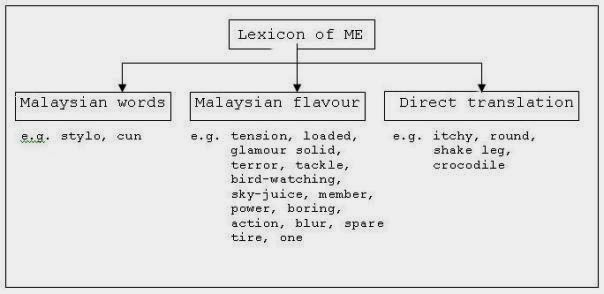 |
| Adapted from: Zaidan Ali Jassem, 1994 |
OBJECTIVE
The research aims to see whether the use of ME lexical items is understood and accepted at the international level by engaging in the IRC. Several ME lexical items are selected and used to find out whether the use of such words is understood and accepted.
RESEARCH DESIGN
In an effort to seek answers to the questions that have been raised by the researchers of this project, the researchers need to collect data. Only by collecting data, can the researchers be able to come to any sort of conclusion about the level of understanding and acceptability that non native speakers of Malaysian English might have towards the use of lexical items originating from Malaysian English in the IRC. Consequently, in an effort to collect the much needed data, the researchers of this project have decided to take to the field and experience for themselves the reactions that they would encounter if they were to use Malaysian English lexical items in the IRC.
THE INSTRUMENTS
In conducting this project, there are basically two types of instrumentation that are deemed necessary in order for the project to succeed. On one hand, a list of Malaysian English lexical items. This list serves the purpose of providing a pool of lexical items from which the researchers of this project will randomly use to gauge the attitude of non Malaysians towards their use. On the other hand, there is the need for a computer with Internet access. This computer will serve the purpose of providing the researchers with a way to get into the chat rooms where the Malaysian lexical items will be used.
THE SUBJECTS
The subjects in this research are simply non Malaysians who are speakers of the English language, regardless of the fact that the language might not be their first language. In the context of this research, there is also no need for the subjects to be of a specific gender or age. This is simply because of the fact that these two factors are of no importance. However, the subjects must be foreigners and not Malaysians because of the simple fact that Malaysians would be familiar with the lexical items that are to be used in this project. In addition, because of the fact that Malaysians would be familiar with the lexical items used, they would also in all likely show no reaction to the use of such lexical items.
THE PROJECT’S FINDINGS
Generally, it is believed that the use of the Malaysian English lexical items in the IRC is understood and accepted. The use of the Malaysian English lexical items is understood simply because most of the participants managed to respond accurately to what the researchers attempted to convey even though the researchers used Malaysian English. A lot of examples can be drawn out to justify the claim. For example:
1. B1: lines 27 – 28 (see Appendix ME)
In this example, it is clear that the respondents understood what the researchers meant by the use of ‘member’ and responded accurately to the question by stating that she had no Malaysian friends.
2. C1: lines 9 – 10
Here the researchers asked about the participant’s feeling over the loss of Holland in the world cup using the word ‘tension’. Amazingly, she understood what the researchers tried to ask and answered the question appropriately.
3. C1: lines 17 – 18
Although the researchers repeated the word ‘glamour’ twice, this did not resulted in the participant had no idea of what the researchers were trying to ask. Instead, she gave a very good response to the question by describing the items that she liked.
4. C1: lines 19 – 20
The researchers attempted to ensure that the response that was given by the participant in the previous example was not accidental. Therefore, once again they use doubled word ‘round’ to look into the response that would be given. Similar to the previous one, the respondent successfully answered the question posed.
5.C1: lines 24 – 25
In this instance, the researchers made use of the word ‘solid’ to test whether the participant could understand, then answering the speaker’s question. She responded well by claiming that she had that kind of body since she worked out everyday.
6. D1: lines 25 – 26
Similar to the first instance (B1), this participant managed to understand what the researchers meant by the word ‘member’. She frankly gave the answer ‘ no’ in answering the question.
7. D1: lines 32 – 33
In this example, it is clear that the participant understood the compliment ‘wowwww!!!! So power onelah’, that was given by the researcher when she responded to the response by trying to be humble ‘normal’.
On the other hand, there were several occurrences where the participants did not understand the use or meaning of the Malaysian English lexical items. This however did not impede the communication from continuing. For example, when they came across such expression, some of the participants actually took the initiative to ask for the meaning of such words. When they were given the explanation, they showed that they accepted the explanation given. There are a lot of examples that can be used to show this point, they are:
1. A1: lines 3- 6
In this example, this particular ‘chatter’ asked the researchers about the meaning of the phrase ‘shake leg’. As the researchers explained the meaning of the phrase, the participant later showed that she now understood what did the researchers mean by the use of the words when she responded ‘ahh.. I see’.
2. A1: lines 7- 12
In this instance, the researchers suggested a new meaning of the phrase ‘bird watching’ to the respondent when she failed to give the required answer. Realizing that the phrase now carried a new meaning, she tried to verify her assumption about the association of girls with birds at the speakers place. When she was asked later about any terms that were used to refer to boys, she claimed that there were no ‘special’ terms used to refer to boys. This shows that the participant accepted the use of phrase since she regarded the use of such phrase as ’special’.
3. B1: line 11- 18
Here, the participant faced a similar problem as the first respondent because she did not understand the use of the phrase ‘shake leg’. Therefore, she decided to ask for the meaning of the words. Making use of the meaning provided by the speakers, she then posed a question to the researchers on the same topic. She showed that she accepted the new meaning given by elaborating on her liking.
4. B1: lines 23-26
The use of “sky juice”, as predicted, caused the participant to fail in grasping the meaning. However, as the researchers explained the meaning of the word, the participant make an attempt to guess what did the researchers meant by the use of the words. She referred the words to ‘rain’. Then, she showed that she accepted the meaning of the words when she included the expression ‘…hahaha…’ which implied that she felt very easy with the explanation.
4. D1: lines 13- 16
Similar to the previous example, this particular participant also did not understand the meaning of the words ‘sky juice’. However, after being explained about the meaning of the words, she then indicated that she accepted the meaning. This is illustrated when she gave her personal views on ‘sky juice’ by stating that was ‘the best thirst quencher’.
6. D1: lines 4- 9
Here, the participant discovered that she did not understand the use of ‘so glamour one’. Later, she indicated that she accepted the use of the phrase when she asked for apology for not being able to understand the use of the words earlier.
7. D1: lines 67- 72
In this example, the participant asked the speakers about the use of ‘so action one’. She showed her acceptance on the use of the words when she borrowed the meaning of the words to deny the allegation made by the researchers about her.
Besides suggesting that they accepted the use of the Malaysian English lexical items, they also indicated that such a use did not deter them from having a casual type of conversation. For example, one of the participants has expressed her liking on the researchers. This could be due to the fact that, they use such a ‘unique’ expression to express their views. This is illustrated by the second respondent (B1) in line 50 who confessed
‘ I really like your company too
so I’m hoping to bump into you again’
This same participant was also found to be ‘generous’ because she offered her e-mail address to the speakers.(B1: lines 56& 60) when she realized that she could not continue to chat. This also indicates that she felt very easy and comfortable chatting with the researchers. In other words, she did not find it troubling for herself to understand and accept the use of the Malaysian English lexical items. In another case, the last participant (E1) indicated that she accepted the use of such lexical items by accepting the researchers’ invitation to play sports even though she was constrained by the physical location factor.
However, despite the numerous instances in which the participants of the research managed to understand and accept the use of Malaysian English lexical items in the IRC, there were exceptions. Basically, these exceptions can be divided into two categories. Firstly, there is the category in which the research participants could not understand the meaning of the Malaysian English lexical item used, and requested further clarification. Examples, of such instances are listed below:
1. A1: line 7 – 10
In this example, despite the fact that the ‘chatter’ actually accepted the use of such a lexical item, upon inquiry, the ‘chatter’ admitted to the researchers that she did not actually understand the meaning of the lexical item used. Thus, prompting the need for the researchers to have to explain to her the actual meaning of the lexical item.
2. B1: line 11 – 13
In this instance, the ‘chatter’ did not seem to mind the use of such lexical items. However, she revealed to the researchers her lack of understanding by nonchalantly asking why the researchers ‘shook their legs.’
3. B1: line 23 – 26
In this example, the ‘chatter’ is again confronted with the use of an unfamiliar lexical item. Here, she simply asks straight away what is the meaning of the lexical item. Once told of its meaning, the ‘chatter’ conveys her new found sense of understanding, and also presumably her sense of acceptance, in a very delighted tone.
4. D1: line 7 – 9
In this instance, the ‘chatter’ signals her lack of understanding by ending the question phrase with the use of multiple question marks. The researchers, obligingly provide her with the meaning of the lexical item. In a show of acceptance of the lexical items usage, the ‘chatter’ even goes to the extent of apologising to the researchers for her lack of understanding.
4. D1: line 14 – 16
As for this example, the ‘chatter’ opts for a different approach in signalling her lack of understanding. For she simply asks in a very direct manner, the meaning of the lexical item that she does not understand. Upon being provided with the lexical items meaning, the ‘chatter’ reveals her acceptance of the lexical items usage by using a compliment.
6. D1: line 36 – 37
With this example, the researchers not only have to accommodate the ‘chatters’ lack of understanding, but also for the very first time, the ‘chatters’ first hint of unacceptability for the use of such a lexical item. This ‘hint’ of unacceptability is assumed by the researchers to have manifested itself in the form of the capitalisation of all the letters in the phrase, “NO BORING BORING ONE.” This assumption is proven to correct a few lines later when the ‘chatter’ asked the researchers to just use plain English.
7. D1: line 45 – 46
Here, the ‘chatter’ not only reveals her lack of understanding, but also her displeasure of having to cope with the usage of such lexical items by using a multitude of question marks. Thus, it would only be logical to rationalise that the participant no longer finds the use of Malaysian English lexical items acceptable.
8. D1: lines 70, 83 and 88.
Again and again, the ‘chatter’ reveals her lack of understanding along with her dislike of the usage of such lexical items by using a multitude of question marks.
Secondly, there is also the category in which the research participants could not understand the meaning of the Malaysian English lexical items used, and simply avoided the matter of asking for further clarification by changing to new topic of conversation. Examples of such instances are listed below:
1. C1: lines 34 – 35
From this example, it is presumed that the ‘chatter’ tries to hide her lack of understanding by simply switching to a completely different topic. In the eyes of the researchers, this ploy of hers did not manage to achieve its objectives. However, because of the fact that the ‘chatter’ switches topics, the researchers are not able to determine whether or not she has accepted the use of the lexical item. This is simply because there is no response to analyse.
2. E1: lines 22 – 23
As for this particular example, the ‘chatter’ is again deemed to be trying to hide her lack of understanding by switching to a completely new topic. Once again, the researchers quickly catch on to this ploy of hers. As with the above example, the researchers are again unable to determine whether or not the ‘chatter’ finds the use of such lexical items acceptable simply because there is no response to analyse.
Besides that, There are also instances where the ideas or messages which the researcher tried to convey did not get across. Examples of such instances are listed below:
1. A1: lines 7 – 9
Here, we can see that the respondent took the meaning of “bird-watching” literally. The word was mentioned earlier, but she did not question it, assuming the meaning is watching birds, while the intended meaning was watching girls. However, when given a short explanation of the meaning of “bird watching” and asked of the names used in her place, she did not reacted negatively, and this signals acceptance.
2. C1: lines 30- 32
The subject understood the meaning of “tackle” as in the tackling skill in sports (for example, rugby or football). Perhaps, that is why she replied “depends where” which is unexpected and somehow funny.
3. D1: lines 48 – 52
From this example, we can see that the subject understood the word “crocodile” differently than the one intended by the researcher. She responded negatively (“Gross!!!”) to the word before the short explanation was given to her. Though she had accepted the meaning of the word after that, it is evident that the idea did not get across to her earlier.
4. D1: 57 – 60)
Here, again the idea did not get across. The subject hesitated to answer to the question “do you mind if I tackle you?”, and understood it differently than the one intended by the researcher. At this point, she started to be angry and seemed to be offended by the question. When asked to clarify her answer, she stated that she would mind and she is not “like that”. The researcher was actually trying to “make a pass at her” here, but in line 73, she stated that “what pass? I missed that”, showing very clearly that she did not understand the use of “tackle”.
Other than the exceptions mentioned above, there are also injection of makers to reflect paralinguistic makers, which of positive and negative nature. Paralinguistic makers of the positive nature can be seen in:
1. A1: lines 6 – 8
The chatter she responded “ah… I see”, which is signalling understanding to the explanation given by the researcher. This is clearly a positive response in the chat. However, in line 8, the subject indicated a negative attitude by inserting “@#$%” at the end of her question. Though the reason of her typing in the symbols is not clear, the symbols are usually used to show a response of a negative nature.
2. D1: line 5,
In this instance, the subject responded with a paralinguistic marker “Huh!!!!”, which has a negative connotation. It is evident here that the subject did not understand the phrase used and responded negatively to it. However, in the following lines, we can see that she accepted the word after given an explanation on it.
3. D1: line 39
From this line, the subject is displaying negative attitude when she inserted “@##$%**&^” after her question. Here, the symbols indicated that the subject was irritated and annoyed with the use of ME words, due to the fact that she could not understand most of them.
4. D1: line 49
The subject used “GROSS!!!!” in responding to the word “crocodile”, indicating irritation and disgust. It is clear here that she did not understand how the word is used and the connotation the word carries in Malaysia, and with her own understanding, was disgusted with the use of it. When researcher asked her if she knows the connotation of the word “crocodile” here, she promptly asked “WHAT?!!!!”, which evidently showing irritation and annoyance. However, after explaining what the word means, she responded well to the researcher’s chatting.
5. D1: line 58
When asked whether the researcher could “tackle” the chatter, she showed hesitation with “……..uh……yah” as she answered the question. Here, she was not sure of the meaning of the word “tackle” and thus, applied her own understanding to it. As expected, from the proceeding lines, it is evident that she misunderstood the word “tackle”.
6. D1: line 70
In this extraction, the subject asked for the meaning of “Action one” with several question marks. Starting from this point onwards, she asked for the meaning of ME lexical items with several question marks, such as in lines 83 and 88, as we can see “spare tire?????” and “blur?????”. We can say that the question marks are used to show irritation and annoyance because she could not understand the meaning of the words.
In short, we can say that the injections of paralinguistic markers which were used by the subjects reflected their attitudes, which could be of positive or negative nature.
SUMMARY OF FINDINGS
In general, we believe that the use of the Malaysian lexical items in the Internet Relay Chat as being understood and accepted. These two claims can be supported by a few number of instances during the course of interaction. First, we managed to engage in the IRC with a number of respondents who actually chatted with us. During the course, there were no instances of anybody who left in the middle of the interaction. In other words, these people continued to ‘chat’ with us for a certain period of time until we quitted or they said goodbye. Second, the use of the Malaysian English lexical items posed minimal difficulty to the respondents. This case is very unique as the words connote different meanings in Malaysian English compared to that of the Standard English. It is assumed that the use of the words was understood and accepted by at least, these groups of respondents who actually made use of the contexts to grasp the ideas conveyed by the researchers.
Among the Malaysian English lexical items that were used throughout the course of the interaction are those words that fall under the Malaysian Flavour words, Direct Translation words and words that are borrowed from the Malaysia context that have been accepted as the lexicon of Malaysian English.
The list of the words are listed below:
Category 1 (Malaysian Flavour)
| WORDS | PLACE OF OCCURRENCE |
| 1. Tension | C1 |
| 2. Loaded | C1 |
| 3. Glamour | C1 |
| 4. Solid | A1& E1 |
| 5. Terror | C1 |
| 6. Tackle | C1,D1&E1 |
| 7. Bird-watching | B1& C1 |
| 8. Sky juice | B1& D1 |
| 9. Member | B1& E1 |
| 10. Power | E1& D1 |
| 11. Boring | D1 |
| 12. Blur | D1 |
| 13. Spare tire | D1 |
| 14. Action | D1 |
Category 2 ( Direct Translation)
| WORDS | PLACE OF OCCURRENCE |
| 1. Itchy | C1& D1 |
| 2. Round | C1 |
| 3. Shake leg | B1& C1 |
| 4. Crocodile | D1 |
| 5. Spare tire | D1 |
Category 3 (Direct Translation)
| WORDS | PLACE OF OCCURRENCE |
| 1. Stylo | C1 |
| 2. One | E1 |
IMPLICATIONS OF FINDINGS IN THE ELT METHODOLOGY
Since the finding suggests that the use of Malaysian English in terms of its lexical items was understood and accepted in the IRC domain, the use of Malaysian English should not be limited. Instead, it should be encouraged because it gives students opportunity to express their views in a more expressive manner. Feeling that they are not imposed to follow any standard, they will be able to talk more confidently.
Furthermore, this will also gives them the opportunity to gradually pick up the language. The stress should be focused on the fluency and not the accuracy. They should be encouraged to talk even their utterances are peculiar. As long as they are understood, they should not be constrained. This will give learners the confidence that they need to speak in the second language. Gradually over the time, they will start to learn about the correct forms of the language and become better second language users. However, the use of Malaysian English should not be suppressed because it gives a sense of identity to its users.
CONCLUSION
The positive result that was acquired in the course of the interactions, implies that users of the IRC are generally tolerant to the use of English in the cyber domain. Because the context of the interaction opens to anybody regardless of their origins and language, many are aware that the users of the IRC may not necessarily be native speakers of English. Instead, they realize that a lot of the users could be the second, third or foreign language speakers. Hence, a lot of them chat with open mind thus, becoming less concerned about the accuracy of the utterances. They are more interested to focus on the content of the interactions as they are more important. The same treatment that is adopted in the ‘world’ should be extended to the ESL classroom because it has the resemblance with the typical daily conversation. In addition, it also suggests that accuracy is only perceived as a secondary factor in communicating effectively.
However depending on the individuals that we ‘chat’ with, some might come across chatters who will be very concerned over the accuracy of the language. The failure to follow the norms may result in situation where one could be given negative remarks, and others. These then may lead to failure of communication where one may encounter those who do not understand the use of those the words. The situation can be aggravated if those participants refuse to accept the use of the Malaysian English lexical items.
Reference
Crystal, D. 1991. A Dictionary of Linguistics and Phonetics. Cambridge : Blackwell Dr.
Zaidan Ali Jassem. 1994. Malaysian English: A Sociolinguistics and TESL/TEFL Perspective. Kuala Lumpur : Pustaka Antara.
Siti Lailatun Abdul Shookor. 1990. The effectiveness of the KBSM English syllabus in dealing with word-stress and intonation patterns. Academic exercise. UKM
Monday, 21 February 2011
Perbezaan di antara Adjektif dalam Bahasa Melayu dan Bahasa Inggeris, dan kesannya dalam proses pembelajaran Bahasa Inggeris Sebagai Bahasa Kedua (ESL)
Pengenalan
Perbezaan antara bahasa ibunda dan bahasa
kedua sedikit-sebanyak mempengaruhi kebolehan seseorang dalam penggunaan
bahasa keduanya. Menurut Contrastive Analysis Hypothesis (CAH),
ini berlaku kerana “gangguan” yang diterbitkan oleh bahasa ibunda
terhadap banyak aspek dalam sesuatu bahasa itu. Contohnya, dalam aspek
tatabahasa, sebutan (fonetik dan fonologi) dan semantik.
Bahasa Melayu dan Bahasa Inggeris adalah dua
bahasa utama di Malaysia. Kedua-dua bahasa ini mempunyai perbezaan
yang agak ketara, terutamanya dari aspek tatabahasa dan sebutan. Adalah
dijangka, pelajar yang mempunyai Bahasa Melayu sebagai bahasa ibunda
dan mempelajari Bahasa Inggeris sebagai bahasa kedua mempunyai masalah
dalam proses pembelajarannya, terutamanya dari aspek tatabahasa.
Adjektif adalah salah satu aspek tatabahasa
yang penting dalam sesuatu bahasa. Ianya digunakan untuk memberi sifat
atau menerangkan kata nama. Penggunaannya yang salah dan tidak
bersesuaian akan menyebabkan salah faham. Kertas ini akan cuba melihat secara umum
perbezaan Adjektif dari segi tatabahasa di antara Bahasa Melayu (BM)
dan Bahasa Inggeris (BI), dan kesannya dalam proses pembelajaran BI
sebagai bahasa kedua.
Perbezaan di antara Adjektif BM dan BI
Di antara perbezaan yang ketara di antara BM
dan BI adalah dari segi kedudukan adjektif dalam sesuatu ayat. Dalam
BM, kedudukan adjektif atau kata sifat yang menerangkan kata nama adalah
selepas kata nama tersebut. Sebagai contoh,
kereta lama orang muda
kain putih budak pandai
rumah besar
Dalam BI, kedudukan adjektifnya dalam ayat adalah sebelum kata nama. Contohnya,
old car clever boy
young man big house
white cloth
Selain daripada kedudukan Adjektif,
pengkelasan jenis-jenis Adjektifnya juga berbeza. Dalam BM, terdapat
sembilan jenis Adjektif iaitu,
- Sifat keadaan
- Sifat warna
- Sifat perasaan
- Sifat ukuran
- Sifat jarak
- Sifat waktu
- Sifat cara
- Sifat bentuk
- Sifat pancaindera
Walau bagaimanapun, hanya terdapat lima jenis Adjektif dalam BI iaitu,
- Descriptive
- Quality
- Posessive
- Interrogative
- Demonstrative
Selain daripada perbezaan-perbezaan itu, BM
dan BI juga berbeza dari segi perbandingan kata, iaitu comparatif dan
superlatif. Dalam BM, perbandingan sifat dinyatakan dengan
perkataan-perkataan atau kata penguat (markers) seperti,
Lebih…daripada (comparatif)
Kurang…daripada (comparatif)
Paling (superlatif)
Sekali (superlatif)
Ter- (superlatif)
Manakala dalam BI, perbandingan sifat dinyatakan dengan penggunaan imbuhan atau perubahan pada perkataan tersebut. Contohnya,
-er (comparatif)
more…than (comparatif)
the most (superlatif)
-est (superlatif)
perkataan yang berubah seperti good - better – best, bad - worse - worst.
Selain daripada itu, kedudukan adjektif di
dalam frasa juga berbeza. Dalam BM, jika terdapat dua adjektif, kata
hubung “dan” akan digunakan. Sebagai contoh,
Orang muda dan kuat
Rumah besar dan cantik
Jika terdapat lebih daripada dua adjektif,
koma akan digunakan di antara adjektif-adjektif itu dan kata hubung
“dan” digunakan sebelum adjektif yang terakhir. Contohnya,
Kereta besar, cantik dan menawan
Meja lama, hodoh dan terbiar
Dalam BI, jika terdapat hanya dua adjektif dalam sesuatu frasa, tiada kata hubung yang digunakan. Contohnya,
Poor old Tom
New long ruler
Jika terdapat lebih daripada dua adjektif, pada penggunaan biasa, peraturan yang sama digunakan. Contohnya,
New, expensive, French dictionary
Big, old, wooden table
Big, old, wooden table
Kesan perbezaan pengunaan Adjektif dalam BM dan BI
Di antara kesan dalam proses pembelajaran BI
sebagai bahasa kedua yang paling nyata ialah kekeliruan dalam
meletakkan adjektif sebelum sesuatu kata nama. Ini disebabkan kedudukan
adjektif dalam BM adalah selepas kata nama. Pelajar-pelajar yang
Bahasa Melayunya adalah bahasa ibunda lazimnya akan menghadapi
kekeliruan apabila mereka menterjemah secara langsung Adjektif + kata
nama. Contohnya,
“rumah besar” akan menjadi *house big
“orang muda” akan menjadi *man young
Ini adalah kesalahan-kesalahan yang biasa
didapati pada ayat-ayat BI yang dibuat oleh pelajar-pelajar yang bahasa
ibunda mereka adalah Bahasa Melayu. Walau bagaimanapun, latih-tubi dan
penggunakan BI secara kerap akan dapat menolong pelajar-pelajar ini
mengatasi masalah ini.
Selain daripada itu, pelajar-pelajar ini
juga akan menghadapi masalah dalam penggunaan perbandingan sifat
(comparatif dan superlatif). Ini kerana perbandingan sifat dalam
kedua-dua bahasa adalah berbeza (seperti yang kita lihat di atas).
Pelajar-pelajar biasanya akan keliru tentang penggunaan more atau most, –er atau –est dan
perubahan pada keseluruhan adjektif dalam BI kerana tiada undang-undang
sifat yang khusus mengenai penggunaan mereka. Sebaliknya dalam BM,
perbandingan sifat dilakukan dengan perkataan atau kata penguat (markers)
seperti “paling”, “ter”, “sekali”, “lebih…daripada”, dan
“kurang…daripada”. Kata-kata penguat ini boleh digunakan dengan semua
adjektif apabila perbandingan sifat dilakukan dalam BM. Kekeliruan
tentang penggunaan comparatif dan superlatif yang biasa adalah seperti,
badder / baddest (sepatutnya worse /worst)
more close (sepatutnya closer)
more longer (sepatutnya longer)
Lazimnya, pelajar-pelajar yang keliru dengan pengunaan perbandingan sifat dalam BI akan menggunakan penggunaan more atau most, –er atau –est dan perubahan pada keseluruhan adjektif dalam BI apabila mereka rasa sesuai atau yang mereka biasa lihat (hasty generalisation),
tanpa rujukan yang lebih terperinci. Walau bagaimanpun, pendedahan
pada perbandingan sifat dan penggunaan BI yang kerap akan dapat membantu
pelajar mengatasi masalah ini.
Penutup
Selain daripada kesan-kesan bahasa ibunda ke
atas bahasa kedua yang telah disebutkan di atas, banyak lagi
perbezaan-perbezaan dan masalah pengunaan yang lain yang tidak
dinyatakan. Sebagai contoh, kekeliruan di antara Adjektif dan Adveb
dalam BI, dan kekeliruan penggunaan kopula be dalam BI untuk
adjektif yang digunakan dalam predikat. Perbezaan-perbezaan ini tidak
dibincangkan di dalam kertas ini kerana ianyanya memerlukan kajian dan
laporan yang lebih panjang, mendalam dan terperinci.
Banyak penyelidikan yang telah dijalankan
mengenai pengaruh serta gangguan yang terbit dari bahasa ibunda ke atas
bahasa kedua. Tidak dinafikan bahawa pengaruh bahasa ibunda jelas
terdapat dalam bahasa kedua kita, dalam kes ini, BM terhadap BI. Sistem
tatabahasa, sebutan (fonetik dan fonologi) dan semantik BM, contohnya,
kadang-kadang nyata dalam BI kita.
Disebabkan oleh perbezaan ini jugalah, ramai
pelajar yang BMnya adalah bahasa ibunda menghadapi kekeliruan tentang
penggunaan undang-undang dan sistem tatabahasa BI. Pelajar-pelajar ini
biasanya akan melakukan terjemahan secara langsung dari BM ke BI,
ataupun mengaplikasikan sistem tatabahasa yang mereka biasa lihat (hasty generalisation).
Walau bagaimanapun, dengan pendedahan yang banyak dan kerap terhadap BI
akan dapat membantu pelajar-pelajar ini mengatasi kekeliruan dan
masalah yang dihadapi oleh mereka. Di sinilah guru memainkan peranan
yang penting dalam menolong and memimpin pelajar-pelajar ini supaya
mereka memahami dan sentiasa cuba memperbaiki diri BI mereka, seperti
menyalakan minat mereka terhadap bahasa kedua itu.
Rujukan
Abdullah Hassan. 1993. Tatabahasa pedagogi Bahasa Melayu. Kuala Lumpur: Utusan Publication and Distributors
Asmah Haji Omar dan Rama Subbiah. 1985. An introduction to Malay grammar. Kuala Lumpur: Dewan Bahasa dan Pustaka
Collins Cobuild. 1990. Collins Cobuild English grammar : helping learners with real English. London: William Collins Sons
Hawkins, J.M. 1997. Kamus Dwibahasa Oxford Fajar (edisi kedua). Shah Alam: Fajar Bakti.
Marlyna Maros. 1998. Practical contrastive and error analysis. Kursus TESL/UKM Tahun 3, UKM
Nandy, M. 1990. Simple English grammar and better writing (second ed.). Singapore: Composite Study Aid.
Othman Sulaiman. 1979. Bahasa Malaysia for everyone. Kuala Lumpur: Utusan Publication and Distributors
.
Tuesday, 21 December 2010
Written Corpus: Grammatical Item Analysis: NOT
The Corpus
The data for the written corpus was obtained from the internet. Five websites were viewed and retrieved, and all of them are related to hobbies. The websites are, Anuar’s Fishing Site: Fishes, Anuar’s Fishing Site: Articles (issues on fishing), New Gunung Online: Gear Page, Kuala Lumpur Mountainbike Hash: Trails in Peninsular Malaysia and Dan Loh’s Martial Arts Site: Background Page.
The pages from Anuar’s Fishing Site, which are Fishes and Articles (issues on fishing) were viewed and retrieved on 21st July 2004 from http://www.fortunecity.co.uk/ olympia/martial/70/ and http://www.fortunecity.co.uk/olympia/martial/70/article1.html respectively. Fishes deals with the types of fish which can be found and caught in Malaysia. It also explains the details of the fishes and how to fish them. Articles (issues on fishing) on the other hand, consists of two articles; Sportsfishing for Dummies talks about the types of fishing equipment, and Is fishing a game or just a hobby or just to cari makan?? talks about issues of game fishing. New Gunung Online: Gear Page was viewed and retrieved on 21st July 2001 from http://marina.fortunecity.com/harbourside/83/. It deals with the types of necessary equipment and gear suitable for jungle trekking in Malaysian climate and weather. Kuala Lumpur Mountainbike Hash: Trails in Peninsular Malaysia was viewed and retrieved on 22nd July 2004 from http://www.bikehash.freeservers.com. The web site offers details of the various mountbiking trails found in Peninsular Malaysia. Dan Loh’s Martial Arts Site: Background Page was viewed and retrieved on 25th July 2004 from http://members.tripod.com/%7EKerg/dan/index.html. The page tells the history and experience of a martial artist, and how he got to be who he is today.
Grammatical Item Analysis
For the grammatical item analysis, the negation aspect is selected for both spoken and written corpora, which is not. Not, according to Oxford Advanced Learner’s Dictionary (1989), basically has three meanings:
1. a. used with auxiliary verbs and modals to for the negative; often contracted to (n’t) in speech or informal writing,
b. used with non-finite verbs to give the negative,
2. a. used after believe, expect, hope, trust etc. instead of a clause beginning with that or containing a negative verb,
b. used to indicate the negative alternative after questions with are you, do you etc.,
3. a. used to reply in the negative part or all of a question, and
b. used to deny the significance of the following word or phrase.
Written Corpus
In the written corpus, NOT occurs 53 times and the contracted form N’T occurs 21 times. It is expected that NOT to have a high frequency in the corpus, it being written texts. Similar to what we see in spoken corpus, NOT collocates mainly with modals, be-copula and auxiliary verbs do in the corpus (35 occurrences).
1. Preceded by modals
2. Preceded by be-copula
3. Preceded by auxiliary verbs do
As spoken corpus, sometimes NOT in the study is also found to be followed adjectives, nouns or noun phrase, usually as compliments to the be-copula. For instance:
1. Followed by Adjectives
2. Followed by Nouns or Noun Phrase
Besides that, NOT is also followed by verbs in base form when used with a modal or auxiliary verb do. We can see instances of this in:
However, different from the spoken corpus, in the written corpus, NOT is also used to deny the importance of the following word or phrase, or to form the negative quite significantly. We can see this in:
We can see from the analysis that NOT when used with modals, be-copula or be-verb, or other auxiliary verbs, are not contracted. Perhaps, because the corpus is in written mode, the authors tend to utilize formal mode of using NOT. It is also possible that, as in spoken corpus, NOT is used its non-contracted form to stress the negative form of the statement.
The contracted form of NOT, N’T, occurs 21 times in the written corpus, and is found to occur with only auxiliary verb do: 13 times with do, four times with did and four times with does. As the spoken corpus findings, the study also found that, because N’T is used with auxiliary verb do, it is followed by base form of verb. For example:
A similar patter can be observed in both spoken and written corpora. It is interesting to find that NOT is only contracted with auxiliary verbs do, does and did. Perhaps the speakers are more comfortable to contract NOT with the most common form of contraction in Malaysian English. Although we also see that NOT being used in non-contracted form with auxiliary verbs do, does and did, we do not see contracted form N’T being used with modals, be-copula or be-verb, or other auxiliary verbs.
Conclusion
In the grammatical item analysis, negation NOT and the contracted form N’Tis selected for analysis. The most interesting finding in this section is that NOTcollocates with only grammar function words, such as modals, be-copula orbe-verb, or other auxiliary verbs, but not with any specific content word. This could suggest that the topic of discussion in written corpus is varied and of different genres. Therefore, patterns of collocation of content words are inadequate to be analysed.
.
The data for the written corpus was obtained from the internet. Five websites were viewed and retrieved, and all of them are related to hobbies. The websites are, Anuar’s Fishing Site: Fishes, Anuar’s Fishing Site: Articles (issues on fishing), New Gunung Online: Gear Page, Kuala Lumpur Mountainbike Hash: Trails in Peninsular Malaysia and Dan Loh’s Martial Arts Site: Background Page.
The pages from Anuar’s Fishing Site, which are Fishes and Articles (issues on fishing) were viewed and retrieved on 21st July 2004 from http://www.fortunecity.co.uk/ olympia/martial/70/ and http://www.fortunecity.co.uk/olympia/martial/70/article1.html respectively. Fishes deals with the types of fish which can be found and caught in Malaysia. It also explains the details of the fishes and how to fish them. Articles (issues on fishing) on the other hand, consists of two articles; Sportsfishing for Dummies talks about the types of fishing equipment, and Is fishing a game or just a hobby or just to cari makan?? talks about issues of game fishing. New Gunung Online: Gear Page was viewed and retrieved on 21st July 2001 from http://marina.fortunecity.com/harbourside/83/. It deals with the types of necessary equipment and gear suitable for jungle trekking in Malaysian climate and weather. Kuala Lumpur Mountainbike Hash: Trails in Peninsular Malaysia was viewed and retrieved on 22nd July 2004 from http://www.bikehash.freeservers.com. The web site offers details of the various mountbiking trails found in Peninsular Malaysia. Dan Loh’s Martial Arts Site: Background Page was viewed and retrieved on 25th July 2004 from http://members.tripod.com/%7EKerg/dan/index.html. The page tells the history and experience of a martial artist, and how he got to be who he is today.
Grammatical Item Analysis
For the grammatical item analysis, the negation aspect is selected for both spoken and written corpora, which is not. Not, according to Oxford Advanced Learner’s Dictionary (1989), basically has three meanings:
1. a. used with auxiliary verbs and modals to for the negative; often contracted to (n’t) in speech or informal writing,
b. used with non-finite verbs to give the negative,
2. a. used after believe, expect, hope, trust etc. instead of a clause beginning with that or containing a negative verb,
b. used to indicate the negative alternative after questions with are you, do you etc.,
3. a. used to reply in the negative part or all of a question, and
b. used to deny the significance of the following word or phrase.
Written Corpus
In the written corpus, NOT occurs 53 times and the contracted form N’T occurs 21 times. It is expected that NOT to have a high frequency in the corpus, it being written texts. Similar to what we see in spoken corpus, NOT collocates mainly with modals, be-copula and auxiliary verbs do in the corpus (35 occurrences).
1. Preceded by modals
| 3 | Betis in Kelantan. As such, the track may | not | remain unsealed for much longer. Start |
| 12 | Liquid from inside the garment will | not | evaporate out as usual, because the humidity |
| 15 | I was greatly frustrated that I could | not | control the fight and I truely understood |
| 17 | drag is set too high, the free spool may | not | function properly on these reels |
2. Preceded by be-copula
| 4 | try to be smart! These lines are | not | only extremely thin but also very strong, |
| 5 | the body temperature well, but its | not | a good choice when its hot. |
| 6 | climbing. Therefore climbing gears are | not | necessary in order to reach the summit |
| 10 | a man brings his fist to your face is | not | the same moment the blow lands, |
| 13 | Tilapia is not a good fighter thus it is | not | considered as a game fish. Besides |
| 14 | ground. Goretex lining on boots is | not | recommended. This lining will cause |
| 18 | reason, GAME. Again, if you think it is | not | a game, you are wrong. Calculate |
| 21 | clothings is not recommended and is | not | suitable in Malaysian equatorial rainforest |
| 27 | is one more important thing. Tilapia is | not | not a good fighter thus it is not considered |
| 31 | photograph Goretex clothings is | not | recommended and is not suitable |
| 32 | that deduces one’s self defence ability is | not | determined by age, sex, and size ; How |
| 35 | You might say that the Toman is | not | good eating, has a flat taste and |
| 36 | bites and scratches. For people who are | not | familiar with moving through thick |
| 37 | causing it to smell bad. Most rucksack are | not | made of waterproof material. Waterproof |
| 42 | coastal waters to the open ocean, but is | not | found along the Pacific coast of North |
| 43 | bushings within the reel housing. This was | not | designed for nothing, the exclusive features |
| 45 | and caught. Then the whole thing is | not | a game fishing. Real freshwater game |
| 48 | is dead upon retrieval. This is definitely | not | a game or sport. But if you used a |
| 49 | (over what was simple enough, but its | not | important in this story … just so that |
| 53 | be a dirt track on your right. The turning is | not | obvious, it’s been a long time since I’ve |
3. Preceded by auxiliary verbs do
| 2 | voice, but also the authorities too do | not | really care We lack game fishermen. The |
| 9 | means exhaustive; for example, it does | not | include Sungai Long. If you have information |
| 22 | 10-20 lb.test). It’s important that you do | not | stray too far from the recommended specs |
| 23 | lever drag reel, it’s important that you do | not | stray too far beyond the recommended |
| 25 | with this big mama. After all, its does | not | only come with quality, but its also come |
| 28 | mountaineering activity in Malaysia does | not | involves climbing. Therefore climbing |
| 34 | maps available for sale to the public do | not | yet cover the whole of peninsular Malaysia |
| 38 | his case, sparring with an opponent did | not | mean physical contact. He felt that |
| 39 | remarked that the point system does | not | represent one’s ability in controlling street |
| 41 | a house and a fork on the trail that I did | not | see, and on another occasion, an exhausted |
As spoken corpus, sometimes NOT in the study is also found to be followed adjectives, nouns or noun phrase, usually as compliments to the be-copula. For instance:
1. Followed by Adjectives
| 4 | try to be smart! These lines are | not | only extremely thin but also very strong, |
| 6 | climbing. Therefore climbing gears are | not | necessary in order to reach the summit |
| 13 | Tilapia is not a good fighter thus it is | not | considered as a game fish. Besides |
| 14 | ground. Goretex lining on boots is | not | recommended. This lining will cause |
| 21 | clothings is not recommended and is | not | suitable in Malaysian equatorial rainforest |
| 31 | photograph Goretex clothings is | not | recommended and is not suitable |
| 32 | that deduces one’s self defence ability is | not | determined by age, sex, and size ; How |
| 35 | You might say that the Toman is | not | good eating, has a flat taste and |
| 36 | bites and scratches. For people who are | not | familiar with moving through thick |
| 49 | (over what was simple enough, but its | not | important in this story … just so that |
| 53 | be a dirt track on your right. The turning is | not | obvious, it’s been a long time since I’ve |
2. Followed by Nouns or Noun Phrase
| 5 | the body temperature well, but its | not | a good choice when its hot. |
| 10 | moment a man brings his fist to your face is | not | the same moment the blow lands, |
| 18 | reason, GAME. Again, if you think it is | not | a game, you are wrong. Calculate |
| 27 | there is one more important thing. Tilapia is | not | a good fighter thus it is not considered |
| 45 | and caught. Then the whole thing is | not | a game fishing. Real freshwater game |
| 48 | is dead upon retrieval. This is definitely | not | a game or sport. But if you used a |
Besides that, NOT is also followed by verbs in base form when used with a modal or auxiliary verb do. We can see instances of this in:
| 3 | Betis in Kelantan. As such, the track may | not | remain unsealed for much longer. Start |
| 12 | Liquid from inside the garment will | not | evaporate out as usual, because the humidity |
| 15 | I was greatly frustrated that I could | not | control the fight and I truely understood |
| 17 | drag is set too high, the free spool may | not | function properly on these reels |
| 2 | voice, but also the authorities too do | not | really care We lack game fishermen. The |
| 9 | means exhaustive; for example, it does | not | include Sungai Long. If you have information |
| 22 | 10-20 lb.test). It’s important that you do | not | stray too far from the recommended specs |
| 23 | lever drag reel, it’s important that you do | not | stray too far beyond the recommended |
| 34 | maps available for sale to the public do | not | yet cover the whole of peninsular Malaysia |
| 38 | his case, sparring with an opponent did | not | mean physical contact. He felt that |
| 39 | remarked that the point system does | not | represent one’s ability in controlling street |
| 41 | a house and a fork on the trail that I did | not | see, and on another occasion, an exhausted |
However, different from the spoken corpus, in the written corpus, NOT is also used to deny the importance of the following word or phrase, or to form the negative quite significantly. We can see this in:
| 1 | (sheet 76) is indispensible. Even so, | not | all the trails are marked on the map |
| 8 | driftnets, especially in the Pacific but | not | here in Malaysia, but use of these |
| 7 | ample shade and ensure a pleasant, even if | not | hardcore, ride. The main trail is |
| 11 | for commercially for its fine flesh but | not | here in Malaysia, which is often sold smoke. |
| 19 | All in the name, of? Certainly | not | self-defence. Indeed everyone knows |
| 24 | a joker tried to make money out of this ( | not | the same ones who fought with me, weird huh?) |
| 26 | all the trails are marked on the map, and | not | all the marked trails still exist. |
| 30 | - Very cheap – Light - | Not | dangerous – Suitable for group |
| 33 | these plants, gloves is essential, but | not | always. Hat / Cap: photograph |
| 40 | if you prefer the more adventurous way by | not | hiring a guide, a map and compass |
| 44 | and make them pay for their crime | not | by fines or jail sentences but make them |
| 47 | trekker in Malaysia, they prefer | not | to bring tent. A flysheet (large plastic sheet) |
| 51 | - Strong wind may blow away lights - | Not | adjustable – Very cheap – Light |
| 52 | while sparring with a partner. I controlled | not | using the hook even though he only |
We can see from the analysis that NOT when used with modals, be-copula or be-verb, or other auxiliary verbs, are not contracted. Perhaps, because the corpus is in written mode, the authors tend to utilize formal mode of using NOT. It is also possible that, as in spoken corpus, NOT is used its non-contracted form to stress the negative form of the statement.
The contracted form of NOT, N’T, occurs 21 times in the written corpus, and is found to occur with only auxiliary verb do: 13 times with do, four times with did and four times with does. As the spoken corpus findings, the study also found that, because N’T is used with auxiliary verb do, it is followed by base form of verb. For example:
| 1 | My advice, if you become snagged, | don’t | pull with the rod. Rather, point the rod |
| 2 | regardless of size, age and sex. The bigger | don’t | always win. In sports karate a |
| 3 | the new braided, super thin diameter lines. | Don’t | try to be smart! These lines are not |
| 4 | individual to choose which one is better. | Don’t | leave the empty cartridge in the jungle. |
| 5 | of trails. However, be careful that you | don’t | get lost if you are unfamiliar with the |
| 6 | on to determine if a martial art is good, I | don’t | want to learn something and train so |
| 7 | backpacking trip. Sleeping Mat | Don’t | leave without them. This gear is |
| 8 | surprisingly technical singletrack trails. I | don’t | know the name of this park, and the directions |
| 9 | over the surface. The flesh is delicious, i | don’t | think so, and is often sold under its Hawaiian |
| 10 | Polo club, and through some pig farms. I | don’t | remember much else of the trail, except |
| 11 | obstacles to overcome. Better still, you | don’t | know if you will ever get a bite |
| 12 | them, you have to back off and untangle. | Don’t | try to tear through the vine, or it will |
| 13 | reel and 7. Ugly Stick Tiger. Hey why | don’t | I tell you a little bit about my |
| 14 | to be so hard (quite unbreakable) but I | didn’t | really feel pain. I convinced myself that |
| 15 | The native people ( orang asli ) | didn’t | wear much except for ornaments. |
| 16 | too! Why??” At that time I thought I | didn’t | train hard enough so I went back to |
| 17 | photograph The third guy I countered | didn’t | turn out properly, I started panicking |
| 18 | the fist. Dan speaks from experience. He | doesn’t | claim to know everything, he insists |
| 19 | department (being fodder for mosquitoes | doesn’t | count), the RRI area has sufficient |
| 20 | in Malaysia, especially the orang asli , | doesn’t | even have any navigation tools (map |
| 21 | kickboxing. I’m learning something that | doesn’t | depend on age for the ability to protect |
A similar patter can be observed in both spoken and written corpora. It is interesting to find that NOT is only contracted with auxiliary verbs do, does and did. Perhaps the speakers are more comfortable to contract NOT with the most common form of contraction in Malaysian English. Although we also see that NOT being used in non-contracted form with auxiliary verbs do, does and did, we do not see contracted form N’T being used with modals, be-copula or be-verb, or other auxiliary verbs.
Conclusion
In the grammatical item analysis, negation NOT and the contracted form N’Tis selected for analysis. The most interesting finding in this section is that NOTcollocates with only grammar function words, such as modals, be-copula orbe-verb, or other auxiliary verbs, but not with any specific content word. This could suggest that the topic of discussion in written corpus is varied and of different genres. Therefore, patterns of collocation of content words are inadequate to be analysed.
.
Subscribe to:
Posts (Atom)